David Shrigley — The World (2020): A Deadpan Map of Absurdity and Existential Wit

March 23, 2026
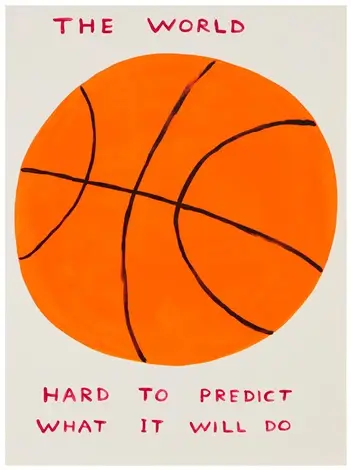
Few contemporary artists have managed to distill the anxieties, contradictions, and quiet hilarities of modern existence as incisively as David Shrigley. Emerging from the lineage of British conceptual humor and anti-art traditions, Shrigley’s work occupies a peculiar space—somewhere between cartoon, philosophy, and social critique. His 2020 piece The World encapsulates this practice with deceptive simplicity: a rudimentary rendering that belies a deeper meditation on how we understand, misinterpret, and emotionally navigate the global condition.
At first glance, The World appears almost trivial—childlike lines, sparse composition, and text that reads like a throwaway observation. But this immediacy is precisely where Shrigley’s genius resides. The work is not a map in the geographic sense, but rather a psychological and cultural diagram. It is less about continents and more about consciousness.
view
Shrigley’s signature aesthetic—intentionally crude, often monochromatic, and visually unrefined—has long functioned as a critical tool. In The World, this language is sharpened to its essence. The drawing resists technical virtuosity, favoring instead a raw immediacy that recalls children’s sketches or marginal doodles. This is not accidental. By stripping away artistic polish, Shrigley eliminates the barrier between artwork and viewer.
The line becomes a democratic device. Anyone could draw this—or so it seems. Yet within that apparent accessibility lies a carefully calibrated tension. The simplicity invites engagement, while the content destabilizes comfort.
This approach aligns Shrigley loosely with traditions established by artists like Jean-Michel Basquiat and Raymond Pettibon, though his tone is markedly more deadpan. Where Basquiat is explosive and Pettibon often literary, Shrigley is dry, almost indifferent. His humor is not loud; it is quietly corrosive.
stir
In The World, text is not supplementary—it is structural. Shrigley’s use of language transforms the drawing into a hybrid object: part image, part statement, part philosophical riddle. The words do not explain the image; they complicate it.
Shrigley’s handwriting—awkward, uneven, unmistakably human—becomes a visual element in its own right. It resists the authority of typography, rejecting the polished neutrality of printed text. Instead, it insists on subjectivity. The viewer is confronted not with a universal truth, but with a perspective—one that may be flawed, ironic, or deliberately misleading.
This interplay between text and image situates Shrigley within a conceptual lineage that includes Lawrence Weiner and Jenny Holzer. Yet unlike these artists, whose works often carry a declarative or political tone, Shrigley’s statements are ambiguous. They hover between sincerity and parody.
idea
2020 was marked by global upheaval—the COVID-19 pandemic, political polarization, environmental crises, and a pervasive sense of uncertainty. The idea of “the world” during this period was not stable; it was fragmented, contested, and emotionally charged.
Shrigley’s work does not explicitly reference these events, yet it resonates with their atmosphere. The simplicity of the drawing contrasts sharply with the complexity of the moment. This contrast generates a kind of cognitive dissonance. How can something so vast and chaotic be reduced to such a minimal representation?
The answer, perhaps, is that it cannot. And that is precisely the point.
The World becomes a commentary on our attempts to comprehend the incomprehensible. It reflects the human tendency to simplify, categorize, and impose order—even when reality resists such efforts.
flow
Humor has always been central to Shrigley’s practice, but it is a particular kind of humor—one that borders on the existential. In The World, the joke, if there is one, is subtle. It does not provoke laughter so much as a wry recognition.
This aligns Shrigley with a philosophical tradition that includes thinkers like Albert Camus, whose concept of the absurd describes the tension between human desire for meaning and the universe’s indifference. Shrigley’s work embodies this tension visually.
The humor in The World is not escapist; it is confrontational. It forces the viewer to acknowledge the gap between representation and reality, between what we think we know and what we actually understand.
scale
One of the most striking aspects of The World is its treatment of scale. The global is rendered intimate, almost trivial. Vastness is compressed into a small, manageable image. This flattening reflects a broader cultural phenomenon—the way digital media and information systems have reshaped our perception of space and significance.
In the age of smartphones and social feeds, the world is constantly mediated, condensed, and reframed. Complex geopolitical events appear alongside memes and personal updates, all occupying the same visual and cognitive space. Shrigley’s work captures this flattening with uncanny precision.
The drawing becomes a metaphor for the contemporary condition: everything is visible, yet nothing is fully graspable.
definition
Unlike traditional representations of the world—maps, globes, atlases—Shrigley’s The World rejects monumentality. It does not aspire to accuracy or grandeur. Instead, it embraces smallness, imperfection, and subjectivity.
This anti-monumental approach is significant. It challenges the authority traditionally associated with representations of the world. Maps, after all, are instruments of power. They define boundaries, assert control, and shape perception.
Shrigley’s drawing undermines this authority. It refuses to present a definitive version of the world. Instead, it offers a provisional, unstable image—one that invites interpretation rather than imposing it.
craft
Though often encountered as prints or reproductions, Shrigley’s works retain a strong sense of material presence. The uneven lines, the texture of the drawing, the idiosyncrasies of the handwriting—all contribute to a feeling of immediacy.
In The World, this materiality is crucial. It anchors the work in the physical act of drawing, reminding the viewer that this “world” is not an objective reality, but a constructed image.
At the same time, the work’s simplicity makes it highly reproducible. It can be printed, shared, and circulated with ease. This duality—between uniqueness and reproducibility—mirrors the tension at the heart of contemporary art.
recept
Shrigley’s work has long enjoyed a broad audience, extending beyond traditional art-world boundaries. His drawings appear on everything from gallery walls to merchandise, blurring the line between high art and popular culture.
The World fits seamlessly into this trajectory. Its accessibility makes it immediately engaging, while its conceptual depth ensures lasting resonance. It is a work that can be appreciated on multiple levels—visual, intellectual, emotional.
Critically, Shrigley’s ability to operate across these levels has solidified his position as one of the most distinctive voices in contemporary art. His work does not demand specialized knowledge; it invites curiosity.
role
Perhaps the most important aspect of The World is the role it assigns to the viewer. The drawing is not complete in itself; it requires interpretation. The meaning is not fixed; it emerges through engagement.
This participatory dimension is central to Shrigley’s practice. By offering an image that is deliberately ambiguous, he creates space for reflection. The viewer is not a passive observer, but an active participant.
What does “the world” look like to you? How do you map your own experiences, anxieties, and understandings onto this minimal image?
These questions linger long after the initial encounter.
sum
In The World (2020), David Shrigley achieves something remarkable: he transforms a simple drawing into a complex meditation on perception, meaning, and the human condition. The work is modest in scale, yet expansive in implication.
It reminds us that the world is not a fixed entity, but a construct—shaped by language, perception, and context. It challenges us to question our assumptions, to embrace uncertainty, and perhaps, to find humor in the absurdity of it all.