Review: Alex Ovechkin Hits 1,000 Goals, Joining Wayne Gretzky in NHL History

March 23, 2026
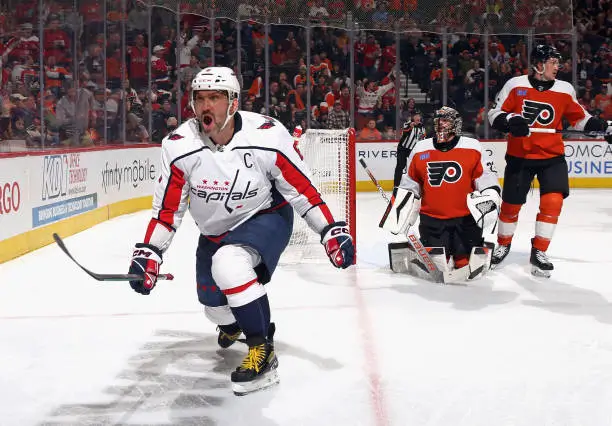
In a sport defined by speed, sacrifice, and split-second precision, scoring goals remains the ultimate currency of greatness. It is the distilled essence of hockey—a moment where anticipation, skill, and instinct converge into a singular act of triumph. For decades, one number stood as an almost mythical threshold, a benchmark so distant it felt untouchable: 1,000 career goals.
Only one player in history had ever reached it—Wayne Gretzky, the undisputed architect of hockey’s statistical universe. His records have long been treated not as milestones to be chased, but as monuments to be admired from afar. Yet in 2026, that exclusivity has been shattered. Alex Ovechkin, the relentless captain of the Washington Capitals, has become only the second player in NHL history to score 1,000 career goals.
This is not merely a statistical achievement—it is a cultural moment, a redefinition of possibility, and a testament to a career built on power, longevity, and an unyielding obsession with the net.
Goodnight, hockey fans! 🦅 pic.twitter.com/blfbiXMgLO
— NHL (@NHL) March 23, 2026
idea
The NHL has evolved dramatically over the decades—rules have changed, defensive systems have tightened, goaltenders have grown larger and more technically refined. Scoring, in many eras, has become harder, not easier.
Wayne Gretzky reached his goal-scoring heights during a period of comparatively higher offensive output, yet even then, his 894 official NHL goals (and over 1,000 including playoffs and international play) seemed insurmountable. The notion that another player could approach, let alone replicate such sustained scoring excellence, was often dismissed as fantasy.
Enter Alex Ovechkin.
From the moment he entered the league in 2005, Ovechkin redefined what a goal scorer could look like. He was not subtle. He was not delicate. He was explosive, physical, and unapologetically direct. His game was built on power—heavy strides, crushing hits, and perhaps the most feared shot of his generation.
But power alone does not yield 1,000 goals. That requires something else entirely: consistency.
move
Ovechkin’s journey to 1,000 goals is, in many ways, a story of adaptation. Early in his career, he was a whirlwind—a player who attacked from every angle, scoring highlight-reel goals with audacity and flair. His rookie season set the tone, announcing the arrival of a generational talent who would not merely participate in the league but reshape it.
As the years progressed, however, the league adjusted. Defenders studied his tendencies. Goaltenders prepared for his shot. Systems were built to contain him. And yet, Ovechkin continued to score.
What changed was not his identity, but his efficiency.
He honed his positioning, particularly on the power play, where his presence in the left faceoff circle—the now-iconic “Ovi spot”—became a tactical inevitability. Opponents knew where the puck was going. They knew what was coming. And still, they could not stop it.
This evolution speaks to a deeper truth about greatness: it is not static. It adapts, refines, and endures.
stir
Hockey is not kind to the body. The physical toll of an NHL career is immense—collisions, injuries, the relentless grind of an 82-game season. For a player whose style is as physically demanding as Ovechkin’s, the challenge is even greater.
Yet longevity has become one of his defining traits.
Season after season, he has remained not just productive, but dominant. While many players experience sharp declines as they age, Ovechkin has defied the curve. His goal totals have remained remarkably consistent, a testament to both his conditioning and his understanding of the game.
This durability is a crucial component of the 1,000-goal milestone. It is not enough to be brilliant for a few seasons. One must be brilliant for decades.
sil
Any discussion of goal-scoring greatness inevitably returns to Wayne Gretzky. His records have long cast a backdrop over the sport, serving as both inspiration and barrier.
For years, Ovechkin’s pursuit of Gretzky’s goal record was framed as a distant possibility. As he climbed the all-time scoring list, however, that possibility began to feel increasingly real. Each goal brought him closer, not just to a number, but to a legacy.
Reaching 1,000 career goals places Ovechkin in an exclusive conversation—one that transcends eras and styles. It invites comparisons that were once considered premature, even inappropriate. It forces a reevaluation of what was thought to be unbreakable.
And perhaps most importantly, it bridges gen.
Gretzky’s dominance defined one era. Ovechkin’s persistence defines another. Together, they represent the continuum of excellence in hockey.
the art
At the middle of Ovechkin’s achievement lies a singular weapon: his shot.
Described often as a “one-timer,” it is in reality a complex synthesis of timing, balance, and raw force. The mechanics are deceptively simple—weight transfer, stick flex, follow-through—but the execution is anything but.
What makes Ovechkin’s shot so effective is not just its power, but its predictability. It is a paradox. Opponents know it is coming, yet they are unable to neutralize it consistently.
This predictability has become part of its mythology. The left circle. The wind-up. The release. It is a sequence that has been replayed thousands of times, each iteration reinforcing its inevitability.
In a league that values deception, Ovechkin has built a career on inevitability.
culture
Ovechkin’s influence extends beyond statistics. He is a cultural figure, a symbol of resilience and charisma in a sport often characterized by restraint.
His celebrations—arms raised, joy unfiltered—have become iconic. They reflect a passion that resonates with fans, a reminder that even at the highest level, the game remains a source of pure exhilaration.
In Russia and across the global hockey community, Ovechkin’s success has inspired a new generation of players. He represents the possibility of transcending boundaries, of bringing a distinct style and identity to a traditionally conservative sport.
His career has also coincided with the NHL’s broader globalization, helping to expand its reach and appeal.
Head coach Spencer Carbery’s full postgame media availability after Washington’s 3-2 overtime defeat.#CapsAvs pic.twitter.com/d9zWvE3MqL
— Washington Capitals (@Capitals) March 22, 2026
show
For the Washington Capitals, Ovechkin is more than a star—he is the foundation upon which the franchise’s modern identity has been built.
Since his arrival, the Capitals have transformed from a team with potential into a perennial contender. The culmination of this transformation came in 2018, when Ovechkin led the team to its first Stanley Cup championship—a moment that cemented his legacy not just as a scorer, but as a leader.
The 1,000-goal milestone adds another layer to this legacy. It is a reminder that individual greatness and team success are not mutually exclusive, but intertwined.
impression
Perhaps the most profound aspect of Ovechkin’s achievement is its impression on the perception of what is possible.
For years, Gretzky’s records were viewed as relics of a bygone era—products of conditions that could not be replicated. Ovechkin’s ascent challenges that narrative. It suggests that greatness is not confined to history, but can emerge anew.
This shift has implications beyond hockey. It speaks to the broader human tendency to set limits based on precedent, to assume that certain achievements are beyond reach.
Ovechkin’s career is a counterargument. It is a demonstration that with the right combination of talent, dedication, and resilience, even the most daunting milestones can be approached.
press
Scoring 1,000 goals is not just a physical feat—it is a psychological one.
The pressure of expectation, the scrutiny of media and fans, the weight of history—these are factors that can influence performance in subtle but significant ways. For Ovechkin, the pursuit of milestones has been a constant companion.
What distinguishes him is his ability to compartmentalize. To focus on the next shift, the next opportunity, rather than the magnitude of the moment.
This mindset is essential for sustained success. It allows for consistency in the face of variability, for performance in the face of pressure.
leg
Unlike many milestones that serve as endpoints, 1,000 goals feels like a continuation.
Ovechkin’s career is not defined by a single moment, but by a trajectory. Each goal is part of a larger narrative, a story that continues to unfold.
The question now is not whether he belongs among the greats—that has been answered—but how his legacy will ultimately be framed. Will he surpass Gretzky’s records? Will he redefine them entirely?
These questions remain open, adding a layer of intrigue to the final chapters of his career.
fin
In the end, the significance of 1,000 goals extends beyond the number itself.
It is a symbol of endurance, of adaptation, of the relentless pursuit of excellence. It is a reminder that records are not static, that history is not fixed.
Alex Ovechkin has not merely joined an exclusive club—he has expanded it. He has transformed what was once a singular achievement into a shared one, bridging eras and redefining expectations.
And in doing so, he has given the sport something invaluable: a new horizon.
A reminder that even in a game defined by tradition, there is always room for the extraordinary.