A Turkish Twist on Sofa Design: Osolo by Gökçe Nafak

March 23, 2026
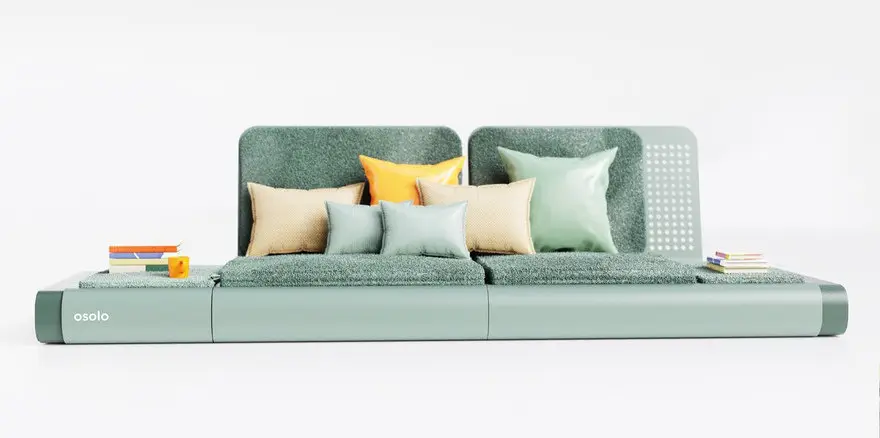
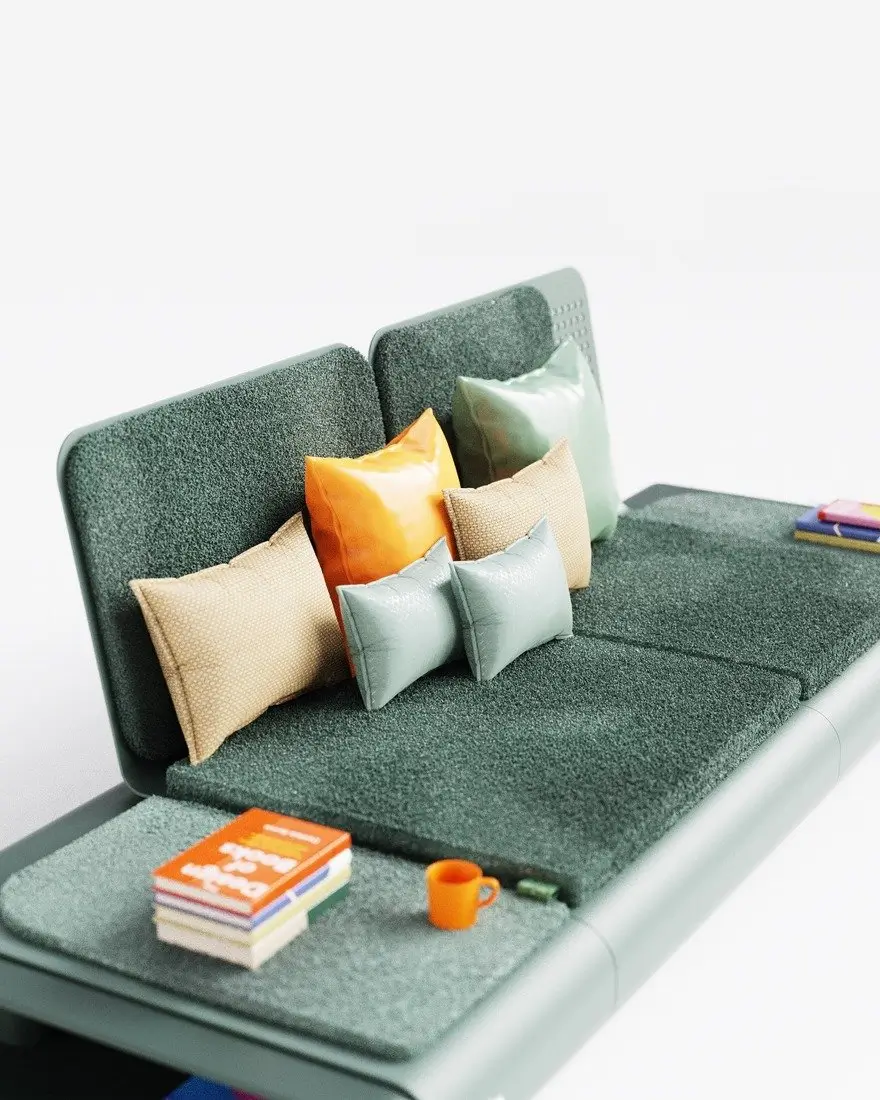
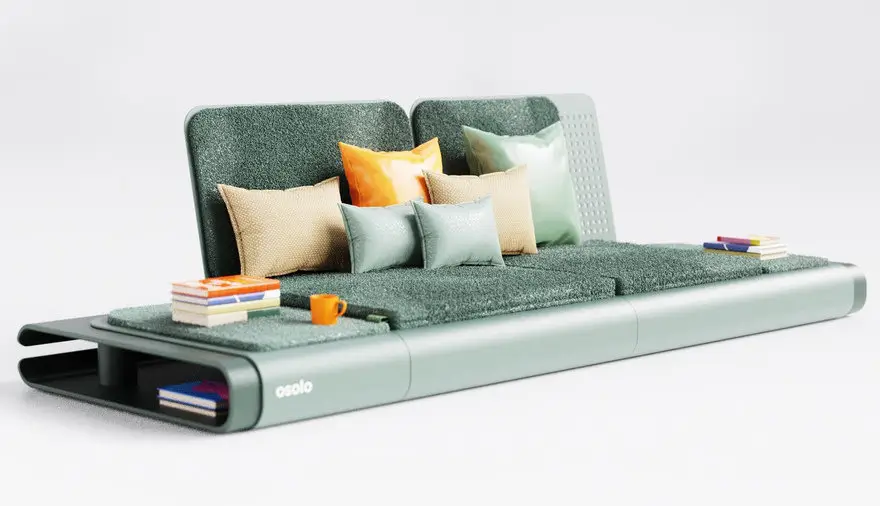
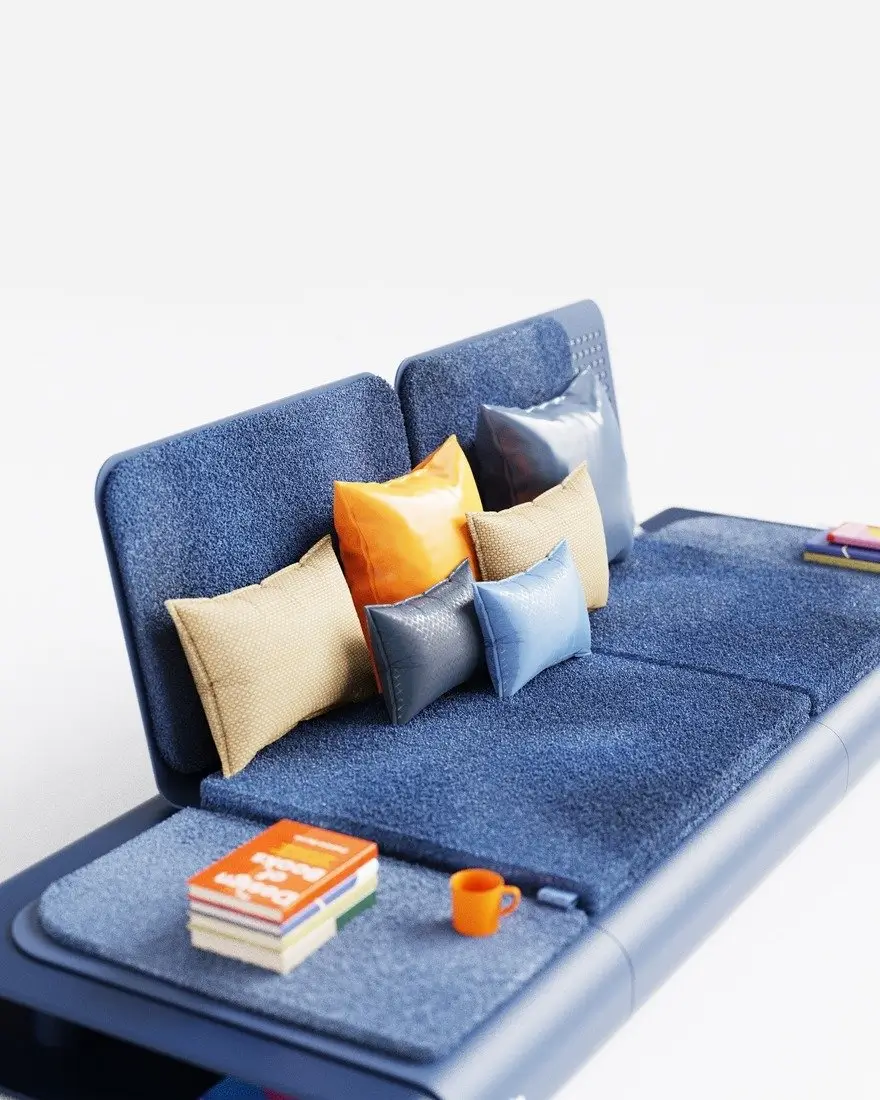
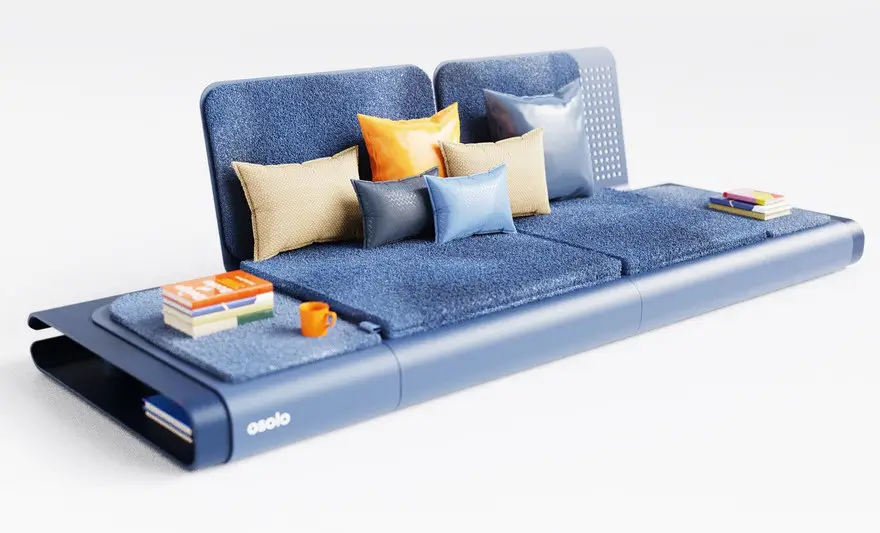
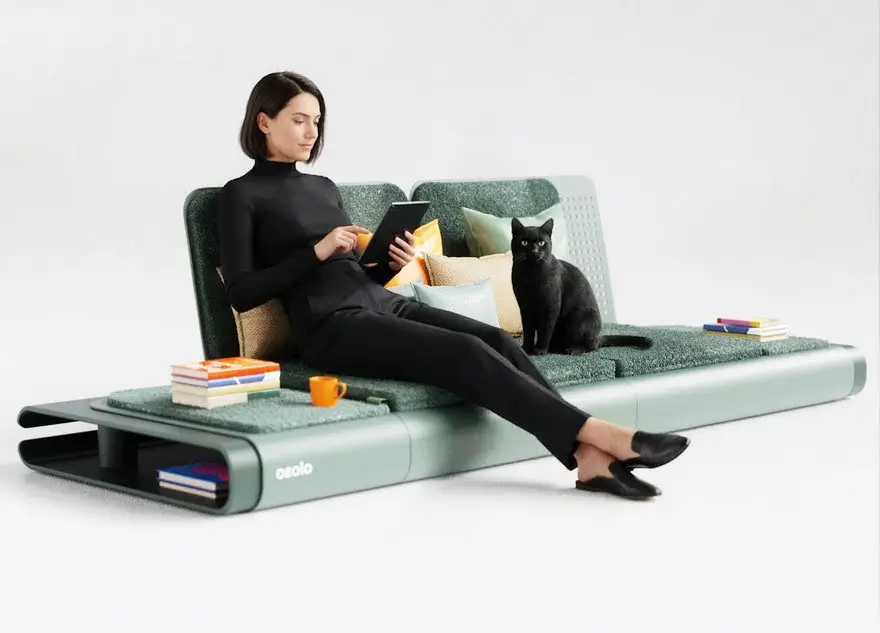
In a global design landscape dominated by overstuffed silhouettes and standardized ergonomics, the Osolo seating unit by Turkish industrial designer Gökçe Nafak arrives with a quiet but radical proposition: what if furniture didn’t dictate posture, but instead invited interpretation?
Osolo is not simply a sofa. It is a spatial philosophy rendered in metal and textile—low, linear, and deeply intentional. It draws from centuries-old Turkish seating traditions while engaging contemporary industrial design language, collapsing time into a single object that feels at once ancient and futuristic.
At its core, Osolo challenges Western assumptions about comfort, hierarchy, and domestic space. It asks us to reconsider not only how we sit, but how we live.
form
The conceptual backbone of Osolo lies in the sedir, a traditional Turkish seating arrangement that once defined domestic interiors across the Ottoman world. The sedir was not merely furniture—it was architecture. Built along the walls of a room, it functioned as seating, lounging, and sometimes even sleeping space. It was communal, flexible, and deeply integrated into daily life.
Osolo channels this lineage through its low-slung profile and elongated geometry. The seating plane sits close to the ground, encouraging relaxed, informal postures—cross-legged, reclined, or conversational. This is a direct departure from the rigid, upright seating encouraged by Western sofas.
Historically, the sedir began to disappear in the 19th century as European furniture styles entered Ottoman homes, bringing with them new spatial hierarchies and social codes. Chairs, dining tables, and upholstered sofas redefined interiors, replacing the fluid, communal ethos of earlier arrangements.
Nafak’s Osolo can be read as a quiet reclamation—an attempt to restore the adaptability and intimacy that were lost in that transition.
struct
At the heart of Osolo’s design is a single, defining gesture: a continuous folded metal structure that serves simultaneously as frame, platform, and visual identity.
Unlike conventional sofas, where structure is hidden beneath layers of upholstery, Osolo exposes its architecture. The metal base curves upward from the floor in a fluid, uninterrupted motion, forming a skeletal shell that is both minimal and expressive. This single-piece construction is not just aesthetic—it consolidates function, reducing the need for multiple components and reinforcing the object’s structural clarity.
This design decision achieves several things at once:
- It creates a monolithic visual language, where the object reads as a unified form rather than an assembly of parts
- It introduces an architectural presence, transforming the sofa into a spatial element rather than a decorative object
- It enables an open cavity beneath the seating plane, a subtle but functional storage zone for books, objects, or daily artifacts
The result is a piece that feels less like furniture and more like infrastructure—an inhabitable surface rather than a prescribed seat.
flow
If the sedir was defined by its adaptability, Osolo extends that principle into the contemporary era through modularity.
The seating surface is composed of independent cushions that can be arranged freely across the platform. Backrests are not fixed; they are movable elements that can be positioned according to need. This allows users to create configurations that range from solitary lounging to expansive communal seating.
Importantly, Osolo is not limited to a single unit. Multiple modules can be connected side by side, forming a continuous seating landscape that stretches across a room.
This modular logic introduces a new kind of domestic flexibility:
- Spaces can evolve throughout the day—reading nook by morning, social hub by evening
- Seating becomes non-hierarchical, removing distinctions between “primary” and “secondary” positions
- The object adapts to the room, rather than forcing the room to accommodate it
In this sense, Osolo aligns with broader shifts in contemporary living—toward open-plan interiors, multifunctional spaces, and less rigid social structures.
mat
Osolo’s material palette is deceptively simple, yet deeply intentional.
The metal base—often rendered in deep, saturated tones—anchors the piece with a sense of permanence and precision. Its smooth, folded edges avoid industrial harshness, instead achieving a refined, almost sculptural quality.
In contrast, the cushions introduce warmth and tactility. Their varied colors—muted neutrals punctuated by occasional bold accents—create a layered visual rhythm across the seating surface. This interplay between hard and soft, structure and comfort, is central to the design’s success.
The aesthetic balance is delicate:
- Too much emphasis on the metal, and the piece risks feeling cold or institutional
- Too much softness, and it loses its architectural clarity
Osolo navigates this tension with restraint, allowing each material to retain its identity while contributing to a cohesive whole.
min
Interestingly, Osolo’s design is not solely rooted in Turkish tradition. Nafak explicitly references Japanese minimalismas a secondary influence, blending two distinct cultural frameworks into a unified object.
From Japanese design, Osolo inherits:
- A commitment to simplicity and reduction
- An emphasis on low, grounded living
- A sensitivity to negative space and proportion
From Turkish tradition, it draws:
- The communal logic of the sedir
- A respect for craft and materiality
- A cultural memory embedded in everyday objects
The fusion is seamless. Rather than feeling like a hybrid, Osolo reads as a natural evolution—an object that belongs equally to both worlds while being fully contemporary.
view
One of Osolo’s most compelling qualities is its restraint. In an era where design often leans toward spectacle—bold forms, exaggerated proportions, hyper-stylized finishes—Osolo opts for quiet confidence.
Its geometry is clean, almost austere. There are no unnecessary embellishments, no decorative excess. Every line, every curve serves a purpose.
This restraint does not result in blandness. On the contrary, it amplifies the object’s presence. The simplicity allows the user’s interaction—the placement of cushions, the arrangement of objects, the lived experience—to become part of the design itself.
In this way, Osolo is not a finished product but an open system—a framework that gains meaning through use.
idea
Osolo can also be understood as a critique of modern furniture design.
Most contemporary sofas are:
- “Over-engineered” for comfort, often sacrificing flexibility
- Visually heavy, occupying space rather than shaping it
- Prescriptive, dictating how users should sit and interact
Osolo rejects these conventions. It offers:
- Comfort through adaptability, not excess cushioning
- Lightness through openness, despite its solid structure
- Freedom through modularity, allowing users to define their own experience
This shift reflects a broader movement in design—away from objects that impose behavior and toward systems that enable it.
imply
Perhaps the most interesting aspect of Osolo is how it blurs the boundary between furniture and architecture.
The continuous metal base, the extended seating plane, and the potential for modular expansion all contribute to a sense of spatial continuity. Osolo does not sit within a room; it participates in its organization.
Placed against a wall, it echoes the traditional sedir. Positioned centrally, it becomes an island—a horizontal landscape around which movement and interaction occur.
This architectural quality suggests new possibilities for interior design:
- Living rooms that function as flexible social platforms
- Workspaces that prioritize informal collaboration
- Hybrid environments that dissolve distinctions between living, working, and resting
In this context, Osolo is less a piece of furniture and more a tool for spatial reconfiguration.
sum
Osolo is not a loud design. It does not demand attention or rely on spectacle. Instead, it operates through subtlety—through proportion, material, and cultural resonance.
Yet its impact is profound.
By reimagining the sedir within a contemporary context, Gökçe Nafak has created a piece that challenges dominant paradigms of comfort, space, and interaction. Osolo invites us to sit differently, to gather differently, to live differently.