The Stone Island Ice Fabric 1988: A Living Textile in Motion

March 23, 2026
a garment
There are garments that define a season, and then there are garments that define a philosophy. The Thermosensitive Ice Fabric vest from Autumn/Winter 1988–1989 sits firmly in the latter category—a piece that transcends its time by introducing a concept that still feels ahead of ours.
Long before “smart textiles” became a talking point and well before wearable technology entered mainstream discourse, Stone Island was already asking a radical question: what if clothing didn’t just exist, but responded?
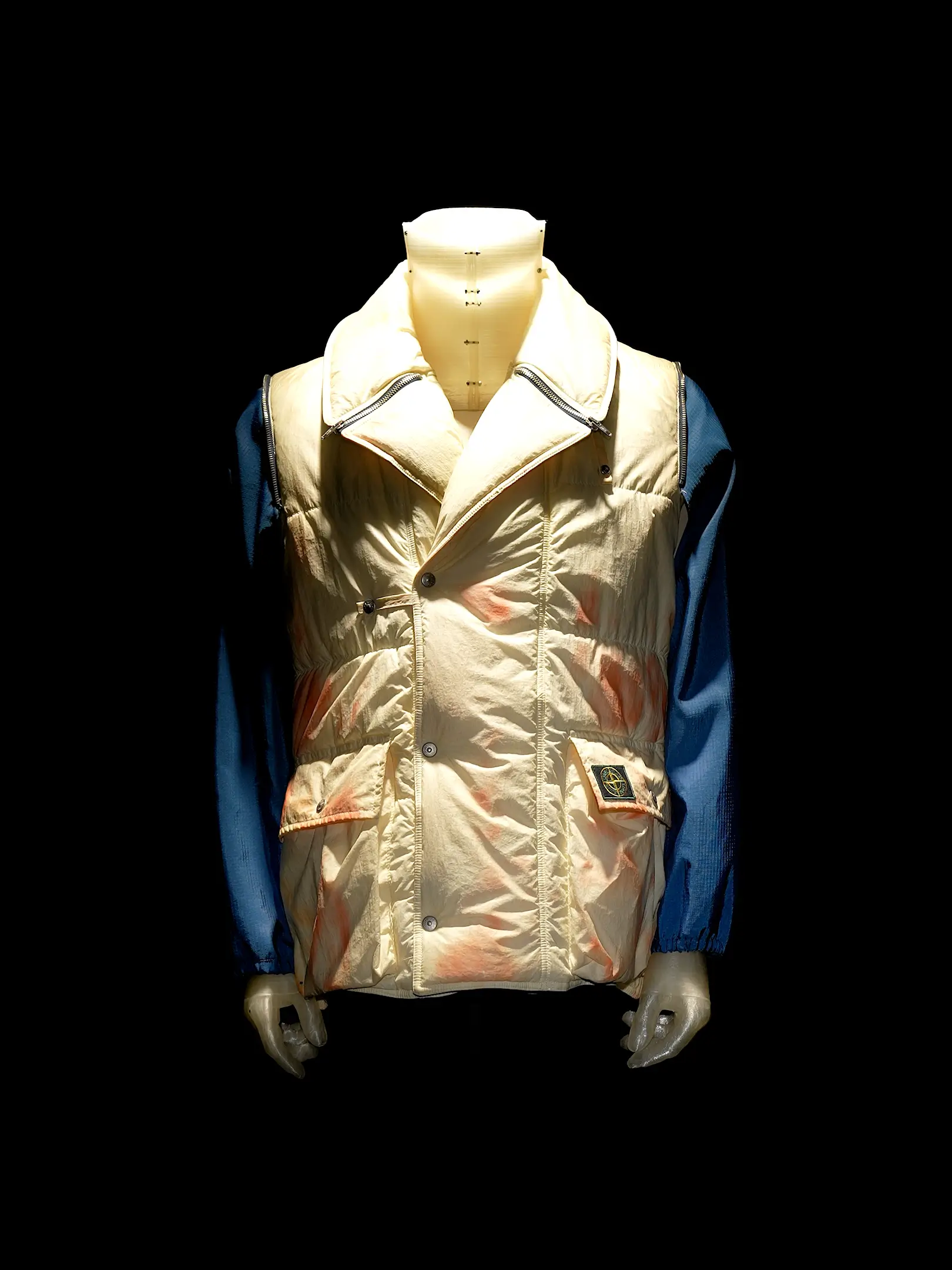
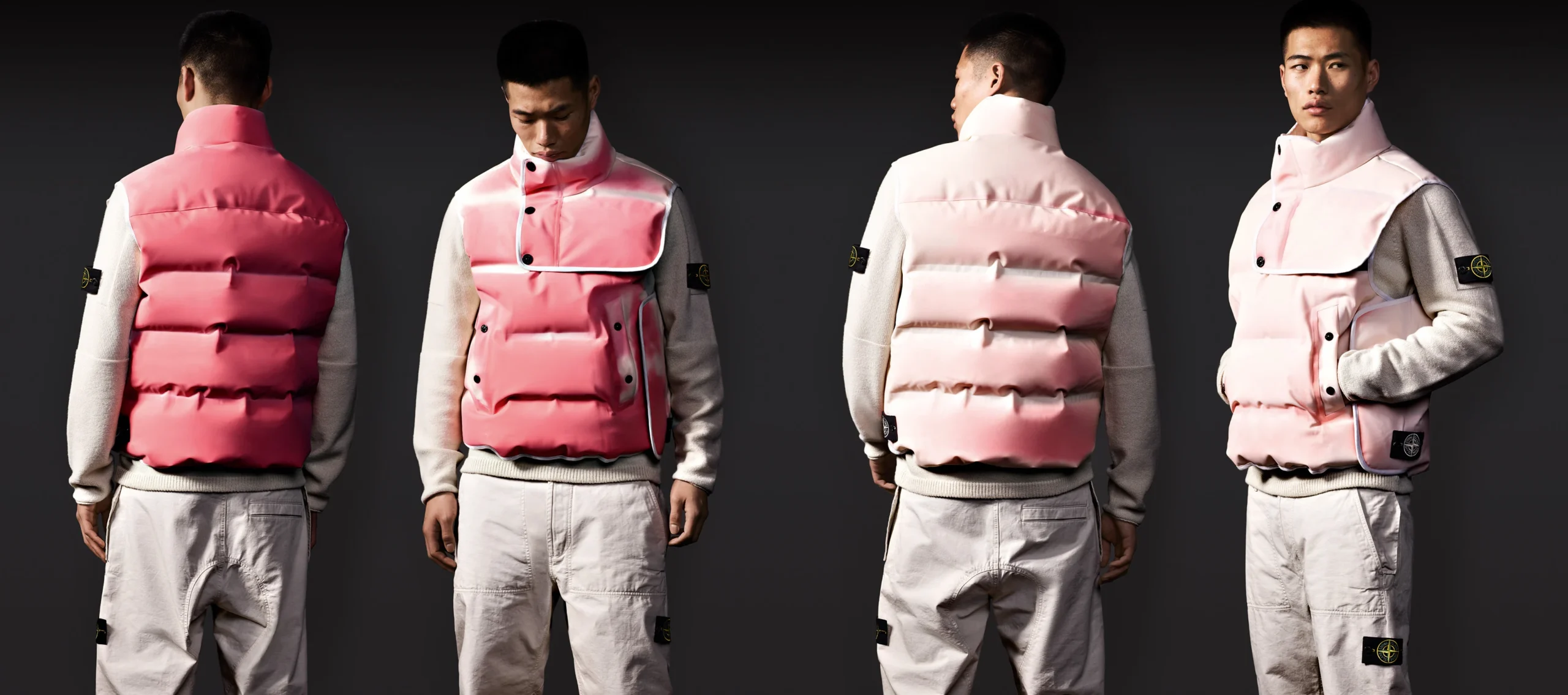
The answer arrived in the form of Ice Fabric—a thermosensitive textile that shifts color according to temperature. The vest, constructed in nylon ripstop and insulated for volume and warmth, becomes not just a garment but an instrument of transformation. It reacts to the wearer’s body heat, to the environment, to friction and exposure. It records presence in real time.
In essence, it moves.
stir
Osti was not simply a designer—he was a researcher, a material obsessive, a figure who approached garments with the curiosity of an industrial engineer and the sensibility of an artist.
During the 1980s, Osti built a creative practice rooted in fabric innovation. Rather than beginning with silhouette or trend, he began with material. Garments were secondary; textiles were primary. The process often involved borrowing techniques from military production, chemical engineering, and industrial dyeing, then adapting them into wearable form.
The Ice Fabric series represents one of the most poetic expressions of this approach. It was not created to follow a trend or to fill a market gap. It was created because the technology existed—and because Osti believed that clothing could be more than static.
mixology
At the heart of the vest lies its defining innovation: thermochromic pigments embedded into the nylon ripstop surface. These pigments react to heat by altering their molecular structure, which in turn changes the way they reflect light.
The result is a visible shift in color.
But what makes this process remarkable is its unpredictability. Unlike uniform dye treatments, thermosensitive reactions occur unevenly, shaped by the body’s heat distribution, movement, and contact. A hand resting on the chest leaves a temporary imprint. A shift in weather subtly alters the entire tone of the garment. Areas of insulation retain warmth longer, deepening the effect.
The vest becomes a canvas of interaction.
This is not decoration—it is transformation driven by physics.
idea
The choice of nylon ripstop as the base fabric is not incidental. Ripstop is engineered for resilience, woven with reinforcing threads that prevent tearing and ensure durability under stress. It has roots in military and aerospace applications—contexts where performance is non-negotiable.
By pairing this material with thermosensitive treatment, Stone Island achieves a compelling duality. The garment is both rugged and delicate, stable and reactive. It can withstand wear, yet it remains visually fluid.
The padded construction enhances this interplay. Insulation traps heat, intensifying the thermochromic response and allowing the garment to hold its transformed state longer. The vest does not simply change—it lingers in change.
Function amplifies expression.
grad
The vest presents a restrained silhouette. The structure is clean: a slightly boxy cut, a pronounced collar, snap-button closure, and two lower pockets. The iconic Stone Island compass badge sits discreetly on the pocket, signaling identity without overwhelming the design.
At first glance, it appears understated—even minimal.
But this is intentional. The true aesthetic emerges through use. As the fabric reacts, the vest develops tonal variations that cannot be pre-designed or replicated. It is a garment that reveals itself over time, shaped by the wearer’s habits and environment.
This approach challenges traditional notions of design. Instead of delivering a fixed visual statement, the vest offers a framework for change. It invites participation.
View this post on Instagram
fashion
One of the most radical aspects of the Ice Fabric vest is its relationship with time.
Fashion is typically experienced as a static moment—a look captured in a photograph, a snapshot of a collection. But this garment resists that fixity. Its appearance is never final. It evolves continuously, responding to conditions that are themselves in flux.
Time becomes part of the design.
This temporal dimension aligns the vest more closely with performance art than traditional clothing. It exists in a state of becoming, always shifting, never fully resolved. Each wear produces a slightly different outcome.
In this sense, the garment is not just worn—it is lived.
tech
The release of the Ice Fabric vest coincided with a broader shift in the fashion landscape. The late 1980s saw the emergence of technical experimentation, driven by advancements in materials and manufacturing.
Yet few brands embraced this shift as fully as Stone Island. While others flirted with functionality, Stone Island committed to it as a core identity. Collections were built around fabric innovation, with each season introducing new treatments, coatings, and dyeing techniques.
The Ice Fabric series stood out even within this context. It introduced a level of interactivity that was unprecedented. It suggested that garments could be dynamic systems rather than static objects.
This idea would take decades to fully permeate the industry.
show
Although initially experimental, pieces like the Ice Fabric vest found resonance within subcultures—particularly in the UK, where Stone Island became deeply embedded in terrace culture. The brand’s emphasis on innovation, durability, and subtle signaling aligned with a generation that valued authenticity over overt branding.
Wearing Stone Island was a statement—not of luxury, but of knowledge.
Over time, these garments transitioned from functional wear to cultural artifacts. Today, the Ice Fabric vest is considered a grail piece within archival fashion circles. Its rarity, combined with its historical significance, has elevated it to near-mythic status.
Collectors seek it not just for its aesthetics, but for what it represents: a moment when fashion pushed beyond its conventional boundaries.
move
Beyond its technical achievements, the vest carries an emotional resonance. There is something inherently intimate about a garment that responds to your body. It acknowledges your presence, reflects your movement, captures traces of your heat.
It feels alive.
This emotional connection is often absent in contemporary fashion, where garments are mass-produced and visually predetermined. The Ice Fabric vest offers an alternative—a relationship between wearer and object that is dynamic and personal.
No two experiences of the garment are identical.
The legacy of the Ice Fabric series can be seen across modern fashion and product design. Thermochromic materials have been adopted in everything from shoes to accessories, often positioned as novelty features or visual enhancements.
But few contemporary applications capture the depth of the original concept. Many prioritize spectacle over substance, treating color change as an effect rather than an interaction.
What distinguishes Stone Island’s approach is its integration. The thermosensitive property is not an add-on—it is central to the garment’s identity. It informs construction, material choice, and user experience.
It is design at a systemic level.
innov
In today’s landscape, innovation is often equated with digital technology—apps, sensors, connectivity. But the Ice Fabric vest offers a different perspective. It demonstrates that innovation can be analog, rooted in chemistry and material science rather than electronics.
There is no interface, no battery, no data.
And yet, the experience is immediate and intuitive. The garment communicates through transformation, visible to the naked eye. It does not require explanation.
This simplicity is what makes it enduring.
phil
Ultimately, the Thermosensitive Ice Fabric vest is more than a product. It is a philosophy encoded in material form.
It suggests that clothing can be:
- responsive rather than static
- experiential rather than purely visual
- personal rather than standardized
It challenges the wearer to reconsider what a garment can do—not just how it looks.
sum
Looking back at the Ice Fabric vest from Autumn/Winter 1988–1989, it becomes clear that this was not just an experiment—it was a glimpse into a future that, in many ways, has yet to fully arrive.
While the industry continues to chase innovation through digital means, this analog masterpiece remains a benchmark. It reminds us that true innovation lies not in complexity, but in clarity of concept.
A fabric that changes color with heat is a simple idea.
But in the hands of Stone Island, it becomes something profound—a garment that lives, reacts, and tells a story with every wear.
And perhaps that is the most enduring lesson of all: that the most powerful designs are not those that shout the loudest, but those that quietly evolve, revealing their depth over time.