Virgil Abloh’s Air Jordan 1 “Alaska”: The Prototype

March 23, 2026
archive
Resurgence is rarely about nostalgia. When done right, it is about clarity.
The April 2026 re-emergence of the Air Jordan 1 through the lens of Virgil Abloh is not a simple revival of an object. It is a reactivation of a system—one that began in 1984, under conditions that feel almost impossible to replicate today. And yet, through Abloh’s interpretive language, that original system becomes legible again.
To understand why this moment matters, you have to move backward. Not just to the shoe, but to the structure that made the shoe inevitable.
Because the Air Jordan 1 is not just a design. It is a convergence.
View this post on Instagram
stir
Before Abloh deconstructed the AJ1, before it became a canvas for quotation marks and exposed foam, there was Peter Moore.
Moore entered Nike in 1983 as its first creative director, following the acquisition of his studio. This detail matters. It meant that Nike wasn’t just hiring a designer—it was absorbing a worldview.
Moore was trained as a graphic designer, but his impact extended far beyond typography or layout. He approached the brand as a cinematic system. Every athlete was a character. Every product was a prop. Every campaign was a scene.
Under his direction:
- athletes received tailored visual identities
- campaigns balanced elegance with playfulness
- the brand developed narrative depth rather than just visibility
His work sat comfortably alongside the era’s most refined corporate image-making—echoing the atmospheric precision of Eiko Ishioka for Parco and the conceptual sharpness of Chiat/Day for Apple.
This is the context in which the Air Jordan 1 was conceived—not as a sneaker, but as a story engine.
idea
In Moore’s own words, his first impression of Michael Jordan was simple: “innately graceful.”
That observation became foundational.
The meeting itself—Moore, Jordan, Rob Strasser, and Phil Knight—was not just a negotiation. It was a recalibration of what an athlete partnership could be.
At the time, Nike needed a breakthrough. Adidas dominated basketball. Converse owned the league. The company’s bet on Jordan, championed by Sonny Vaccaro, was risky.
The offer reflected that risk—and its ambition:
- royalties on sales
- a signature line
- a dedicated logo
- apparel integration
- a fully realized marketing ecosystem
Today, this reads as standard practice. In 1984, it was unprecedented.
It transformed the athlete from endorser to collaborator. From participant to axis.
flow
The Air Jordan 1 was developed in months.
That timeline is almost unthinkable by contemporary standards, where product cycles stretch across years. But in that compression lies something important: intensity sharpens decisions.
Moore’s directive was clear. He wanted to bring color into basketball footwear—at a time when NBA regulations required shoes to be at least 51 percent white.
Constraint became catalyst.
The now-iconic “Bred” colorway—black and red—was not just a design choice. It was a challenge. A visual disruption within a system that favored uniformity.
Even Jordan himself resisted it initially. Compared to his University of North Carolina blues, the palette felt aggressive, even theatrical. “Clownish.” “Devilish.”
But disruption often looks wrong before it looks inevitable.
show
On October 18, 1984, Jordan stepped onto the court wearing a pair of Nike Air Ships, customized to reflect the AJ1 color concept.
The NBA responded immediately.
David Stern issued a warning: a $5,000 fine for every game in violation of the dress code.
What could have been a setback became ignition.
Nike’s response was immediate—an advertisement conceived and executed in roughly 24 hours. It reframed the violation not as a problem, but as a feature.
Forbidden became desirable.
The narrative wrote itself:
- the league rejects it
- the brand embraces it
- the athlete embodies it
This is where the system clicks into place. Design, regulation, rebellion, and performance converge.
a protean
Around the same time, Moore captured Jordan mid-dunk against the Chicago skyline.
This image would become the foundation for the Jumpman logo.
It is difficult to overstate the importance of this moment.
Because this is where performance becomes symbol.
A single photograph transforms into:
- a logo
- a brand
- a mythology
This is what the earlier insight points to: imagery doesn’t just add to product—it multiplies it.
The AJ1 was already compelling as an object. But with the Jumpman, it became something else entirely. It became a vessel for identity.
virg
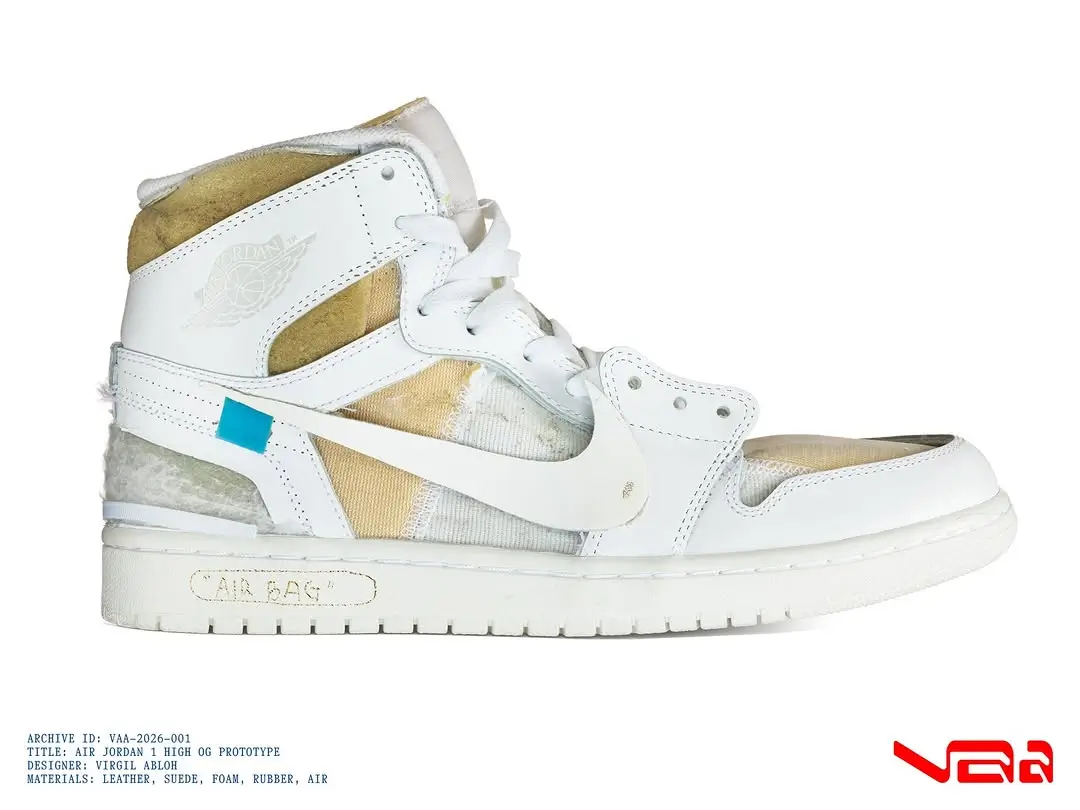
Decades later, Abloh approached the AJ1 not as a designer encountering a new object, but as a student returning to a foundational text.
His methodology was not about reinvention. It was about exposure.
By:
- removing layers
- revealing stitching
- annotating components
- destabilizing symmetry
he made visible what had always been there—the decisions, the structure, the logic.
Abloh’s AJ1 is often described as “deconstructed,” but that term undersells it. It is analytical. It is didactic.
It teaches.
It takes the invisible architecture of Moore’s original design and brings it to the surface. It allows the viewer to see the system, not just the outcome.
In doing so, it echoes the same realization that occurred decades earlier in Chicago:
this is made. this can be understood. this can be done.
fwd
The archival release in April 2026 does not simply revisit Abloh’s work. It recontextualizes it.
In a landscape saturated with references, collaborations, and accelerated cycles, the return to the AJ1—filtered through Abloh’s lens—functions as a reset.
It reminds us:
- where the system began
- how it evolved
- why it still matters
It reconnects contemporary audiences with the original sequence:
Moore → Jordan → Nike → Culture → Abloh → Now
Each link builds on the last. Each iteration carries forward the logic.
a combo
What makes the AJ1 enduring is not just its design, but its combinatorial nature.
It exists at the intersection of:
- athletic performance
- graphic design
- corporate strategy
- cultural timing
- individual charisma
Remove any one element, and the system weakens.
Together, they create something self-reinforcing.
Moore provides the visual language.
Jordan provides the performance.
Nike provides the platform.
The NBA provides the tension.
The media provides the amplification.
Abloh provides the reinterpretation.
This is not linear influence. It is networked.
endure
At its core, the story of the AJ1—and its re-emergence in 2026—is not about a shoe.
It is about recognition.
The recognition that:
- objects are constructed
- narratives are engineered
- images are strategic
- culture is iterative
For the Chicago kid in the 1980s, this recognition was an unlock.
For Abloh, it became a methodology.
For the present moment, it becomes a reminder.
shape
The phrase “perfect storm” is often used to describe the AJ1’s origin. But storms are only perfect in retrospect.
At the time, it was uncertainty:
- a young athlete
- a struggling brand
- an untested model
- a controversial design
What made it work was not luck. It was alignment.
Alignment of vision, timing, and execution.
The April 2026 release does not recreate that storm. It does something more valuable.
It allows us to see it clearly.
To trace its components.
To understand its structure.
To recognize its patterns.
And once you can do that, the story changes.
It is no longer about witnessing history.
It is about understanding how to build it.