Kid Cudi Is Artmaxxing: Inside the KAWS-Adjoining Expansion of a Cultural System

March 24, 2026
a shift
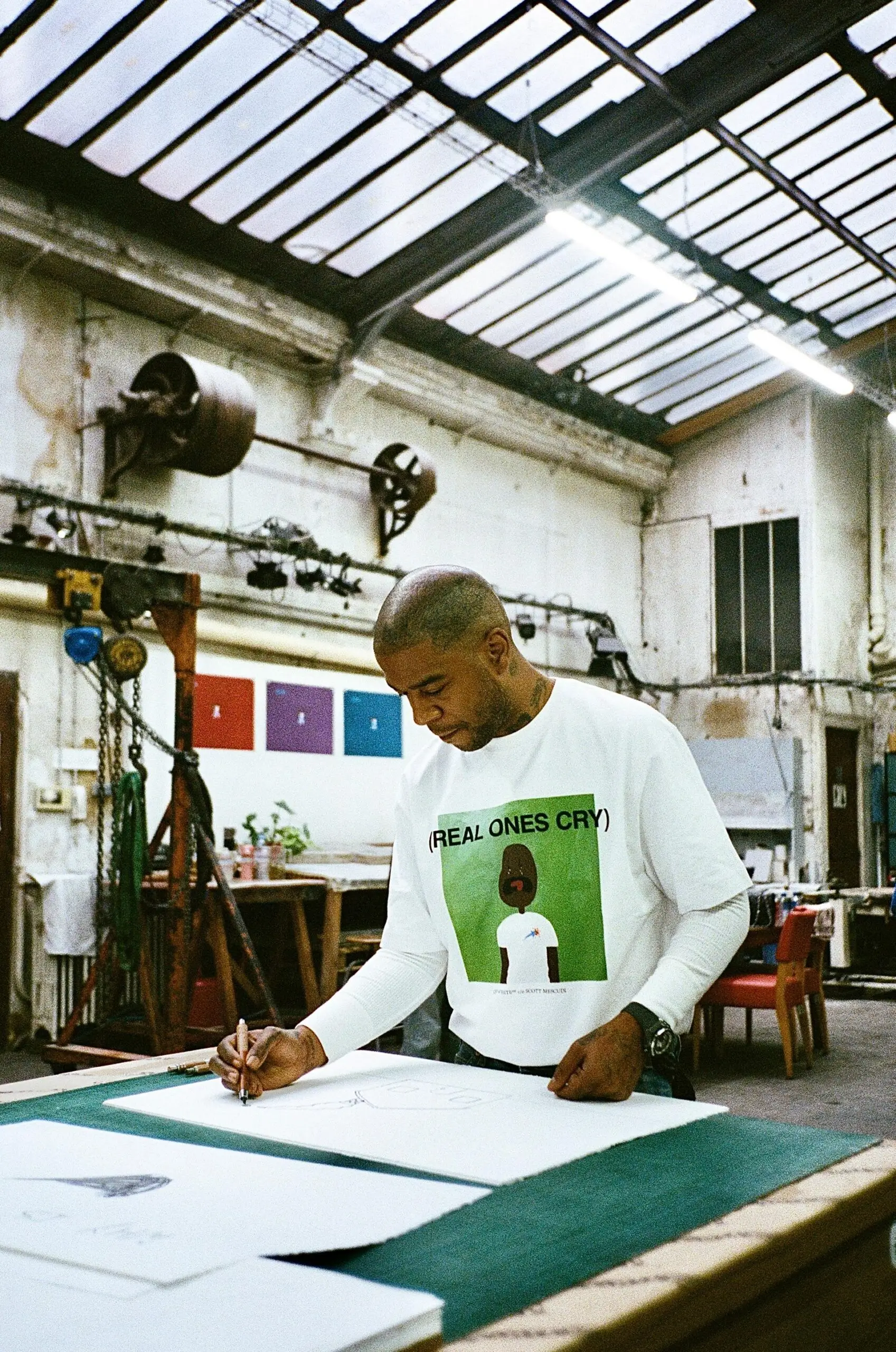
There is no formal declaration when an artist crosses a threshold. No press release arrives to confirm that a musician has outgrown the category that once defined them. Instead, the shift accumulates quietly, expressed through decisions that begin to reorient how the work is made, where it appears, and what form it ultimately takes. Around Kid Cudi, that threshold is becoming increasingly visible.
The language that has emerged to describe it—“artmaxxing”—is informal, even slightly tongue-in-cheek, but it captures a genuine condition. It suggests an artist pushing beyond the boundaries of a primary discipline, not in search of novelty, but in pursuit of a more complete expression of their identity. In Cudi’s case, this is not a pivot away from music, but a redistribution of emphasis. The music remains central, yet it no longer operates alone. It is being positioned within a broader constellation that includes visual language, physical objects, and spatial experiences.
This evolution feels less like experimentation and more like alignment. For years, Cudi’s work has been structured around interiority—translating emotional states into something that can be shared, felt, and recognized. What is changing now is the medium through which that translation occurs. Sound is no longer sufficient. It is being supplemented, and in some cases rivaled, by form.
idea
KAWS operates across domains that were once considered incompatible. His work exists simultaneously within galleries, retail environments, and private collections, without sacrificing coherence. A Companion figure can be encountered as a monumental sculpture, a small-scale collectible, or a graphic printed on clothing. Each iteration carries the same visual language, the same underlying identity, yet adapts to different contexts with ease.
This is not simply versatility; it is infrastructure. It is a model for how an artist can maintain authorship while allowing their work to circulate widely. For Kid Cudi, proximity to that model offers more than inspiration. It offers a framework through which his own ideas can be expanded and stabilized.
Where music dissipates into experience—heard, internalized, and then gone—KAWS’ objects insist on permanence. They occupy space. They can be revisited, collected, and displayed. This distinction introduces a new dimension to artistic practice, one where meaning is not only communicated, but physically embedded.
experiment
Cudi’s work has always carried a visual undercurrent. Even at its most sonically driven, it has evoked imagery, atmosphere, and narrative space. Albums have functioned as environments rather than sequences of tracks, each one constructing a world that listeners could inhabit, if only temporarily. The challenge has been that this world dissolves as soon as the music stops.
Artmaxxing, in this context, becomes a response to that limitation. It represents an effort to give those worlds a form that persists. The transition from sound to object is not merely a change in medium; it is a shift in ontology. It asks how emotion, which is inherently fluid and intangible, can be translated into something fixed without losing its complexity.
This is where the influence of KAWS becomes instructive. His figures are deceptively simple, yet they carry a weight that exceeds their form. They do not attempt to replicate emotion directly. Instead, they create a structure within which emotion can be projected. Their ambiguity is their strength, allowing them to resonate across contexts without becoming reductive.
For Cudi, adopting a similar approach offers a way forward. Rather than attempting to literalize his themes, he can construct forms that suggest rather than dictate, that invite interpretation rather than enforce it. In doing so, he preserves the openness that defines his music, while extending it into new dimensions.
view
The seeds of this transition were already visible in projects like Entergalactic, where Kid Cudi expanded his practice into animation and narrative design. That project was not an auxiliary to the music; it was an extension of it, a parallel channel through which the same ideas could be explored.
What made Entergalactic significant was not simply its execution, but its structure. It introduced characters, environments, and a cohesive visual language that could exist independently of the music, while still remaining connected to it. It suggested a move toward character-driven storytelling, where identity is distributed across multiple forms rather than contained within a single output.
This approach aligns closely with the logic that underpins KAWS’ practice. His characters are not confined to a single medium; they migrate, adapting to different contexts while retaining their core identity. They function as anchors within a broader system, providing continuity across otherwise disparate expressions.
Cudi’s adoption of this logic signals a shift toward building a similar system. His work is beginning to cohere around a set of visual and narrative elements that can be extended, replicated, and transformed across mediums. Music becomes one expression among many, rather than the sole container of meaning.
flow
What emerges from this is a new archetype, one that can no longer be adequately described as a musician, or even as a multidisciplinary artist. It is something closer to a cultural system, an entity that produces work across multiple domains while maintaining a unified identity.
Kid Cudi occupies a distinctive position within this landscape. Unlike artists who pivot toward fashion or design as extensions of brand, his movement remains rooted in emotional expression. The expansion into art does not replace that core; it amplifies it, providing new surfaces through which it can be articulated.
This distinction is crucial. It prevents the shift from feeling opportunistic or superficial. Instead, it reads as a natural evolution, a response to the limitations of a single medium and a recognition of the possibilities that lie beyond it.
KAWS, in contrast, operates through a different set of principles. His work is less about interiority and more about iconography, about constructing images that can circulate and endure. The intersection of these two approaches creates a productive tension. It suggests a model where emotional depth and formal clarity can coexist, where feeling is given structure without being diminished.
pulse
This convergence does not occur in isolation. It is shaped by a broader set of cultural conditions that have made such expansions not only possible, but necessary.
The collapse of traditional boundaries between disciplines has created an environment where artists are expected to operate fluidly. The distinction between music, art, and design has become increasingly porous, replaced by a more integrated understanding of creative practice. Audiences no longer engage with work in isolated categories; they move between formats, seeking continuity and coherence.
At the same time, the digitization of culture has altered the way art is consumed. Music, once a physical object, has become a stream, accessible but intangible. Images circulate endlessly, detached from their original contexts. In response, there is a growing desire for objects, for things that can be held, owned, and experienced in physical space.
KAWS anticipated this shift, building a practice that integrates digital circulation with physical presence. His work moves seamlessly between screens and spaces, maintaining its identity across both. For Kid Cudi, entering this space offers a way to reintroduce materiality into his work, to create forms that anchor his ideas in the physical world.
style
The term artmaxxing, despite its casual origins, describes a disciplined approach. It implies not only expansion, but optimization—a deliberate effort to realize the full potential of an artistic identity across all available mediums.
For Cudi, this means constructing a practice that is both cohesive and adaptable. Each element must contribute to a larger system, reinforcing rather than diluting the core identity. Music, visual design, objects, and environments must all speak the same language, even as they operate in different contexts.
This requires a level of precision that goes beyond traditional artistic practice. It demands an understanding of how work circulates, how it is perceived, and how it can be extended without losing coherence. It is as much about strategy as it is about expression.
KAWS provides a precedent for this approach. His career demonstrates that it is possible to build a system that operates across multiple domains while maintaining clarity and control. His work does not fragment as it expands; it consolidates, becoming more recognizable and more resonant with each iteration.
Cudi’s engagement with this model suggests a similar ambition. He is not simply adding new mediums to his practice; he is reorganizing it, creating a structure that allows for sustained expansion without fragmentation.
compare
One of the most significant implications of this shift is the changing relationship between artist and audience. As work moves into physical forms, the act of engagement becomes more participatory. Listeners become collectors, acquiring objects that extend their connection to the artist beyond the ephemeral experience of music.
KAWS’ success has been built in part on this dynamic. His work invites ownership, encouraging audiences to engage not only emotionally, but materially. Each object becomes a point of connection, a way of inhabiting the artist’s world.
For Kid Cudi, this introduces new possibilities for interaction. His audience, already deeply invested in the emotional content of his work, is now being offered new ways to engage with it. Objects, visuals, and environments become extensions of the same narrative, allowing for a more immersive and sustained relationship.
mood
If this trajectory continues, the boundaries between Cudi’s various outputs will continue to dissolve. Future releases may not arrive as isolated albums, but as components within a larger system that includes visual narratives, physical objects, and possibly even exhibition spaces.
The emphasis will likely shift further toward character-driven storytelling, with recurring motifs and figures providing continuity across different forms. These elements will function as anchors, allowing the work to expand while remaining coherent.
At the same time, the integration of fashion and design will deepen, not as branding exercises, but as extensions of the same aesthetic language. Clothing, objects, and environments will all contribute to a unified expression, reinforcing the sense of a cohesive system.
KAWS’ influence will remain present, not as a direct reference, but as an underlying structure. His model demonstrates what is possible when an artist approaches their practice as a system rather than a series of outputs. Cudi’s engagement with that model suggests a commitment to building something similarly expansive.
sum
What is unfolding around Kid Cudi is not a moment, but a process. It is the gradual construction of a system that allows his work to exist across multiple domains without losing its identity. The term artmaxxing, for all its informality, captures the essence of this process. It describes an artist seeking to fully realize their potential, to extend their presence into every available dimension.
KAWS stands as both a reference and a proof of concept, demonstrating that such a system can be built and sustained. His work shows that it is possible to operate at the intersection of art, commerce, and culture without compromise, to create objects that are both widely accessible and deeply considered.
Cudi’s movement into this space suggests a similar ambition. He is not abandoning the medium that defined him, but expanding beyond it, translating his interior world into forms that can be seen, held, and inhabited. The shift is subtle, but it carries significant implications. It marks the emergence of an artist who is no longer confined by a single discipline, but operates as a system, generating work that resonates across multiple dimensions.