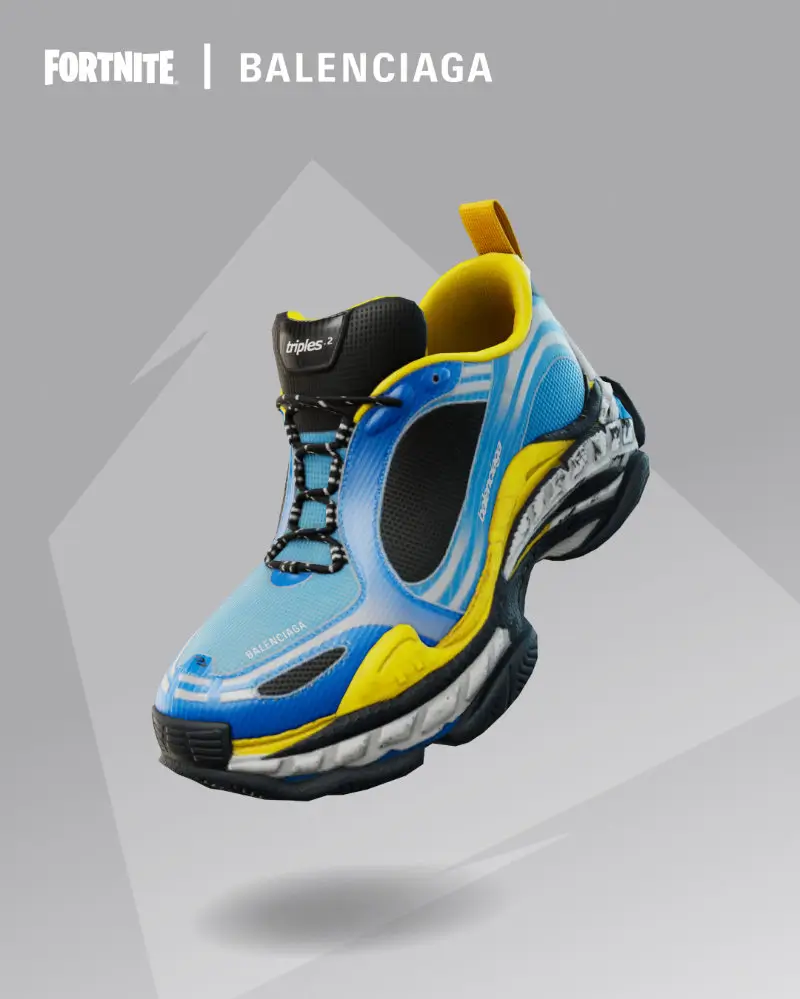
In Fortnite, the Triple S.2 is rendered with a fidelity that underscores this shift. The sneaker’s defining features—its pre-distressed tread, layered sole units, and stretch lace system—are not simplified for performance efficiency. Instead, they are carefully simulated, preserving the visual language that made the original silhouette culturally potent. The tread appears worn, as if it has already traversed physical landscapes; the laces stretch and contour with believable tension; the branding remains legible yet integrated into the object’s overall geometry.
This attention to detail is not incidental. It signals an understanding that digital fashion, to resonate, must retain the semiotics of physical luxury—craft, wear, and imperfection—while adapting to the expectations of a gaming audience.
platform
The choice of Fortnite is strategic. Since its launch by Epic Games, the platform has evolved from a battle royale game into a hybridized cultural hub—part social network, part entertainment venue, part retail environment. Collaborations with music artists, film franchises, and now luxury fashion houses have redefined what a “game” can be.
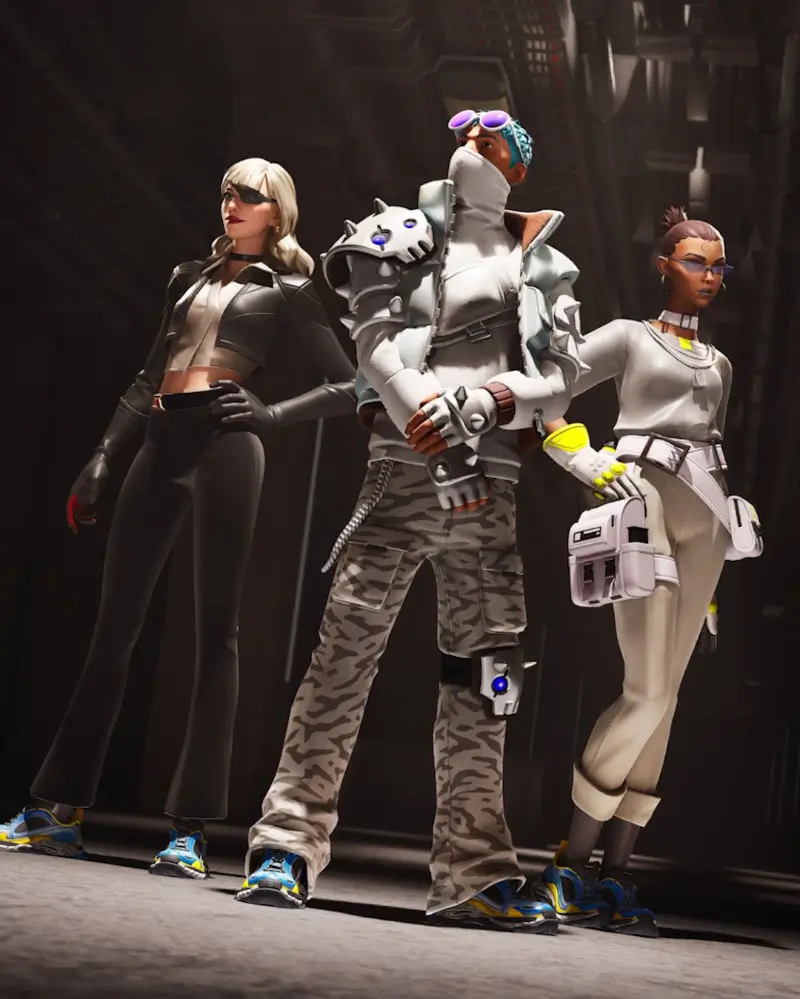
Within this ecosystem, skins and accessories function as both aesthetic upgrades and social signals. To wear a specific item is to participate in a shared cultural moment, to align oneself with a particular narrative or brand. The introduction of the Triple S.2 into this environment extends Balenciaga’s reach into a demographic that may never encounter the physical sneaker in a retail context.
Yet the move is not purely about access. It is about relevance. By embedding itself within Fortnite, Balenciaga positions its design language within a space where identity is fluid, performative, and continuously updated.
mat
One of the most compelling aspects of the Triple S.2’s digital translation is its treatment of materiality. In the physical world, luxury is often communicated through tactile qualities—weight, texture, and finish. In Fortnite, these qualities must be inferred visually.
The sneaker’s pre-distressed tread is a case in point. In reality, such distressing would be achieved through manufacturing processes that simulate wear. In the digital version, the effect is constructed through texture mapping and shading, creating the illusion of depth and abrasion. The result is a paradox: a brand-new object that appears aged, existing in a space where physical degradation is impossible.
This paradox speaks to a broader shift in how value is constructed. In digital environments, scarcity and authenticity are no longer tied to material constraints. Instead, they are defined by design, distribution, and cultural resonance.
flow
The involvement of Pierpaolo Piccioli introduces an additional layer of interpretation. Known for his work in redefining contemporary couture, Piccioli brings a sensibility that prioritizes emotional clarity and visual impact. His approach to the Triple S.2 in Fortnite is not about technical novelty for its own sake, but about ensuring that the sneaker communicates within the visual language of the game.
This is evident in the balance between realism and stylization. While the textures are highly detailed, the overall form remains legible within Fortnite’s aesthetic framework. The sneaker does not feel out of place; it integrates seamlessly, suggesting a careful calibration between brand identity and platform-specific design.
eco
The release also invites consideration of how luxury operates in digital economies. In Fortnite, items are typically acquired through in-game currency, creating a transactional model that is distinct from traditional retail. The price point, while lower than that of a physical Balenciaga sneaker, still carries symbolic weight.
Owning the Triple S.2 in Fortnite is not about utility—it does not enhance gameplay performance. Its value lies in visibility, in the ability to signal taste and affiliation within a shared space. This mirrors, in many ways, the function of luxury goods in the physical world.
However, the digital context introduces new dynamics. Items can be distributed globally without logistical constraints, and their availability can be tightly controlled through timed releases. This creates a sense of urgency and exclusivity that parallels traditional fashion drops, while operating at a vastly different scale.
stir
What emerges from this collaboration is a redefinition of fashion as interface. The Triple S.2 is not merely worn; it is experienced as part of a larger system that includes avatars, environments, and interactions. It becomes a point of contact between the player and the world of the game, shaping how both are perceived.
This shift has implications beyond Fortnite. As digital environments become increasingly central to social interaction, the role of fashion within these spaces is likely to expand. Brands that can navigate this transition—translating their identities into forms that resonate across both physical and digital contexts—will be positioned to lead.
fin
The Balenciaga Triple S.2 in Fortnite is not an isolated experiment. It is part of a broader trajectory in which the boundaries between fashion, entertainment, and technology continue to blur. The collaboration underscores a key insight: that cultural relevance today is not confined to any single medium.
Balenciaga’s engagement with Fortnite suggests a future in which sneakers exist simultaneously as physical objects and digital assets, each informing the other. The Triple S.2, in this sense, is both a product and a proposition—a statement about where fashion is heading and how it will be experienced.
In translating an iconic silhouette into a virtual environment, the house does more than extend its reach. It redefines the conditions under which design operates, inviting us to consider what it means to wear, to own, and to see in a world where the line between the real and the virtual is increasingly indistinct.
The sneaker, once grounded in the street, now moves through code. And in doing so, it carries with it the weight of a new kind of cultural currency—one that is measured not in materials, but in moments.