Cope 2: True Legend Parking Street Sign, (2014)

March 25, 2026
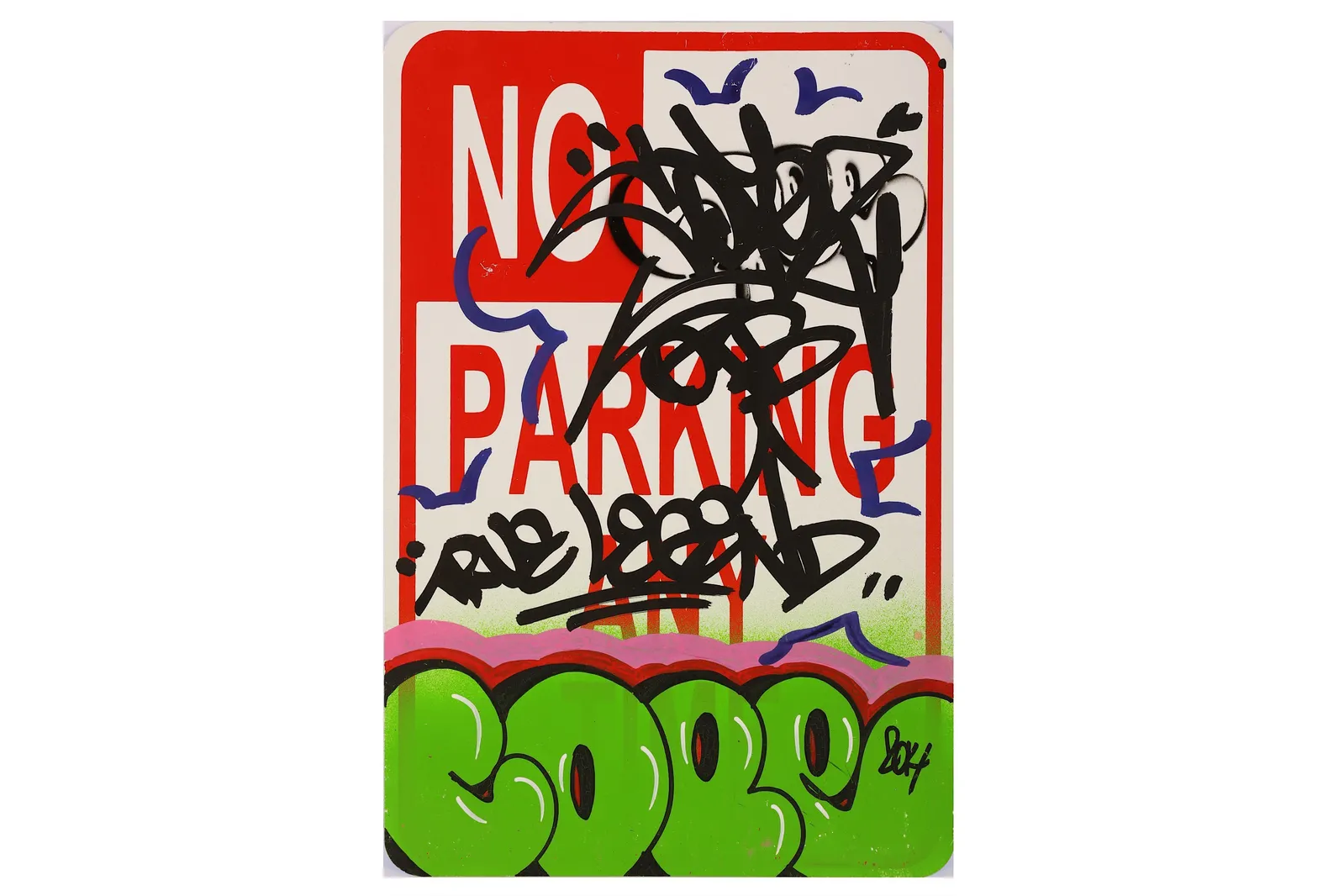
The painted parking sign—acrylic on metal, measuring 12 × 18 inches—demands to be understood first as an object before it is read as an image. In this work, attributed to Cope 2, the substrate is not neutral. It is not canvas, paper, or panel. It is infrastructure—salvaged or replicated from the regulatory systems of the city.
A street parking sign carries authority. It instructs, prohibits, and organizes movement. It belongs to the language of governance, not expression. By painting directly onto this surface, Cope 2 intervenes at the level of function. The sign is no longer directive; it becomes declarative.
This shift is fundamental. The work does not simply depict graffiti—it enacts it. The gesture of marking over a sign echoes the original logic of graffiti as an interruption of controlled space. Yet within the gallery or auction context, this interruption is preserved, framed, and reclassified as art.
flow
A return to the origins with Cope 2—born Fernando Carlo in 1968 in the South Bronx. His entry into graffiti in 1978 situates him within a critical period in the history of New York writing, when the city’s subway system became a vast, moving archive of names.
Influenced by his cousin Chris, Cope 2 quickly moved from imitation to authorship. By 1982, he had formed his own crew, initially “Kids Destroyer,” later evolving into “King’s Destroyer.” These names are not incidental; they articulate a relationship to space defined by assertion and presence.
The subway, particularly the New York City Subway, functioned as both medium and distribution system. Writing across all lines, Cope 2 embedded his name into the circulatory system of the city. Fame, in this context, was not mediated by institutions but by repetition and reach.
The painted parking sign carries this history within it. Even removed from the subway, the logic of the tag persists. The object becomes a condensed version of a much larger practice.
auth
Street signs operate within a system of authority. They regulate behavior, enforce order, and maintain the flow of urban life. Graffiti, historically, has been positioned in opposition to this system—viewed as defacement, vandalism, or disruption.
In Cope 2’s parking sign works, this opposition is complicated. The act of painting on the sign recalls the illicit gesture of marking public property. Yet the context in which the work now exists—submitted by a gallery, circulated through auctions—reframes that gesture.
The authority of the sign is not erased; it is overwritten. The original function remains legible in the object’s form, even as its meaning is transformed. The viewer is confronted with a tension between two systems: one of regulation, the other of expression.
This tension is not resolved. Instead, it becomes the central dynamic of the work. The sign continues to signify authority, but that authority is destabilized by the presence of the tag.
show
The use of metal as a surface introduces a distinct material dimension. Unlike canvas, which absorbs paint, metal resists it. The acrylic sits on the surface, creating a different kind of interaction between medium and support.
This resistance is significant. It echoes the conditions of street writing, where artists work on surfaces not designed for painting—steel train cars, concrete walls, glass panels. The material is not chosen for its receptivity but for its availability.
In the parking sign, the metal carries traces of its previous life. Even if cleaned or repurposed, it retains an industrial presence. This presence grounds the work in a specific material reality, preventing it from becoming purely aesthetic.
The paint, layered over this surface, introduces a contrast between permanence and impermanence. Street signs are meant to endure, yet graffiti is often temporary, subject to removal or decay. In this work, both temporalities coexist.
interval
At the center of the composition is the tag—COPE2. It is both name and symbol, functioning as a marker of presence. The repetition of this tag across decades has transformed it into a recognizable visual form.
The lineage of this practice can be traced back to early writers such as TAKI 183, whose simple inscriptions established the foundation of graffiti as a name-based practice. Cope 2 extends this tradition, developing a style that balances legibility with abstraction.
On the parking sign, the tag interacts with the pre-existing graphic language of the object. Letters overlap with official typography, arrows intersect with strokes, and the hierarchy of information is disrupted.
The result is a layered text, where the original message of the sign competes with the assertion of the artist’s name. This competition is not merely visual; it is conceptual. It raises questions about who has the right to mark public space.
qualify
The trajectory of Cope 2’s career reflects a broader shift in the perception of graffiti. What began as an illegal practice has, over time, been absorbed into the art market and institutional frameworks.
This transition was not seamless. In the 1980s and 1990s, New York authorities intensified efforts to eradicate graffiti, implementing strict penalties and surveillance. Many artists, including Cope 2, were forced to adapt—moving between street work, commissioned pieces, and gallery exhibitions.
The parking sign works exemplify this adaptation. They retain the aesthetic and conceptual elements of graffiti while conforming to formats that can be exhibited and sold. The object becomes a bridge between two worlds.
Cope 2’s collaborations with brands such as Converse, Adidas, and Foot Locker further illustrate this shift. Graffiti moves from the margins to the center of visual culture, influencing fashion, advertising, and design.
commune
Despite this institutional recognition, Cope 2’s practice remains rooted in a culture of collide. His work alongside artists such as Shepard Fairey, RETNA, and Kenny Scharf situates him within a network of practitioners who have collectively expanded the boundaries of street art.
These collaborations are not merely professional; they reflect a shared language and history. Graffiti, at its core, is a communal practice. Crews, collaborations, and shared spaces are integral to its development.
The parking sign, though a singular object, carries this collective dimension. It references a broader culture of writing, one that extends beyond the individual artist.
hx
The inclusion of the work in auction contexts, such as Chiswick Auctions, situates it within a global market for contemporary art. The designation of Lot 444 transforms the work into a unit of exchange, subject to valuation and competition.
Exhibitions such as COPE2 – UNHINGED (2024) and Within My Essence (2023) further establish the artist’s presence within institutional frameworks. These exhibitions provide contexts in which the work can be interpreted, contextualized, and historicized.
Yet the movement into these spaces does not erase the work’s origins. Instead, it introduces new layers of meaning. The parking sign becomes both artifact and commodity, carrying the history of graffiti into new arenas.
style
One of the defining visual characteristics of the work is the act of overwriting. The original graphics of the sign are partially obscured, yet still visible. This creates a palimpsest—a surface where multiple layers of information coexist.
Overwriting is a fundamental gesture in graffiti. New tags are placed over old ones, creating a constantly evolving surface. This process is replicated in the parking sign, where the artist’s marks interact with the pre-existing design.
The viewer is invited to navigate these layers, to decipher the interplay between official and unofficial language. The work becomes an exercise in reading, where meaning is not fixed but negotiated.
frame
At 12 × 18 inches, the work occupies a relatively intimate scale. This is a significant departure from the large-scale interventions typical of subway graffiti. The reduction in size shifts the mode of engagement.
Instead of encountering the work in motion—on a passing train or a distant wall—the viewer engages with it up close. Details become visible: the texture of the paint, the edges of the strokes, the interaction between layers.
This intimacy does not diminish the work’s impact. On the contrary, it intensifies it. The viewer is drawn into the surface, compelled to examine the nuances of the composition.
sum
Cope 2’s painted parking sign is not merely an artwork; it is an intervention into the language of the city. By marking over a surface designed for regulation, the artist reclaims it as a site of expression.
In transforming a street sign into a collectible object, Cope 2 does not neutralize its original function. He complicates it. The sign continues to signify authority, but that authority is now contested, layered, and open to interpretation.
What remains is a surface that speaks—not with a single voice, but with many.