Review: size? – A Reconstructed Interior Study For Airmax

March 26, 2026
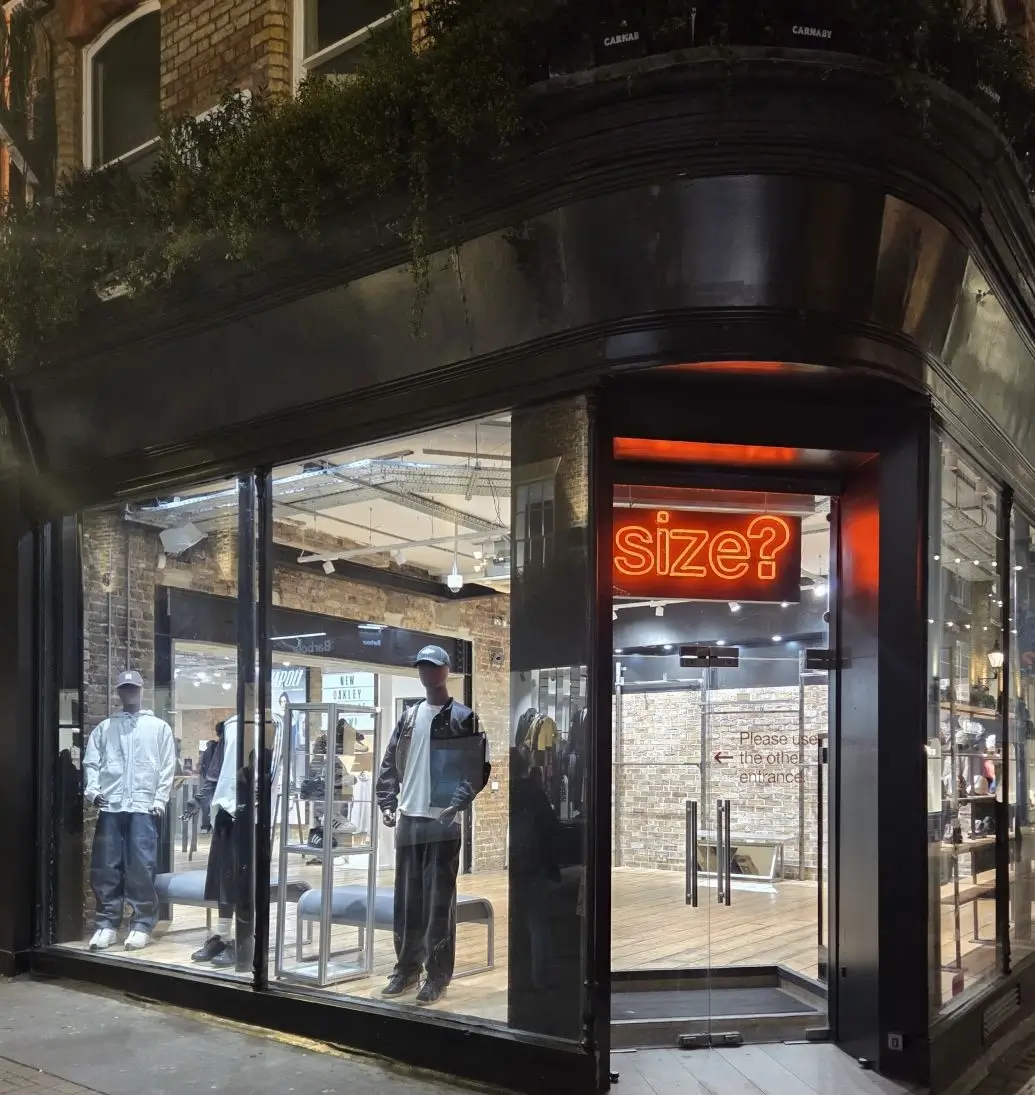




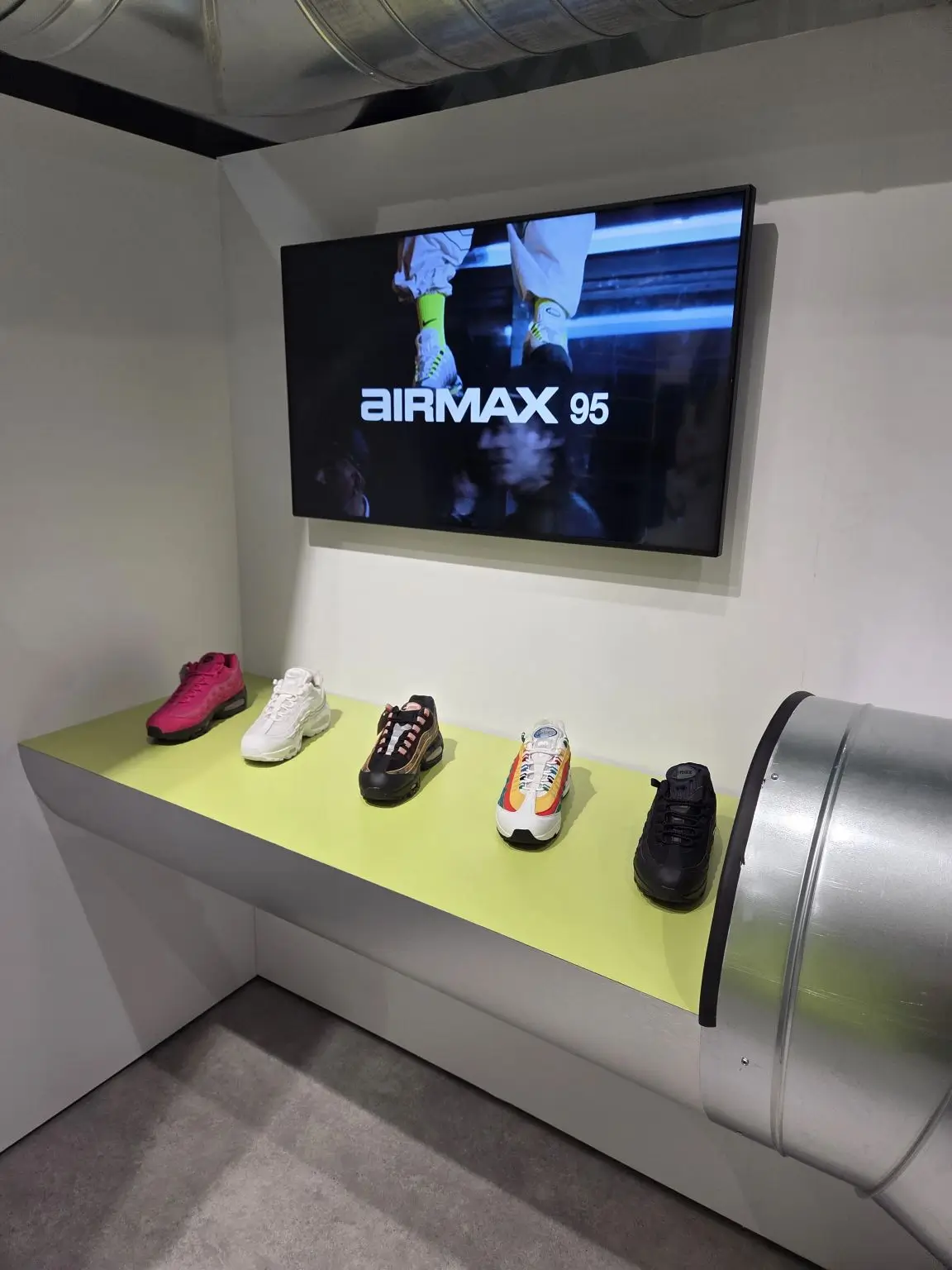
Inside size?’s Air Max installation, industrial airflow becomes architecture—
product, space, and narrative moving as one.
At the turn of the millennium, when shoe retail was still largely defined by volume and distribution rather than narrative or curation, size? emerged as something of an anomaly. Founded in 2000 under the umbrella of JD Sports Fashion, the concept was never meant to be a flagship in the traditional sense. It was, instead, a controlled risk—a retail laboratory designed to test what might happen if footwear was treated not simply as product, but as culture.
This framing matters. Because to understand size? today—its influence, its restraint, its quiet authority—you have to begin with the fact that it was never designed to dominate. It was designed to observe, refine, and respond.
Where JD Sports built scale through accessibility and breadth, size? was tasked with the inverse: to narrow the field, to edit, to select. Early stores in cities like London, Manchester, and Brighton weren’t just points of sale; they were microclimates of taste, embedded within urban environments where music, streetwear, and sport were already converging into something harder to categorize.
From the outset, the proposition was deceptively simple: fewer products, better choices, deeper stories.
before
The timing of size?’s arrival is critical. In 2000, sneaker culture had not yet crystallized into the globally synchronized hype economy we recognize today. There were no ubiquitous raffles, no algorithmic resale markets dictating demand in real time. Instead, there were regional scenes—fragmented, localized, and often insulated.
In the UK, this meant a sneaker culture shaped as much by terrace fashion and music subcultures as by basketball or American sports. Brands like Nike and adidas had deep roots, but their narratives were being interpreted through a distinctly British lens—one that favored subtlety, materiality, and a certain understatement.
size? stepped directly into that space.
Rather than attempting to import American hype cycles wholesale, it leaned into regional specificity. Its early assortments reflected an understanding that UK consumers didn’t necessarily want louder products—they wanted better contextualized ones. This meant colorways that felt grounded, materials that aged well, and silhouettes that carried history without needing explanation.
In this sense, size? was not simply selling sneakers. It was translating them.
View this post on Instagram
r & d
If size?’s origin can be described as experimental, its first decade can be understood as a prolonged period of testing—an iterative process in which retail itself functioned as a form of research.
Within the structure of JD Sports, size? occupied a unique position. It had access to the supply chains and brand relationships of a major retail group, but it operated with a degree of independence that allowed for risk. This meant it could:
- Introduce niche silhouettes before they had proven commercial viability
- Explore limited regional exclusives without the pressure of global rollout
- Build relationships with brands on a more editorial, less transactional basis
This last point is particularly important. While most retailers functioned as endpoints in the distribution chain, size? began to position itself as a collaborative partner. Its work with Nike, adidas, and later New Balance was not about co-branding for visibility. It was about co-authoring product narratives.
The result was a series of exclusives that felt less like marketing exercises and more like curatorial statements—projects rooted in geography, infrastructure, and everyday environments. Transport systems, city palettes, industrial materials—these became recurring motifs, grounding each release in something tangible.
What size? was effectively doing was redefining the role of the retailer. It was no longer just a conduit. It was becoming a producer of meaning.
idea
The physical retail environment played a crucial role in this evolution. Unlike larger-format sneaker stores designed for throughput, size? locations were intentionally restrained. Footwear was given space—both literally and conceptually.
Walls were often sparse. Displays were deliberate. The absence of clutter created a different kind of attention, one that encouraged inspection rather than impulse.
This approach aligned with the broader philosophy of the brand: slow down the experience to deepen the engagement.
Each store, while consistent in identity, also reflected its location. In London, there was an awareness of global influence; in Manchester, a connection to music and local subculture; in Brighton, a more relaxed, coastal sensibility. These nuances were subtle, but they reinforced the idea that size? was not imposing a singular aesthetic. It was adapting to context.
stir
As shoe culture entered the 2010s and began its transformation into a globalized, digitally accelerated ecosystem, size?faced a challenge. The very conditions that had allowed it to operate as a niche curator were disappearing.
Hype was becoming louder. Collaborations were multiplying. Social media was compressing timelines and amplifying visibility.
For many retailers, this shift resulted in a race toward scale and spectacle. But size? took a different approach. Rather than competing on volume or noise, it refined its core principles.
Exclusivity remained central, but it became more disciplined. Collaborations continued, but they avoided excess branding. Storytelling evolved, but it resisted becoming overly didactic.
In effect, size? doubled down on its original premise: that restraint could be a competitive advantage.
This positioning allowed it to maintain credibility even as the market expanded. It wasn’t chasing trends; it was filtering them.
new
By the mid-2020s, the sneaker industry had entered a period of recalibration. The explosive growth of the previous decade had led to saturation. Consumers, once driven by scarcity and resale value, were becoming more selective.
Several shifts began to define the landscape:
- A move away from overtly branded collaborations toward subtle design language
- Increased interest in heritage silhouettes and archival references
- Greater emphasis on materials, construction, and longevity
- A fatigue with constant drops and an appetite for considered releases
These changes did not disrupt size?. They validated it.
The retailer’s long-standing focus on quiet exclusivity and narrative depth suddenly aligned with broader consumer sentiment. What had once felt niche now felt prescient.