Review: Swang x Jordan Brand: Recasting the Golf Experience

March 26, 2026
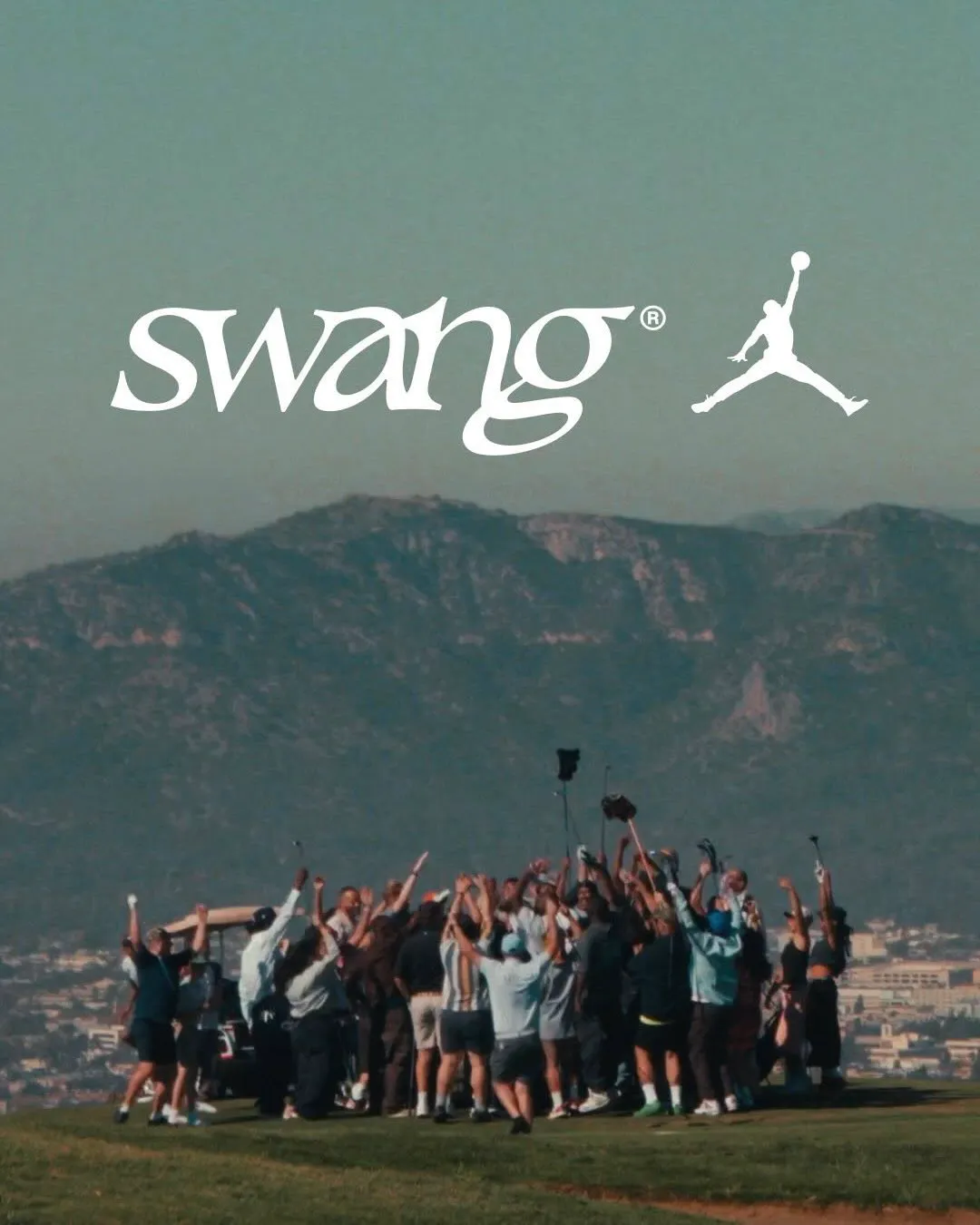
An emerging collective meets a legacy institution—where fairways become stages, and the dress code becomes dialogue.
The image of golf has long been preserved within a narrow visual language: manicured greens, hushed etiquette, polos tucked into pressed slacks. It is a sport defined as much by its codes as by its mechanics. Yet somewhere between the rhythm of city life and the open expanse of a driving range, a new cadence has been forming—one that resists quiet conformity in favor of expression.
Los Angeles-based swang arrives at this inflection point not as a disruption for disruption’s sake, but as a recalibration. Founded by Modi Oyewole, the collective reframes golf through the lens of culture rather than tradition. Showing up in Jordans instead of spikes, oversized silhouettes instead of tailored uniforms, and soundtracked rounds instead of silent ones, swang has cultivated a space where the game feels less like inheritance and more like participation.
Their newly announced multi-year partnership with Jordan Brand signals something more than cooperate. It marks an alignment between two entities that understand sport not just as competition, but as cultural infrastructure.
View this post on Instagram
idea
Since its inception, Jordan Brand has functioned as a bridge—translating performance into identity, and identity into global language. It took the language of basketball and extended it into fashion, music, and everyday life.
Golf, historically insulated from this kind of translation, presents a different challenge. It is slower, more codified, and often resistant to aesthetic deviation. Yet the same principles that elicited Jordan Brand to transcend the court—individuality, defiance, and narrative—are precisely the ones swang has been cultivating within golf.
Where Jordan Brand once redefined what basketball could look like, swang offers a blueprint for what golf could feel like.
infra
Swang’s emergence is less about style than it is about access. At its core, the collective addresses a longstanding tension within golf: the perception of exclusivity. Dress codes, membership barriers, and social expectations have historically dictated who belongs and who does not.
Oyewole’s approach prudently attempts to dissolve these barriers not through overt critique, but through invitation. By reframing the golf course as a social space—one where music plays, conversations flow, and clothing reflects personal identity—swang creates an environment where participation feels organic.
This is not golf stripped of its discipline, but golf recontextualized within contemporary culture. The swing remains technical, the game remains precise, but the atmosphere shifts. It becomes less about adherence and more about presence.
flow
One of the earliest manifestations of this philosophy is swang’s “FREE RANGE Thursdays.” On paper, the concept is simple: an open invitation to the driving range. In practice, it operates as a cultural gathering point.
Participants arrive not in uniformity but in variation—Jordans paired with relaxed tailoring, hoodies layered over polos, music weaving through the air. The range becomes a hybrid space, part training ground, part social forum. It is here that the partnership with Jordan Brand begins to materialize not as product placement, but as lived experience.
“FREE RANGE Thursdays” function as a ritual, one that subtly rewrites the expectations of the sport. There is no pressure to perform at a professional level, no emphasis on adherence to tradition. Instead, the focus shifts to participation, to learning, to simply being present.
loc
The geography of swang’s origin is not incidental. Los Angeles has long served as a testing ground for cultural synthesis. It is a city where sport, fashion, and music intersect with a fluidity that resists categorization.
Within this context, swang’s approach feels less like an anomaly and more like a natural extension of the city’s ethos. The golf course becomes another canvas—one that can absorb influences from streetwear, sound, and community without losing its core identity.
The partnership with Jordan Brand positions Los Angeles not just as a starting point, but as a reference. What begins in LA has the potential to scale globally, carrying with it the nuances of the city’s cultural fabric.
refine
Visual identity has always played a central role in how sports are perceived. In golf, this identity has remained largely static—rooted in tradition, resistant to reinterpretation. Swang challenges this stasis not through rejection, but through expansion.
The introduction of Jordans onto the course is emblematic of this shift. It is not merely a footwear choice; it is a statement about the permeability of boundaries. When a shoe historically associated with basketball enters the golf space, it carries with it an entire cultural lineage.
This lineage does not overwrite golf’s history, but it does complicate it. It introduces new references, new aesthetics, and new possibilities for how the sport can be seen and experienced.
commune
What distinguishes this partnership from conventional brand collections is its emphasis on community. Rather than centering product drops or limited releases, the focus is on activation—events, gatherings, and shared experiences.
This approach reflects a broader shift within contemporary brand strategy, where value is increasingly derived from participation rather than consumption. By investing in community-driven initiatives, swang and Jordan Brand create a feedback loop: the culture informs the product, and the product, in turn, supports the culture.
It is a model that prioritizes longevity over immediacy, depth over surface.
eco
Golf’s global growth has been well-documented, with increasing participation across diverse demographics. Yet growth alone does not guarantee transformation. Without a shift in perception, the sport risks expanding its reach without altering its core identity.
Swang’s role within this landscape is both symbolic and practical. Symbolically, it represents a break from exclusivity. Practically, it introduces new entry points—events that feel accessible, aesthetics that feel relatable, and narratives that resonate with a broader audience.
The partnership with Jordan Brand amplifies this impression, providing the resources and platform necessary to scale these initiatives beyond local contexts.
bal
One of the inherent tensions in any cultural movement is the balance between authenticity and growth. As swang steps into a larger spotlight, the challenge will be to maintain the intimacy and spontaneity that defined its early iterations.
Jordan Brand’s involvement introduces both opportunity and scrutiny. The brand’s global reach can elevate swang’s initiatives, but it also brings expectations—of consistency, of scalability, of alignment with a broader corporate identity.
Navigating this balance will be critical. The success of the partnership will depend not on how widely it expands, but on how faithfully it retains the ethos that made swang compelling in the first place.
stir
What swang proposes is not a rejection of golf’s traditions, but a re-tempoing. The game remains deliberate, its mechanics unchanged.
In this new rhythm, silence is no longer a requirement, and uniformity is no longer the default. Instead, the game opens itself to variation, to individuality, to the kinds of expressions that have long defined other sports.
chance
The significance of this partnership extends beyond golf. It reflects a broader cultural moment in which boundaries between disciplines are increasingly fluid. Sport, fashion, and lifestyle no longer operate in isolation; they intersect, inform, and reshape one another.
Swang and Jordan Brand sit at this intersection, using golf as a medium through which these dynamics can be explored. The result is not just a new way of playing the game, but a new way of thinking about it.
fwd
As the partnership unfolds, its impact will likely be measured not in immediate metrics, but in gradual shifts. More players showing up in shoes. More courses embracing relaxed atmospheres. More events that prioritize community over competition.
These changes may seem incremental, but collectively, they signal a redefinition of the sport’s cultural framework.
Swang’s journey from a local collective to a partner of Jordan Brand encapsulates this transition. It is a story of how small, intentional shifts can accumulate into broader transformation.
sum
Golf has always been a game of precision, of measured movements and calculated decisions. What swang introduces is a different kind of precision—one rooted in cultural awareness, in the understanding that how a sport is experienced is as important as how it is played.
The partnership with Jordan Brand does not seek to overwrite golf’s history, but to expand its possibilities. It invites a new generation to see the game not as a closed system, but as an open framework—one that can accommodate different styles, different sounds, and different ways of being.
In doing so, swang does not just step into a bigger spotlight. It changes the angle of the light itself.