Joan Mitchell’s Iva (1973): A Triptych of Memory, Gesture, and Lived Abstraction

March 27, 2026
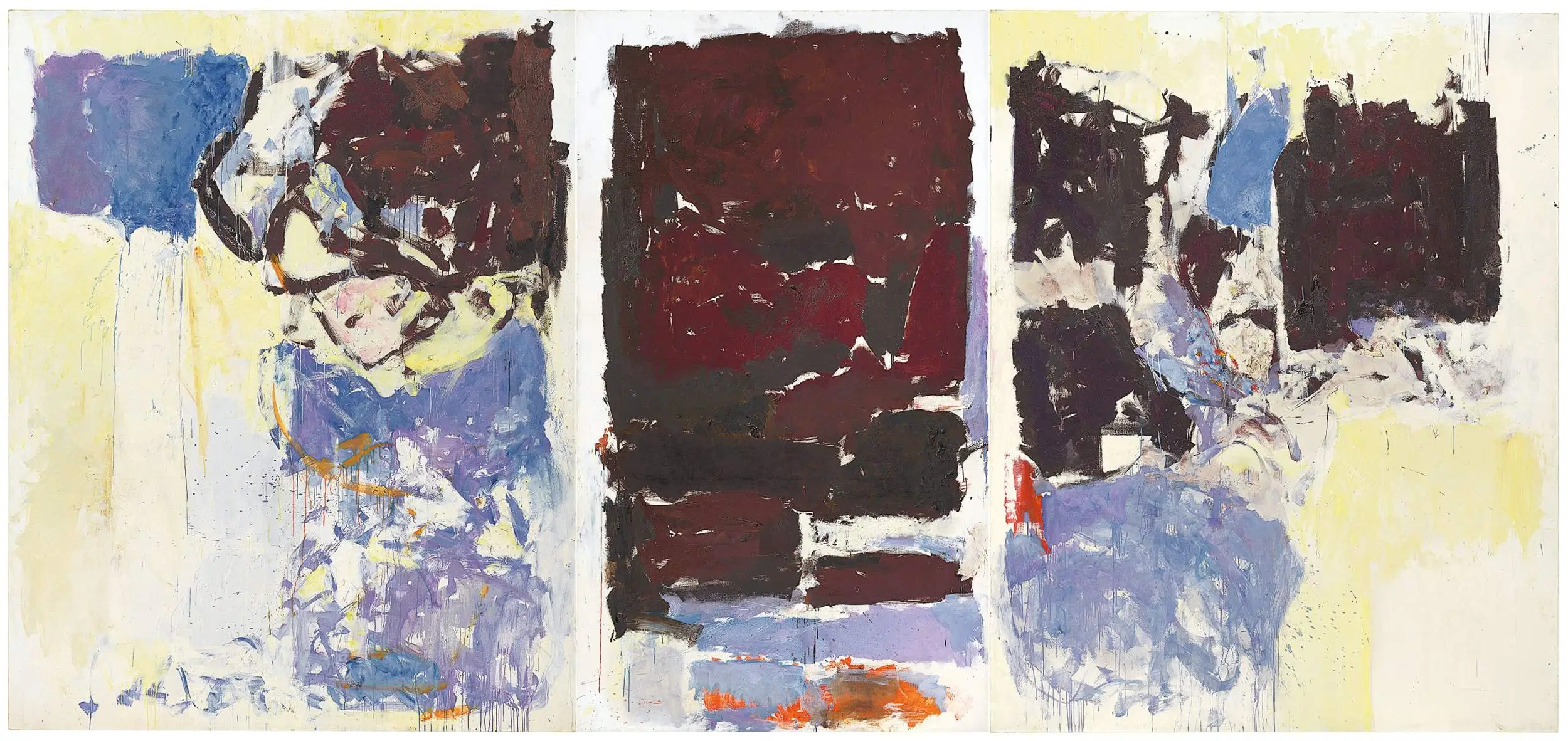
In 1973, Joan Mitchell entered a new phase of her practice that was as much about geography as it was about gesture. Having recently settled in Vétheuil, a village along the Seine in northern France, Mitchell encountered a landscape already saturated with art historical weight—most notably associated with Claude Monet, who had lived and painted there nearly a century earlier. Yet Mitchell’s Vétheuil was not a nostalgic return to Impressionism; it was an intensification of abstraction, memory, and sensation.
Iva, completed that same year, stands as the first in a sequence of paintings created in this new environment. It is not simply a painting tied to a location, but one that absorbs place into the logic of its surface. Named after Mitchell’s German Shepherd, the work introduces a rare intimacy into her otherwise non-figurative practice—an anchoring presence that complicates the boundary between abstraction and lived experience.
configure
Mitchell’s move to Vétheuil was decisive. The house, with its expansive grounds and proximity to the Seine, allowed her to work at a scale and intensity that her previous Paris studio could not accommodate. Here, the landscape was not something to be depicted directly, but something to be internalized.
Her paintings from this period do not replicate the horizon line or the river’s reflection. Instead, they translate sensation—the density of foliage, the rhythm of wind, the shifting tones of light—into layered, gestural fields of color. The environment becomes a condition rather than a subject.
Iva marks the beginning of this translation. It is a painting that feels rooted in place, yet refuses to describe it.
a presence
The decision to name the painting after her dog, Iva, introduces a personal dimension that is both subtle and profound. Animals appear infrequently in Mitchell’s titles, making Iva an exception that demands attention.
Rather than depicting the dog, the painting evokes presence through energy. The brushwork—urgent, directional, at times almost tactile—suggests movement, companionship, and proximity. There is a sense that the painting is not about the dog as an object, but about the experience of living alongside another being.
This distinction is critical. Mitchell’s abstraction does not isolate itself from the world; it absorbs it. The naming of Ivasignals that the emotional and sensory life of the artist remains embedded within the work, even when the image itself resists representation.
flow
At first encounter, Iva appears as a dense field of color and mark. But sustained looking reveals a compositional intelligence that organizes its apparent spontaneity.
Mitchell’s brushwork operates across multiple registers. There are sweeping gestures that establish directional flow, countered by shorter, more fragmented marks that accumulate into clusters. Color is layered rather than blended—applied in strokes that retain their autonomy while contributing to a larger visual rhythm.
The palette, characteristic of her early 1970s work, balances intensity with restraint. Greens, yellows, blues, and occasional flashes of red or orange interact in a way that suggests natural phenomena without describing them. The painting feels alive, but not illustrative.
This is where Mitchell diverges from earlier Abstract Expressionists. While her work shares the gestural energy of figures like Jackson Pollock, it resists the notion of the canvas as a purely autonomous field. Instead, it remains tethered—however loosely—to memory, place, and perception.
compare
Mitchell often described her paintings as rooted in memory rather than direct observation. She did not paint the landscape in front of her; she painted the remembered sensation of it.
Iva operates within this framework. The painting is not a depiction of Vétheuil, nor is it a portrait of her dog. It is a condensation of experience—a layering of moments, impressions, and emotional states.
This approach aligns her with a lineage that includes Willem de Kooning, whose work similarly oscillates between abstraction and reference. Yet Mitchell’s sensibility is distinct. Where de Kooning’s paintings often suggest figures dissolving into gesture, Mitchell’s remain resolutely non-figurative, even as they evoke the world beyond the canvas.
scale
One of the defining features of Iva is its scale. Mitchell’s canvases from this period are large enough to envelop the viewer, creating an experience that is less about viewing and more about entering.
Scale, for Mitchell, is not merely a formal choice—it is a way of structuring perception. The viewer does not stand outside the painting; they are implicated within it. The gestures, when seen up close, become almost bodily—extensions of the artist’s movement translated into paint.
In Iva, this immersion is heightened by the density of the surface. There are no empty areas, no pauses. The painting is continuous, demanding sustained attention.
the cycle
As the first painting in a new cycle, Iva establishes a set of concerns that Mitchell would continue to explore throughout the 1970s. These include the relationship between color and structure, the role of memory in abstraction, and the integration of personal experience into non-representational forms.
Subsequent works from this period expand on these ideas, often increasing in complexity and scale. Yet Iva retains a particular clarity—a sense of beginning that makes its gestures feel exploratory rather than resolved.
This openness is part of its significance. It captures a moment of transition, when Mitchell’s practice was recalibrating itself in response to a new environment.
show
In 1978, Iva was acquired by the city of Jacksonville, Florida—a testament to Mitchell’s growing recognition within institutional contexts. The painting entered a public collection, becoming accessible to audiences far removed from its origins in Vétheuil.
Its later sale at auction in 2018 marks another phase in its trajectory. Moving from public ownership to the private market, the painting reflects broader shifts in how postwar American art circulates and is valued.
These transitions do not alter the work itself, but they shape its reception. Each context—studio, museum, auction house—frames the painting differently, influencing how it is seen and understood.
stir
Joan Mitchell occupies a complex position within the history of Abstract Expressionism. Often grouped with the second generation of the movement, she nonetheless resists easy categorization.
Her work is neither purely gestural nor purely color-field. It inhabits a space between—where mark and color operate in tension, and where abstraction remains open to the world beyond itself.
In this sense, Mitchell’s paintings anticipate later developments in contemporary abstraction, where the boundaries between image, memory, and environment continue to blur.
Iva exemplifies this position. It is a painting that belongs to its moment, yet extends beyond it.
fwd
More than five decades after its creation, Iva continues to resonate. Its surface remains active, its gestures unresolved, its meanings open.
In a contemporary context, the painting can be read through multiple lenses: as a work of postwar abstraction, as a meditation on place, as an expression of personal attachment, or as a precursor to later developments in environmental and experiential art.
What remains constant is its ability to hold these readings simultaneously. Iva does not resolve into a single interpretation. It remains in motion.
sum
Iva is, in many ways, a beginning. The first painting in a new cycle, created in a new place, named for a companion that anchored the artist’s daily life.
Yet it is also a work that contains within it the seeds of Mitchell’s later practice. Its gestures, its scale, its integration of memory and environment—all point forward.
To look at Iva is to encounter a painting that resists closure. It invites the viewer into a field of sensation, where color, movement, and presence converge.
In that convergence, Mitchell achieves something rare: an abstraction that feels lived, inhabited, and continuous—like the landscape that inspired it, and the companion whose name it carries.