Bershka’s OUT OF CORE: A New Collection Mapping Youth Identity Beyond

March 27, 2026



a shift
There is a subtle recalibration happening within fast fashion—one that moves away from trend replication toward something closer to cultural mapping. With the launch of its OUT OF CORE collection, Bershka positions itself within that shift, reframing its relationship with youth culture not as a reactive force, but as a distributed network of identities.
The phrase “out of core” itself carries a layered implication. It suggests distance from established centers—geographic, aesthetic, and ideological. It signals a move outward, toward the margins where new styles, languages, and communities form before being absorbed into the mainstream. For Bershka, a brand historically associated with accessibility and rapid trend cycles, this is not a rejection of its foundation, but an expansion of it.
The collection does not attempt to define a singular look. Instead, it operates as a system—one that accommodates contradiction, fluidity, and the fragmented nature of contemporary identity.
View this post on Instagram
stir
OUT OF CORE reflects a broader understanding of youth culture as decentralized. In the past, style moved from identifiable hubs—cities, subcultures, scenes—into wider circulation. Today, those boundaries are less stable. Aesthetic references emerge simultaneously across platforms, geographies, and communities.
Bershka’s collection acknowledges this by avoiding overt allegiance to any one subculture. Instead, it pulls from a range of visual languages: utilitarian workwear, early-2000s nostalgia, skate-informed silhouettes, and digital-era minimalism.
Oversized fits dominate, but they are not uniform. Some pieces lean toward structured tailoring, others toward softness and drape. Fabrics vary from technical synthetics to washed cottons, creating a tactile diversity that mirrors the conceptual one.
This multiplicity is not accidental. It reflects a generation that navigates identity as a series of overlays rather than fixed categories.
collect
At the level of design, OUT OF CORE is defined by tension—between structure and looseness, visibility and subtlety, function and expression.
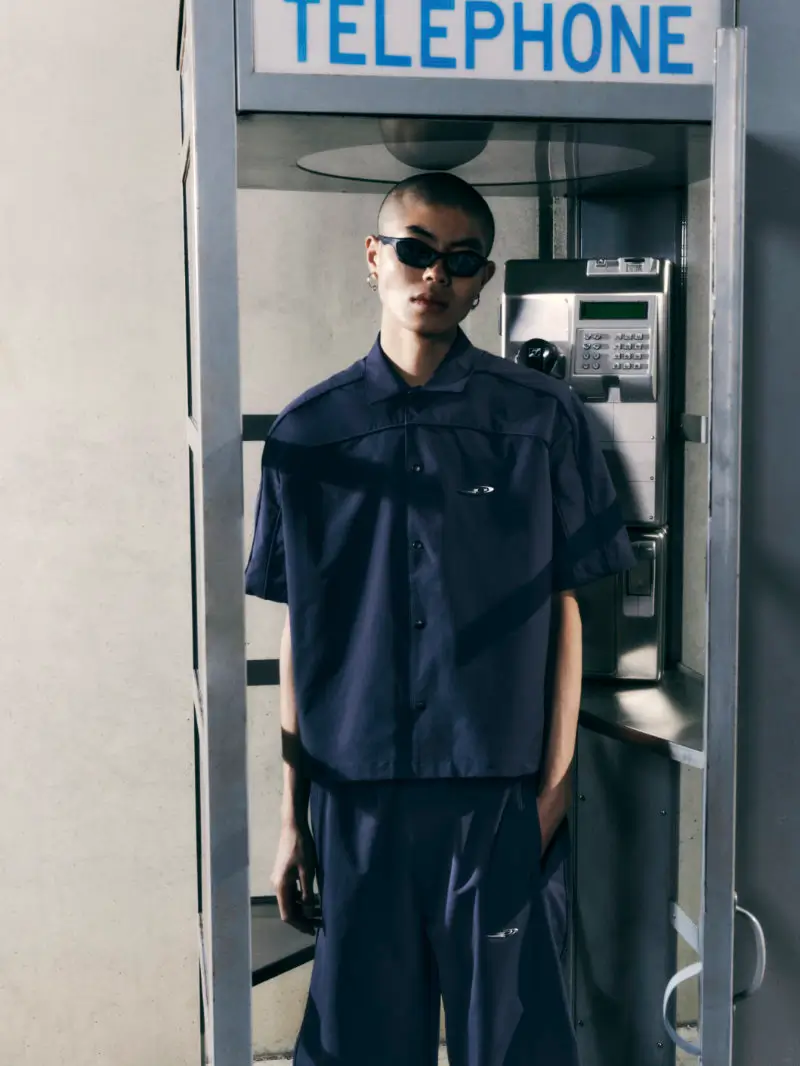
Cargo trousers appear alongside pared-back knits. Graphic tees coexist with nearly blank surfaces, where texture becomes the primary detail. Outerwear, often oversized, introduces volume that shifts the proportions of the body, creating silhouettes that feel both protective and performative.
Color plays a strategic role. Earth tones—khaki, muted greens, washed browns—anchor the collection, while intermittent bursts of brighter hues disrupt that grounding. The palette suggests a connection to environment, but one filtered through urban experience.
Details are restrained but intentional. Stitching, paneling, and layering create depth without overwhelming the garment. The result is clothing that invites interpretation rather than dictating it.
style
If the garments form the vocabulary of OUT OF CORE, styling becomes its syntax.
The lookbook imagery emphasizes layering—not simply as a functional choice, but as a narrative device. Pieces overlap, partially conceal one another, or extend beyond expected proportions. This creates a sense of incompleteness, as if each outfit is part of an ongoing process rather than a finished statement.
Footwear, often understated, grounds the looks. Sneakers and utilitarian shoes reinforce the collection’s connection to movement and everyday life. Accessories are minimal, allowing the garments themselves to carry the visual weight.
The models, diverse in appearance and presentation, are styled in ways that resist uniformity. There is no single “Bershka look” here. Instead, there are multiple entry points, each suggesting a different way of inhabiting the collection.
bal
The campaign accompanying OUT OF CORE occupies a space between studio precision and street-level immediacy.
Backgrounds are often minimal—neutral surfaces that allow the garments to stand out. Yet the poses and compositions introduce a sense of movement and spontaneity. Models lean, crouch, or shift their weight in ways that feel unposed, even within controlled environments.
This interplay reflects the collection’s conceptual foundation. Just as the clothing navigates between structure and fluidity, the imagery moves between constructed and candid.
Lighting is soft but directional, emphasizing texture and depth. Shadows are present, but not dramatic. The overall effect is one of clarity—an invitation to look closely at the details.
consider
Bershka’s OUT OF CORE arrives at a moment when fast fashion faces increasing scrutiny—environmental, ethical, and cultural. The brand’s response, as seen here, is not to abandon its model, but to refine its approach.
By focusing on versatility and longevity of style, the collection suggests a shift away from disposable trends. Pieces are designed to be combined, reinterpreted, and worn across contexts. This does not eliminate the challenges associated with fast fashion, but it indicates an awareness of them.
The emphasis on neutral palettes and adaptable silhouettes supports this direction. Rather than seasonal statements, the garments function as components within a broader wardrobe system.
role
As part of the Inditex portfolio, Bershka occupies a specific position—targeting younger consumers with a focus on accessibility and immediacy.
OUT OF CORE can be read as an evolution of that role. It retains the brand’s responsiveness to current aesthetics, but introduces a more considered framework. This aligns with broader shifts within Inditex, where brands are increasingly exploring ways to balance speed with sustainability and cultural relevance.
For Bershka, the challenge is to maintain its core identity while expanding its conceptual range. OUT OF CORE represents a step in that direction.
show
The visual language of OUT OF CORE is deeply informed by digital culture. Platforms like TikTok and Instagram have accelerated the circulation of style, creating a feedback loop where trends emerge, evolve, and dissipate at unprecedented speed.
The collection responds to this by embracing fragmentation. Rather than presenting a cohesive, unified aesthetic, it offers a series of fragments—each capable of existing independently or in combination.
This approach mirrors the way users engage with fashion online. Outfits are assembled from disparate influences, often documented in isolated moments rather than continuous narratives.
OUT OF CORE translates this behavior into physical form.
position
Bershka’s OUT OF CORE occupies a complex position within the fashion landscape. It is both a mass-market collection and a gesture toward deeper cultural engagement.
This duality is not easily resolved. Fast fashion, by definition, operates at scale, often prioritizing speed and accessibility over nuance. Yet OUT OF CORE suggests that these priorities can coexist with a more thoughtful approach to design and storytelling.
The collection does not claim to redefine fashion. Instead, it situates itself within an ongoing conversation—one that acknowledges the fluidity of identity, the influence of digital culture, and the need for adaptability.
fwd
Early responses to OUT OF CORE indicate a positive reception, particularly among younger consumers who recognize its alignment with their own experiences of style.
The collection’s success will ultimately depend on its ability to sustain this relevance—whether Bershka can continue to evolve its approach without losing the immediacy that defines it.
Future iterations may expand on the themes introduced here, exploring new materials, collaborations, or narrative frameworks. The concept of “out of core” itself offers a flexible foundation, capable of accommodating ongoing change.
fin
Bershka’s OUT OF CORE is less a collection than a proposition.
It proposes that fashion can operate beyond fixed centers—geographic, aesthetic, or conceptual. It suggests that identity is not singular, but layered, and that clothing can reflect this complexity without resolving it.
In doing so, Bershka positions itself not as a leader of trends, but as a participant in a broader cultural network.
OUT OF CORE does not offer definitive answers. Instead, it creates space—space for interpretation, for movement, for the continual redefinition of what fashion can be.