ABCNT’s Seppuku: A Measured Tension Between System and Break

March 29, 2026
1 hour ago
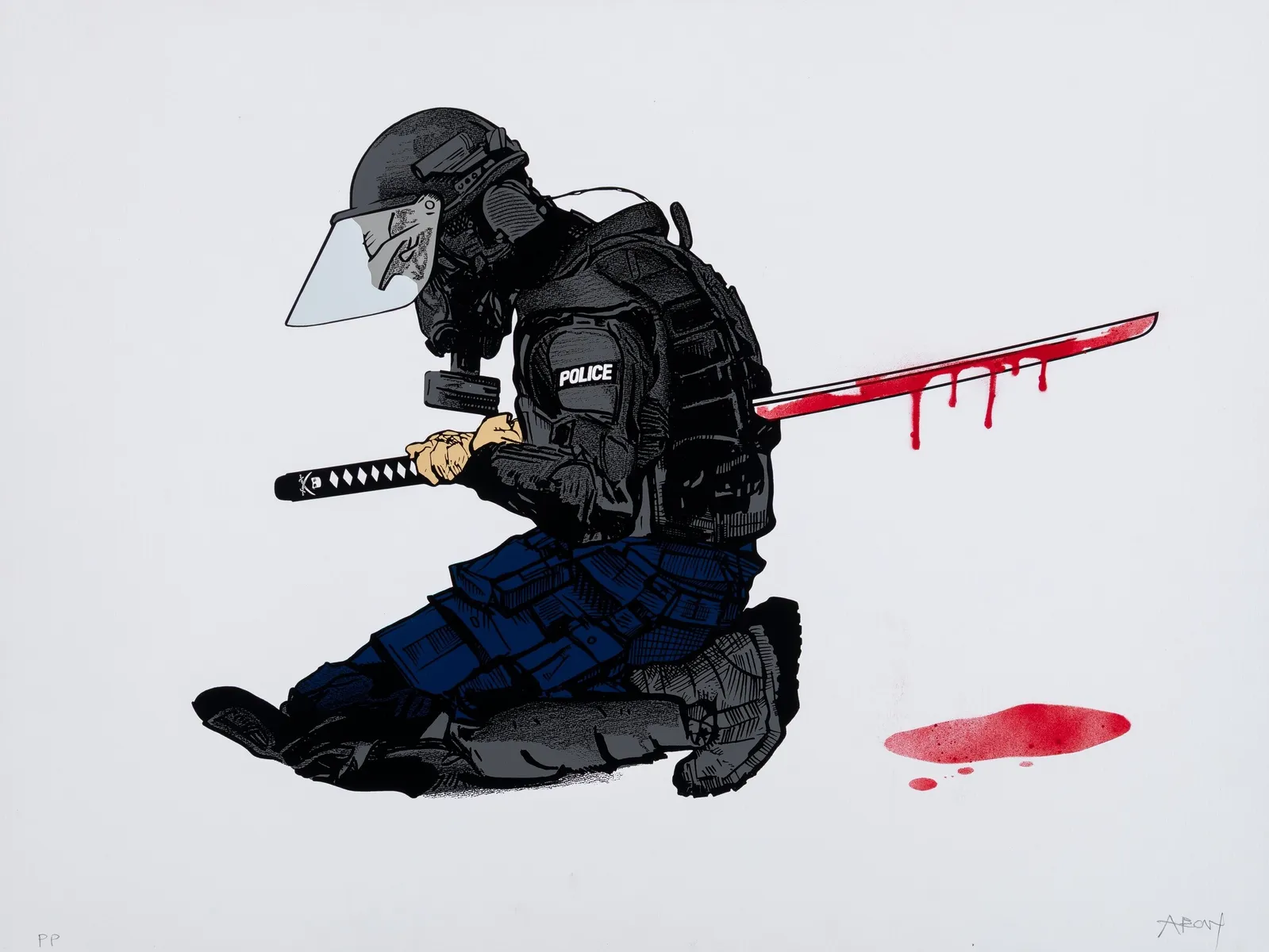
There are works that ask to be understood, and there are works that resist that impulse entirely—choosing instead to be felt, confronted, even misread. Seppuku, a screenprint in colors with hand-embellishments on fine art paper by ABCNT, belongs to the latter. It doesn’t offer clarity so much as it stages tension: between surface and meaning, repetition and rupture, discipline and defiance.
The title alone carries weight. “Seppuku” invokes ritualized self-destruction, historically rooted in Japanese samurai culture, where the act becomes a performance of honor, control, and final authorship over one’s own narrative. In contemporary art, such a term arrives already charged—layered with history, misinterpretation, and the risk of aestheticizing something inherently violent. Yet ABCNT’s approach doesn’t dwell in literal representation. Instead, the work abstracts the idea of rupture into material language: ink, gesture, layering, interruption.
This is not about depicting the act. It is about staging its echo.
stir
At its core, Seppuku begins with screenprinting—a process defined by repetition, registration, and mechanical precision. Traditionally associated with both commercial production and pop art, the medium carries an inherent duality: it is capable of infinite reproduction, yet each pull of ink retains subtle variation.
ABCNT leans into this tension. The base image—structured, graphic, likely composed of bold color fields and sharply defined forms—suggests control. It suggests a system. Screenprinting, after all, is about layers applied in sequence, each color locked into place through careful alignment.
But here, that system becomes something to disrupt.
Because over the printed surface come the hand-embellishments: gestures that refuse uniformity. They interrupt the clean logic of the print, introducing irregularity, texture, and evidence of the artist’s presence. Where the screenprint speaks in multiples, the embellishment speaks in singulars.
This interplay is where the work begins to breathe.
style
The addition of hand-embellishment shifts the ontology of the piece. It is no longer simply a print—it becomes a hybrid object, suspended between edition and original. Each iteration carries the same underlying structure, but the surface variations ensure that no two works are entirely identical.
In the context of Seppuku, this feels deliberate.
If screenprinting represents system, repetition, perhaps even societal expectation, then the hand becomes interruption—a break in continuity. A refusal to remain within prescribed boundaries. The gesture may appear minimal—a stroke, a mark, an added layer of pigment—but conceptually, it is decisive.
It is the moment where control fractures.
There is something almost performative in this act. The artist revisits the printed surface, not to refine it, but to disturb it. To insist that even within a controlled framework, deviation is inevitable.
And perhaps necessary.
show
Color in Seppuku does not function passively. It is not merely decorative; it operates as signal, as tension, as emotional register. Screenprinting elicits for saturation—fields of color that are dense, opaque, and immediate. These are not gradients that dissolve into one another. They are statements.
Depending on the palette—either it leans into stark contrasts or unexpected harmonies—the work can oscillate between aggression and restraint. Bold reds may suggest urgency or violence; deep blacks can anchor the composition in gravity; unexpected hues disrupt any straightforward reading.
But it is in the layering that color becomes most active.
Each pass of ink sits atop another, creating a hierarchy of surfaces. Some colors dominate, others recede. The hand-applied elements further complicate this, introducing tones or textures that sit outside the printed logic.
The result is not a stable image, but a field of negotiation.
idea
Fine art paper, often overlooked in casual viewing, plays a critical role here. Its weight, its texture, its ability to hold ink and pigment—all contribute to the physical presence of the work.
In Seppuku, the paper is not simply a support. It is part of the event.
Screenprinted ink sits differently on paper than hand-applied media. It has a certain flatness, a crispness at the edges. Hand embellishment, by contrast, can soak into the fibers, sit atop them, or even disrupt them. The interaction between these materials creates a tactile dimension that resists digital translation.
This is a work that asks to be seen in person—not just visually, but materially.
The surface becomes a record of actions: mechanical, then manual. Predictable, then unpredictable.
tradition
To engage with the title Seppuku is to engage with the idea of ritual. But ABCNT does not illustrate ritual in any literal sense. There are no figures, no narrative scenes, no explicit references to historical imagery.
Instead, ritual is translated into process.
Screenprinting itself becomes ritualistic: the repeated act of layering ink, the precision required, the sequence that must be followed. The hand embellishment then interrupts this ritual, introducing a second, less predictable set of actions.
The work, therefore, embodies two competing rituals: one of control, one of disruption.
This duality mirrors the tension embedded in the title. Seppuku, as an act, is both controlled and violent, disciplined and final. ABCNT abstracts this contradiction into material terms, allowing the viewer to feel the tension without being directed toward a specific interpretation.
lang
There is often a view language in contemporary screenprinting that draws from pop art—bold graphics, high contrast, accessible imagery. ABCNT appears to engage with this lineage, but not to replicate it.
Instead, the work feels like a rewiring of that language.
Where pop art often embraced repetition as commentary on mass culture, Seppuku uses repetition as a baseline only to destabilize it. The familiar becomes slightly off. The clean graphic edge becomes interrupted. The expected rhythm breaks.
This subtle destabilization is key. It prevents the work from settling into comfort. Even if the imagery initially feels recognizable, the longer one looks, the more it resists easy categorization.
It becomes something else entirely.
sig
Screenprinting complicates authorship by its very nature. It allows for multiple impressions, each theoretically identical. Hand embellishment reasserts the artist’s presence, marking each piece as unique.
In Seppuku, this dynamic becomes central.
Who is the author of the work—the system or the hand? The print or the gesture? The edition or the variation?
ABCNT seems less interested in resolving this question than in holding it open. The work exists in a space where authorship is layered, not singular. It acknowledges the role of process, of medium, of repetition, while also insisting on the irreducibility of the individual mark.
This layered authorship mirrors broader questions in contemporary art: about originality, reproduction, and the value of the unique object in a world of endless duplication.
subject
What ultimately defines Seppuku is not any single element—color, composition, technique—but the tension between them.
The work does not resolve its contradictions. It sustains them.
Mechanical precision meets manual intervention. Repetition meets variation. Surface meets disruption. Title meets abstraction.
This refusal to resolve is what gives the piece its energy. It keeps the viewer in a state of engagement, of questioning. There is no final reading to arrive at, no singular meaning to extract.
Instead, the work functions as a site of ongoing negotiation.
germaine
Within the broader landscape of contemporary printmaking, Seppuku occupies an interesting position. It acknowledges the history of screenprinting—from its commercial origins to its elevation within fine art—while pushing against its limitations.
The addition of hand embellishment is not new, but in this context, it feels purposeful rather than decorative. It is not about adding value through uniqueness alone. It is about altering the logic of the medium itself.
In a time where digital reproduction dominates viewed culture, works like this reassert the importance of materiality. They remind us that art can still exist as object, as surface, as something that carries the trace of its making.
fin
Seppuku by ABCNT is a work that operates through contradiction. It is structured yet disrupted, repeatable yet singular, visually immediate yet conceptually layered.
It does not illustrate its title. It translates it.
Through the interplay of screenprint and hand embellishment, the work stages a dialogue between system and rupture, between control and its inevitable breakdown. It asks what happens when a process designed for uniformity is deliberately unsettled—and what remains in the aftermath.
What remains, perhaps, is not clarity, but presence.
A surface that records both intention and interruption.
A composition that refuses to settle.
A work that continues to unfold, even after the final layer has been applied.