Robert Cottingham’s Fox (2009) and the Architecture of American Signage

March 29, 2026
3 hours ago
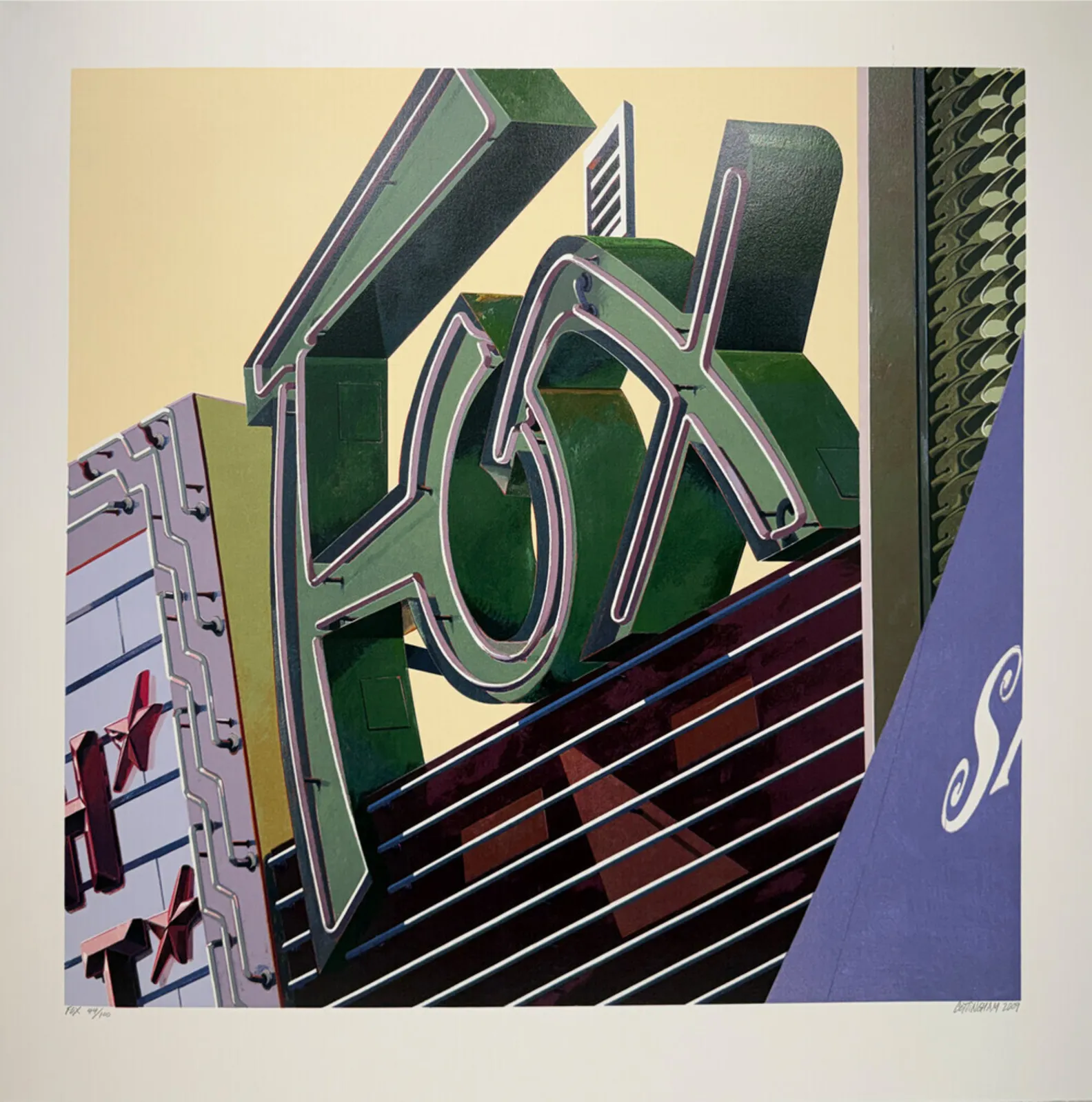
Within the quiet persistence of American visual culture, there exists a category of object that is both overlooked and unforgettable: the commercial sign. Not quite architecture, not quite typography, and certainly not neutral, the sign occupies a charged middle ground between commerce and memory. In the work of Robert Cottingham, this space becomes the central theater of artistic inquiry. His 2009 screenprint Fox, from the American Signs Portfolio, distills decades of observation into a singular, monumental rendering of mid-century signage—precise, saturated, and quietly elegiac.
frame
The American Signs Portfolio (2009) is a suite of twelve screenprints that revisit and reinterpret Cottingham’s most iconic motifs. These works translate his earlier photorealist paintings into silkscreen form, creating a bridge between singular painted objects and reproducible editions.
Each print functions as both continuation and recontextualization. The portfolio gathers familiar subjects—marquees, neon signage, storefront typography—and renders them with renewed clarity and graphic precision. The transition from painting to screenprint is not merely technical; it is conceptual. The democratic nature of printmaking aligns with the commercial origins of the signs themselves.
Fox, as part of this series, carries this logic forward. It is not just a depiction of signage—it is signage reimagined through a medium historically tied to reproduction and dissemination.
show
At first glance, Fox appears deceptively simple: a cropped view of a theater sign, its bold lettering dominating the frame. Yet this simplicity is carefully constructed. Cottingham’s signature approach involves isolating fragments—letters, surfaces, edges—removing them from their architectural context and presenting them as autonomous compositions.
The word “FOX” becomes both subject and structure. The letters are not merely read; they are experienced as forms. Their scale is exaggerated, their edges sharpened, their surfaces rendered with meticulous attention to light and texture. The cropping eliminates narrative distraction. There is no street, no sky, no surrounding environment—only the sign, suspended in a kind of timeless viewable field.
This isolation transforms the sign into a monument. It no longer advertises; it exists.
demeanor
One of the defining characteristics of Fox is its chromatic intensity. The print features bold greens, deep purples, and saturated reds—colors that evoke the glow of neon without directly depicting illumination.
Cottingham’s color palette operates on two levels. On one hand, it captures the view impression of mid-century signage, designed to attract attention in urban environments. On the other, it introduces a subtle sense of temporal distance. The colors feel slightly heightened, almost too perfect, suggesting not the sign as it exists, but the sign as it is remembered.
This tension between immediacy and memory is central to Cottingham’s work. The signs he depicts are often aged, weathered, or no longer in use. Yet in his prints, they are restored—clean, vivid, and precise. The result is a paradox: images of decay rendered with immaculate clarity.
hault
Cottingham is often associated with photorealism, a movement that emerged in the late 1960s and 1970s, characterized by its use of photographic reference and meticulous detail. However, his work complicates this classification.
While Fox exhibits the precision associated with photorealism, it also pushes toward abstraction. The tight cropping, the emphasis on flat planes, and the reduction of context all contribute to a composition that is as much about form as it is about representation.
In this sense, Fox operates at the boundary between realism and abstraction. The letters are legible, the sign recognizable, yet the overall image resists narrative interpretation. It becomes a study in shape, color, and surface—a painting (or print) about seeing as much as about what is seen.
culture
The subject of Fox—a theater sign—carries its own cultural weight. The Fox Theatre name has been associated with a network of grand movie palaces across the United States, many of which were built in the early 20th century and later fell into decline.
By focusing on this specific type of signage, Cottingham taps into a broader narrative of American entertainment history. The theater sign is not just a commercial object; it is a symbol of collective experience—of cinema, of public gathering, of urban life.
In isolating the sign, Cottingham both preserves and transforms it. The absence of context allows the viewer to project their own associations onto the image. The sign becomes a placeholder for memory, a fragment of a larger cultural story.
sawn
Fox is a large-scale work, typically measuring around 40 by 39 inches (approximately 101.6 × 99.1 cm).
This scale is significant. It examples the viewer to engage with the image physically, to experience the letters as objects rather than symbols. The size reinforces the monumentality of the sign, echoing its original presence in the urban landscape.
At the same time, the flatness of the screenprint medium emphasizes the image’s constructed nature. The viewer is constantly cognizant of the tension between the illusion of depth and the reality of the printed surface.
type
As a screenprint in colors on wove paper, Fox exists as part of a limited edition, often around 100 impressions, with additional artist proofs.
This editioned nature introduces another layer of meaning. The work is both unique (as an individual impression) and multiple (as part of a series). This duality mirrors the original function of signage—mass-produced yet site-specific, standardized yet embedded in particular locations.
The use of screenprinting also enhances the clarity and saturation of the image. The medium allows for precise color separation and layering, resulting in the crisp edges and vibrant hues that define Cottingham’s aesthetic.
praxis
Cottingham’s process is rooted in observation. He often photographs signs, sketches them, and studies their details before translating them into paintings or prints. However, the final image is not a direct reproduction of any single photograph.
Instead, it is a reconstruction—a synthesis of multiple observations, adjusted and refined to achieve a particular visual effect. This approac admits Cottingham to emphasize certain elements while minimizing others, creating compositions that are both accurate and idealized.
In Fox, this process is evident in the precision of the lettering, the controlled color palette, and the absence of extraneous detail. The sign is not presented as it exists in the world, but as it exists in the artist’s vision.
american
One of the most compelling aspects of Cottingham’s work is its engagement with American sawn language. The signs he depicts are not just objects; they are carriers of meaning, shaped by decades of commercial design, technological innovation, and cultural change.
The typography of Fox reflects a particular moment in design history—a time when bold, legible lettering was essential for visibility in crowded urban environments. The sign’s aesthetic is both functional and expressive, balancing clarity.
By isolating and magnifying these elements, Cottingham invites the viewer to reconsider their significance. The sign becomes a text to be read, not for its literal message, but for its formal qualities and cultural implications.
anticip
Works from the American Signs Portfolio, including Fox, have appeared in galleries and auctions, reflecting sustained interest in Cottingham’s practice. Auction results for similar prints from the series typically fall within a modest but consistent range, underscoring their accessibility relative to unique paintings.
This accessibility aligns with the ethos of printmaking, offering a broader audience to engage with the work. At the same time, the limited edition ensures a degree of exclusivity, maintaining the work’s status within the art market.
bal
What distinguishes Fox from purely nostalgic imagery is its restraint. Cottingham does not romanticize the past; he reconstructs it with clinical precision. The absence of context prevents the work from becoming sentimental.
Instead, the nostalgia in Fox is subtle, almost ambient.
This ambiguity is central to the work’s power.
sum
In Fox (2009), Robert Cottingham achieves a delicate balance between representation and transformation. The screenprint captures the essence of a specific sign while elevating it into a broader meditation on perception, memory, and American view culture.
The work stands as a testament to the enduring significance of everyday objects. In Cottingham’s hands, the commercial sign becomes something more than functional—it becomes a site of reflection, a fragment of history, and a study in form.