A Crocodile, Recalibrated: Pierre Gasly Steps Into Lacoste

April 8, 2026
1 hour ago
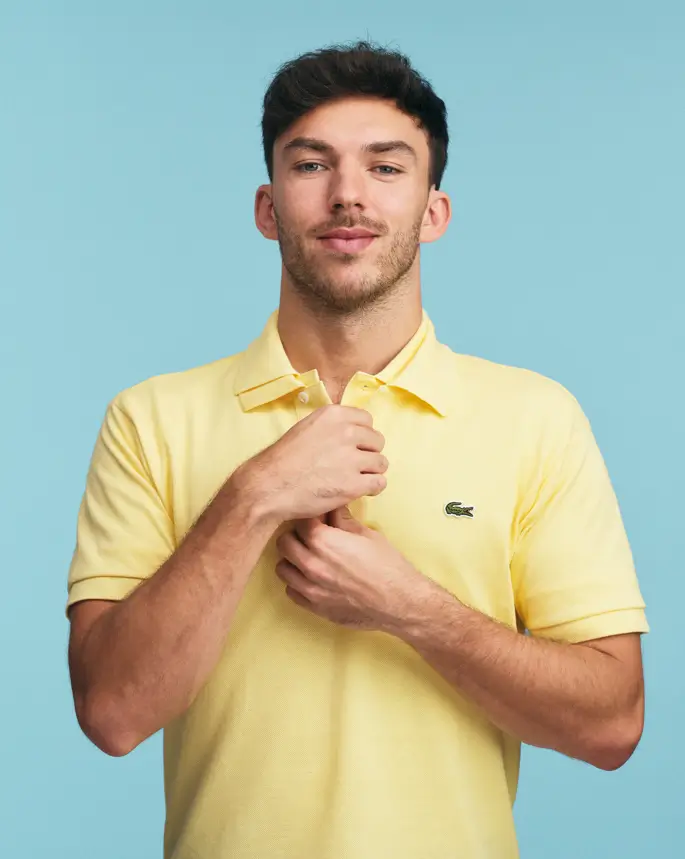
There are partnerships that feel engineered, and then there are those that arrive with a kind of cultural inevitability. The alignment of Pierre Gasly with Lacoste belongs to the latter category—a meeting point between precision sport and a maison that has long treated athleticism not as performance alone, but as a language of style.
Gasly, now one of the defining French presences in modern Formula 1, enters Lacoste not simply as a face but as a continuation of a lineage. A lineage that traces back to René Lacoste himself—a player who understood that sport could extend beyond the court, into the way one carries themselves in the world.
At the center of this collaboration sits a single object: the polo shirt. Not as a product, but as an idea.
View this post on Instagram
flow
There is something deceptively simple about the Lacoste polo. Cotton piqué, a structured collar, the small embroidered crocodile. But simplicity, in this case, is the result of decades of refinement. The shirt, first introduced in the 1930s, was designed to liberate movement—to replace the rigidity of traditional tennis attire with something breathable, functional, and quietly radical.
Over time, it detached itself from the court. It moved through decades, subcultures, geographies. It became shorthand for a certain kind of ease: composed but never overstated, athletic but not performative.
When Gasly speaks of the polo as “a symbol of effortless elegance,” he isn’t repeating a brand line. He’s identifying its duality. The garment exists between worlds. Sport and leisure. Discipline and relaxation. Heritage and reinvention.
That duality mirrors his own trajectory.
follow
Born in Rouen in 1996, Gasly’s introduction to speed came early—karting at six, an age where instinct often precedes intention. Motorsport, unlike many disciplines, reveals its demands quickly. It is not just about talent, but about calibration: reflexes, endurance, psychological control.
Gasly moved through the junior ranks with a steadiness that would later define his Formula 1 career. By 2017, he made his debut in the sport’s highest tier. What followed was not a linear ascent, but something more complex—moments of acceleration punctuated by recalibration.
In 2019, at the Brazilian Grand Prix, he became the youngest French driver to stand on a Formula 1 podium. It was a result that felt both improbable and precise, a race defined by split-second decisions and an almost architectural sense of positioning.
Then came 2020. Italian Grand Prix. Monza, a circuit synonymous with velocity, delivered something else that year: interruption. Chaos. Opportunity. Gasly seized it with clarity, securing his first Formula 1 victory—and with it, the first French win in the sport since 1996.
The narrative writes itself easily. Redemption, breakthrough, arrival. But what’s more compelling is how Gasly carries those moments—not as spectacle, but as structure.
stir
Formula 1 is often described in terms of extremes. Speed, risk, technology. But beneath that surface lies an obsession with detail. Micro-adjustments. Marginal gains. The difference between positions measured in fractions of a second.
This is where Gasly aligns with Lacoste—not in the obvious shared language of sport, but in their mutual relationship to precision.
Lacoste, at its best, operates in a similar register. It refines rather than reinvents. It adjusts proportion, fabric, color, context. The polo shirt remains recognizable across decades, yet never static.
Gasly embodies that philosophy. On track, his performance is built on calibration. Off track, his presence is defined by restraint. There is a clarity to his style—clean lines, considered choices, an understanding that impression does not require excess.
In this way, the merge feels less like an endorsement and more like a translation.
frame
There is an specific tension within French style—a balance between tradition and modernity, between formality and ease. Lacoste has long occupied a unique position within that spectrum. It is neither strictly image nor purely sport. It exists in the space between.
Gasly brings a contemporary dimension to that identity.
He represents a generation of French athletes who operate globally but remain anchored in a certain cultural sensibility. His career unfolds across continents, yet his aesthetic—both literal and metaphorical—retains a kind of French clarity.
This is not about nationalism. It’s about continuity. About how certain codes persist, even as contexts shift.
The crocodile, in this sense, becomes less a logo and more a symbol of adaptation.
from
In recent years, the role of the athlete has expanded. No longer confined to performance, athletes now operate as cultural figures—navigating fashion, media, and identity with increasing fluency.
Gasly fits within this evolution, but without overstating it.
There is a measured quality to his public presence. He does not attempt to dominate the conversation. Instead, he occupies it selectively, allowing moments to accumulate rather than forcing them into narrative.
This aligns with Lacoste’s own repositioning. The brand has, over the past decade, shifted from a heritage staple to a more fluid cultural entity—collaborating with designers, engaging with younger audiences, and recontextualizing its archive.
Gasly becomes part of that strategy, but also something more nuanced: a stabilizing figure. Someone who brings credibility without disruption.
consider
At the center of all this remains the polo shirt.
It is easy to overlook, precisely because it is so familiar. But familiarity, in fashion, is often where the most interesting work happens. How does a brand maintain relevance without abandoning its core? How does it evolve without erasing its past?
Lacoste’s answer has been to treat the polo not as a fixed object, but as a platform.
Different cuts, materials, collaborations, contexts. The shirt adapts, but its essence remains intact.
Gasly’s involvement reinforces that approach. He does not transform the polo into something else. Instead, he reframes it—placing it within the context of contemporary sport, modern masculinity, and a more fluid understanding of style.
campaign
Gasly’s own words point toward something ongoing: “I am eager to bring this collaboration to life through new projects in the coming months.”
This suggests a partnership that extends beyond imagery. Potentially into design input, storytelling, or new forms of engagement.
Lacoste, historically, has understood the value of continuity. Its most successful moments are rarely singular campaigns, but sustained narratives.
Gasly offers that possibility. A figure whose career is still unfolding, whose identity is not yet fixed.
In this way, the collab remains open-ended.
idea
If there is a unifying thread between Gasly and Lacoste, it is movement.
Not just physical movement—the velocity of a Formula 1 car, the motion of a tennis player—but cultural movement. The way ideas travel, evolve, and reappear in new forms.
The polo shirt, once a functional innovation, becomes a cultural constant. Gasly, once a karting child in Rouen, becomes an ambassador for a global maison.
These trajectories intersect not by coincidence, but by alignment.
end
There is a tendency, in fashion and sport alike, to focus on moments—wins, launches, campaigns. But what endures is not the moment itself, but the structure it contributes to.
Gasly’s partnership with Lacoste is less about a single image and more about a longer narrative. One that connects past and present, performance and style, individuality and tradition.
The crocodile remains. The polo remains. But their meaning continues to shift.
And now, with Gasly, it shifts again—quietly, precisely, and with intent.