There is a specific category of accessory that does not rely on declaration to assert its presence. It enters a wardrobe gradually, almost imperceptibly, until it becomes indispensable—not because it dominates, but because it resolves. The A–Esque Midi Cloud Bag in Grain White Wash operates within that quieter register, where design is less about statement and more about calibration. Every curve, every fold, every tonal decision appears considered, then softened, then reconsidered again.
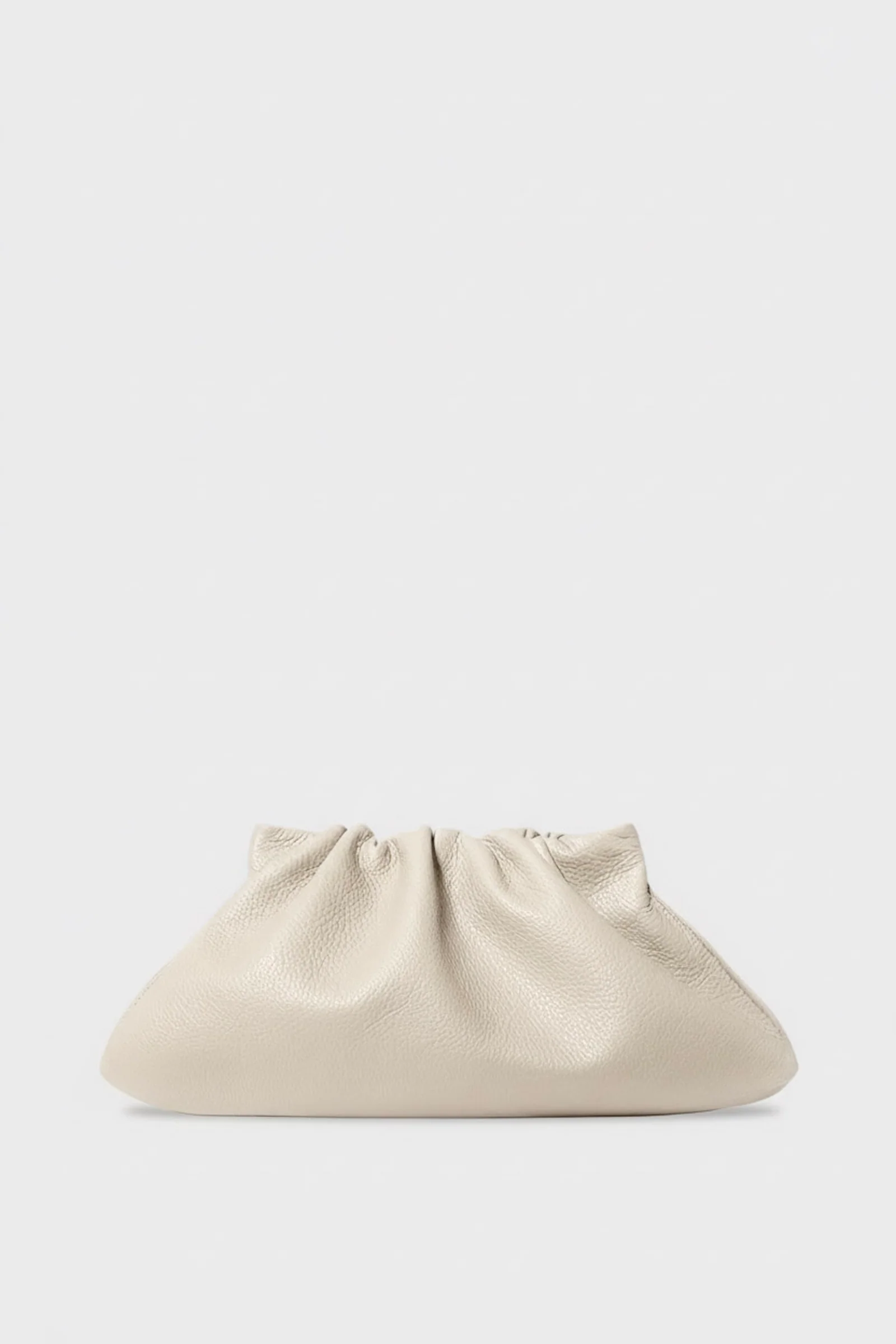
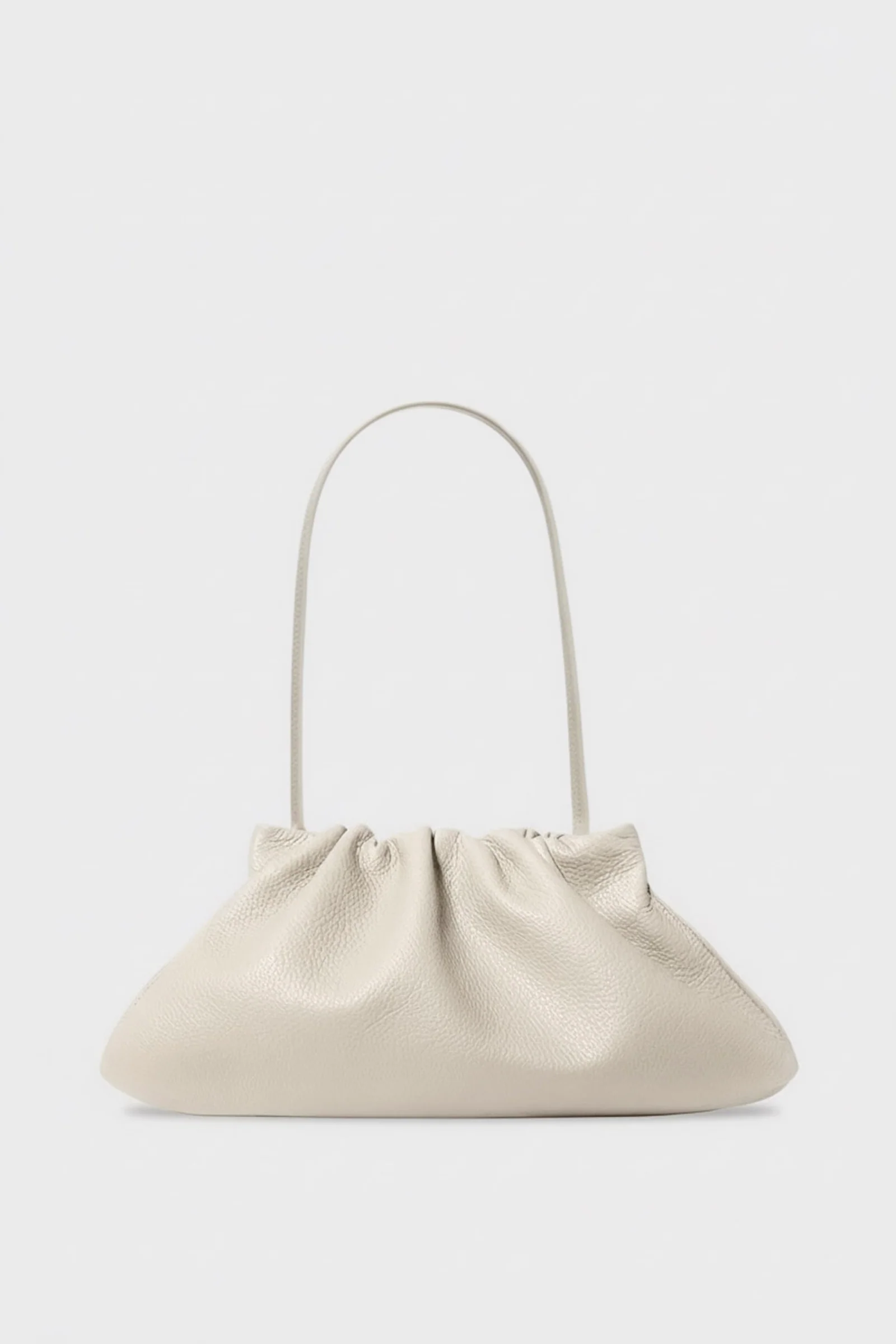
The silhouette is immediately recognizable yet deliberately unresolved. It sits somewhere between a pouch and a shoulder bag, resisting strict categorization. Its gathered body produces a sense of volume that feels organic rather than constructed, as if the leather has naturally settled into place. This is where the “cloud” analogy becomes precise rather than poetic—the bag carries an impression of air, of suspension, of something that holds shape without appearing to enforce it.
idea
Softness in design often risks collapsing into formlessness. What distinguishes the Midi Cloud Bag is its control. The gathering mechanism—subtle, almost concealed—creates tension points that guide the silhouette without hardening it. This tension is what allows the bag to retain presence. It neither slouches excessively nor stands rigid; instead, it hovers in a middle state that feels responsive to the wearer’s movement.
This responsiveness is key. When carried, the bag shifts slightly, adapting to posture and motion. It doesn’t resist the body; it follows it. This creates a relationship between object and wearer that feels less transactional and more collaborative. The bag becomes part of the silhouette rather than an addition to it.
In an era where many accessories are engineered to hold their form regardless of context, this kind of adaptability reads as intentional. It suggests a design philosophy that values interaction over imposition.
a stay
Color, in this instance, is not a surface decision—it is a structural one. The Grain White Wash finish avoids the clinical flatness often associated with white leather. Instead, it introduces variation: a washed, slightly diffused tone that allows the natural grain to remain visible. This creates depth without relying on contrast.
Up close, the texture reveals itself gradually. The grain is neither overly pronounced nor artificially minimized. It sits in a middle register, offering enough tactility to catch light while maintaining a sense of continuity across the surface. The “wash” effect softens the white, giving it a lived-in quality that feels intentional rather than worn.
This tonal approach aligns with a broader shift in contemporary accessories, where color is used less as a focal point and more as an atmospheric condition. The bag does not demand attention through brightness; it holds it through nuance.
ratio
The “Midi” designation is not incidental—it defines the bag’s role within a wardrobe. Larger bags often prioritize utility at the expense of form, while smaller ones lean into ornamentation or minimal carry. The Midi Cloud Bag navigates between these extremes.
Its capacity is calibrated for daily use without excess. It accommodates essentials—phone, wallet, keys, and a few additional items—without encouraging overpacking. This restraint is part of its design logic. By limiting volume, the bag preserves its shape and avoids the distortion that often accompanies larger, softer silhouettes.
Proportionally, it sits comfortably against the body. Whether worn under the arm or held in hand, it maintains a presence that feels balanced. It neither overwhelms nor disappears. This equilibrium is difficult to achieve and even harder to sustain across different styling contexts, yet the Midi format manages it with consistency.
move
There is a tendency to equate minimalism with reduction—to strip away until only the essential remains. The A–Esque approach feels different. It is not about removing elements, but about refining them to a point where nothing feels extraneous.
Branding, for instance, is nearly imperceptible. There are no overt logos competing for attention, no hardware designed to signal identity. Instead, recognition comes through form and finish. This places the emphasis back on design integrity rather than brand visibility.
Hardware, where present, is integrated rather than highlighted. Closures are discreet, functional without becoming focal points. This allows the bag’s surface—its folds, its grain, its tonal shifts—to remain the primary visual field.
show
The grain leather, softened by the white wash treatment, creates a surface that feels both structured and yielding. It holds shape, yet responds to pressure. This duality is central to its appeal.
Tactility here is not an afterthought; it is a design driver. The way the leather gathers, the way it compresses slightly under the arm, the way it rebounds when set down—all contribute to the experience of the bag. It is as much about how it feels as how it looks.
In a market saturated with visually driven products, this emphasis on physical interaction feels increasingly relevant. It suggests a return to objects that engage multiple senses rather than relying solely on appearance.
view
The neutrality of the Grain White Wash finish allows the bag to operate across a wide range of contexts. It pairs as easily with tailored garments as it does with more relaxed silhouettes. This versatility is not accidental—it is built into the bag’s DNA.
Against darker tones, the washed white provides contrast without sharpness. It softens the overall palette rather than interrupting it. With lighter garments, it blends more seamlessly, contributing to a tonal composition that feels cohesive rather than matched.
Seasonally, the bag resists categorization. While white accessories are often associated with warmer months, the grain and wash treatment give it enough depth to function year-round. It does not read as seasonal; it reads as considered.
label
Within the broader landscape of contemporary accessories, A–Esque occupies a distinct position. The brand’s focus on material integrity, subtle construction, and tonal refinement places it outside the cycle of rapid trend turnover. Its pieces are not designed to capture a moment, but to extend across them.
The Midi Cloud Bag exemplifies this approach. It does not rely on novelty to sustain interest. Instead, it builds value through consistency—of form, of material, of experience. This is a slower kind of design, one that rewards prolonged engagement rather than immediate reaction.
fin
What ultimately allows the A–Esque Midi Cloud Bag in Grain White Wash to endure is its refusal to resolve into a single idea. It is soft, but controlled. Minimal, but not empty. Neutral, but not flat. Each of these tensions contributes to its longevity.
It is a bag that becomes more legible over time. The more it is used, the more its design reveals itself—not through transformation, but through familiarity. It settles into the routines of daily life without losing its sense of intention.
In that way, it aligns with a broader shift in how accessories are valued. Rather than serving as markers of momentary relevance, they function as ongoing companions—objects that adapt, endure, and quietly define the spaces they occupy.
The A–Esque Midi Cloud Bag does not ask to be noticed. It simply remains, consistent and considered, until noticing it becomes inevitable.