A Rebel: John Lawrence Sullivan’s Patent Massive Rounded Sleeve Bomber Jacket

January 23, 2026
In the constantly evolving world of avant-garde menswear, few designers have navigated the intersection of classic tailoring and radical silhouette with the consistency of John Lawrence Sullivan. Founded by former professional boxer Arashi Yanagawa, the Tokyo-based label has built a reputation on tension: Savile Row-inspired sharpness colliding with punk abrasion, fetishistic materials, and architectural distortions of the male form.
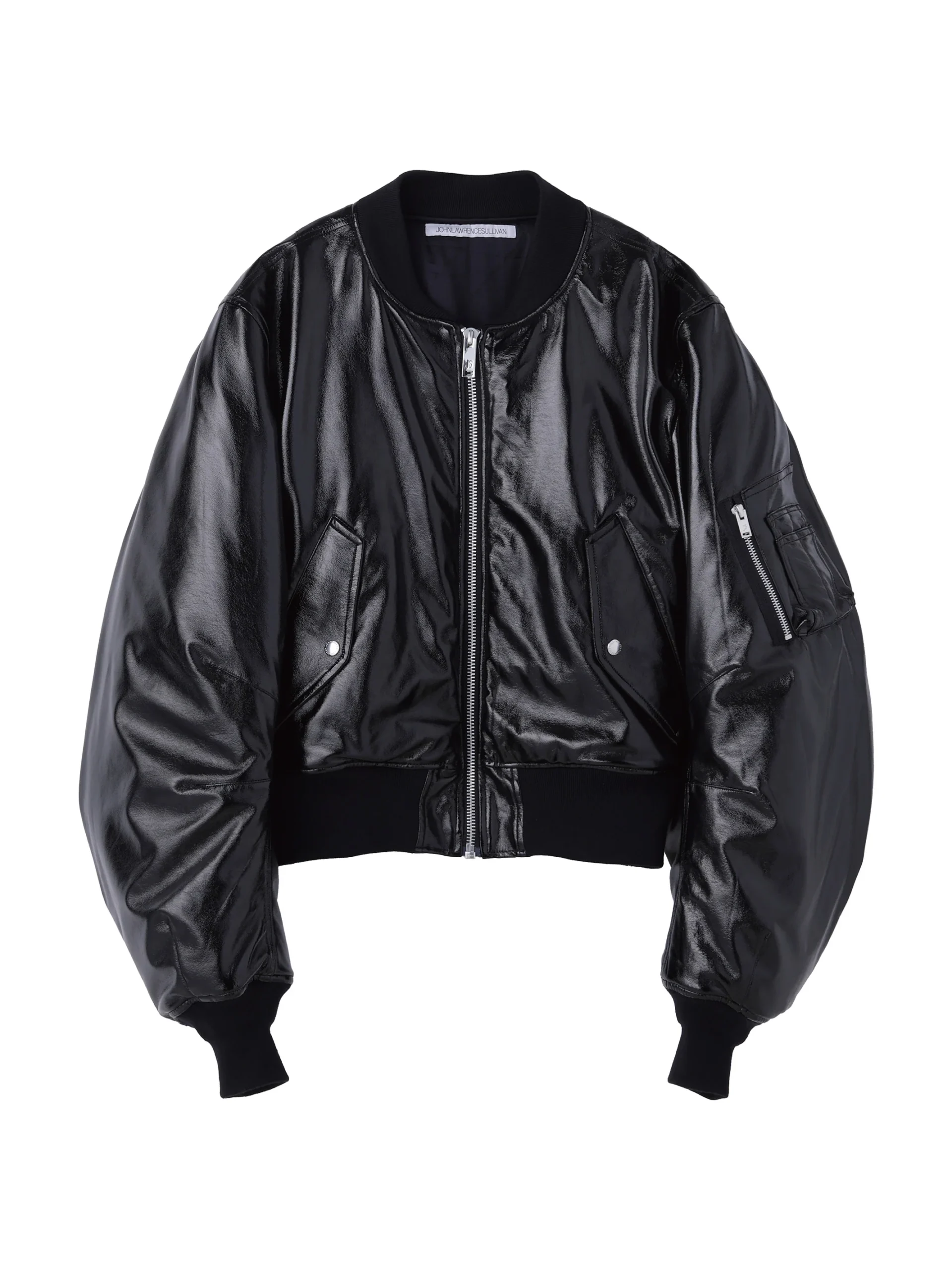
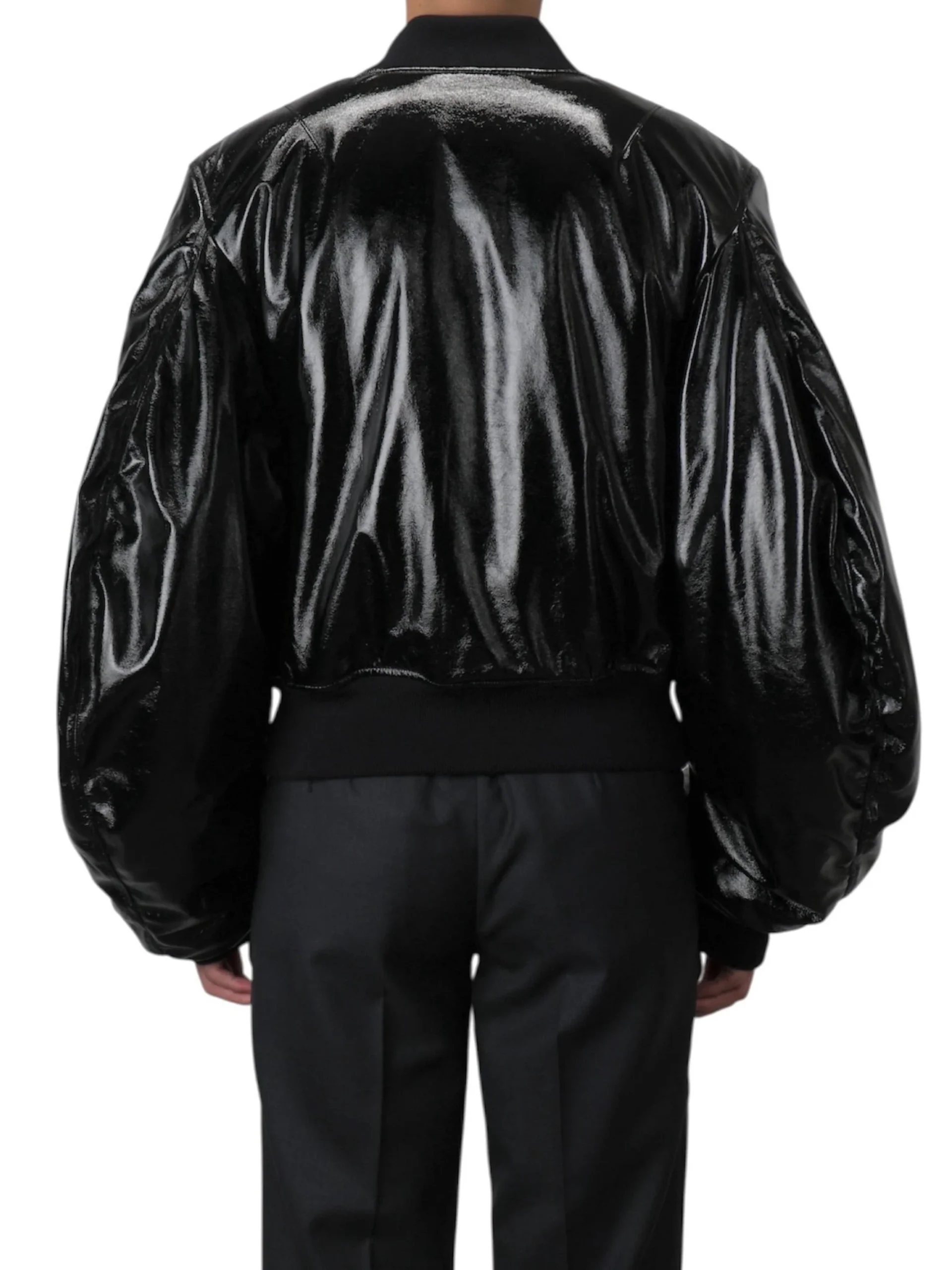
The Patent Massive Rounded Sleeve Bomber Jacket stands as a distilled expression of that ethos. At once recognizably utilitarian and defiantly sculptural, the piece transforms one of menswear’s most entrenched staples—the MA-1 bomber—into a glossy, bulbous, almost futuristic object. It is less an outerwear item than a wearable proposition about volume, surface, and the ongoing renegotiation of masculine dress.
from
John Lawrence Sullivan’s story is inseparable from Yanagawa’s background in boxing. The brand’s earliest collections in the mid-2000s channeled the discipline, aggression, and ritual of the sport through razor-sharp suits and leather-heavy silhouettes. Even as the label expanded into knitwear, denim, and experimental outerwear, that underlying physicality remained central: garments were designed to confront the body rather than merely clothe it.
By the late 2010s and into the 2020s, the brand increasingly turned toward exaggerated proportions—elongated lapels, extreme flares, and inflated sleeves—placing it in dialogue with broader Japanese avant-garde traditions while maintaining its own distinctly confrontational polish. The Massive Rounded Sleeve Bomber emerges from this period of volumetric exploration, using shine and curvature to re-script a military classic into something closer to fashion sculpture.
arch
The bomber jacket is one of menswear’s most codified garments. Originally developed for military pilots, it has passed through postwar youth cultures, punk movements, hip-hop scenes, and luxury runways alike. Its typical traits—ribbed cuffs, cropped hem, utilitarian pockets—are deeply embedded in collective visual memory.
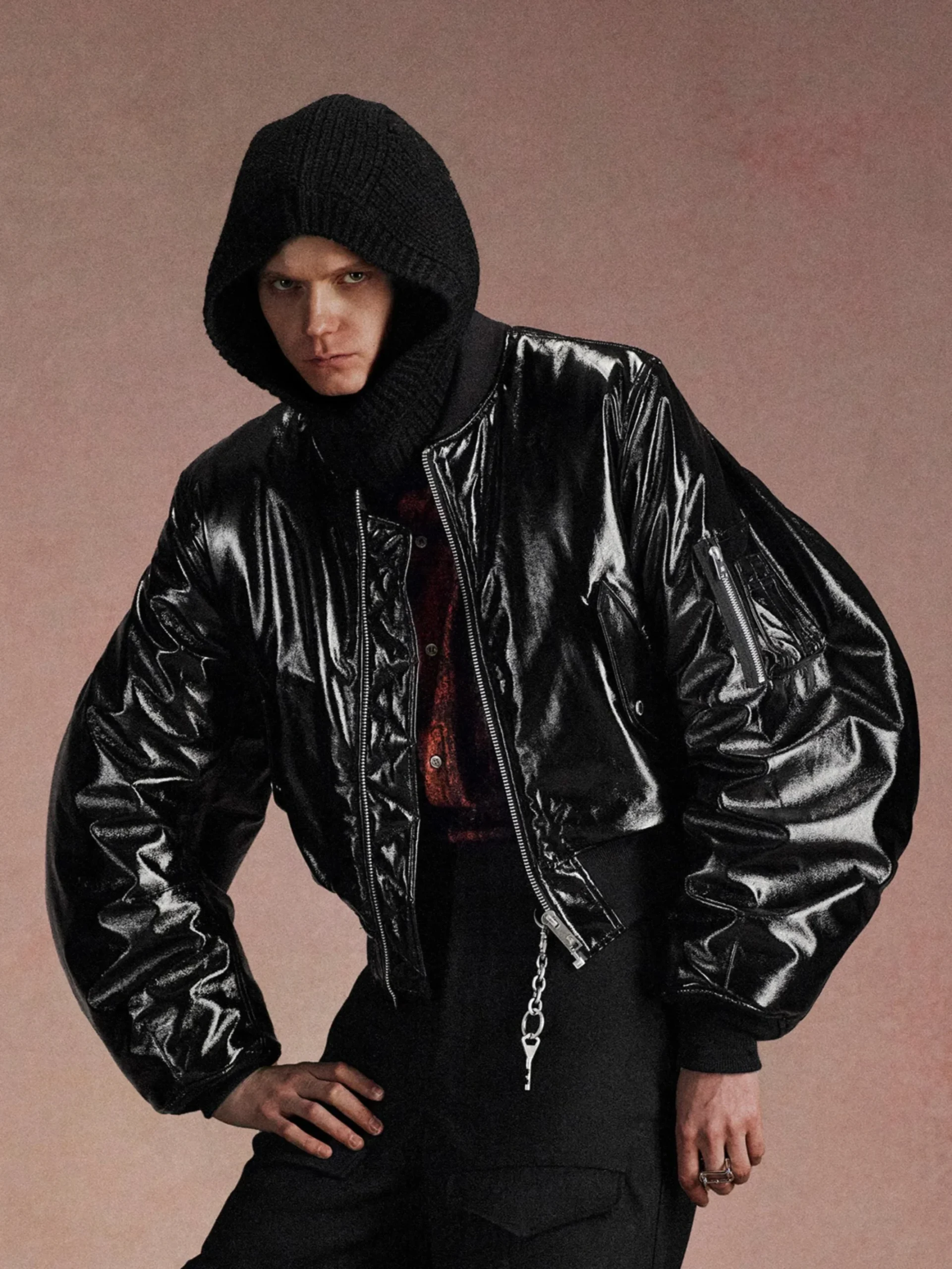
John Lawrence Sullivan preserves enough of these cues to anchor the design, but the jacket’s impact comes from how aggressively those elements are destabilized. The sleeves balloon outward into exaggerated arcs, producing a silhouette that reads almost spherical in profile. This distortion disrupts the wearer’s outline, shifting focus from torso to extremity and challenging the streamlined masculinity traditionally associated with flight jackets.
style
Material choice is central to the jacket’s effect. The patent-coated surface introduces a mirror-like sheen that immediately distances the piece from its utilitarian roots. Where nylon or matte twill once signaled practicality, this lacquered finish suggests fetishwear, club culture, and runway spectacle.
In fashion history, patent fabrics have long carried transgressive undertones—linked to subcultural uniforms, erotic aesthetics, and futurist fantasies alike. On Sullivan’s bomber, the high-gloss surface amplifies every fold and seam, turning the inflated sleeves into reflective sculptures that respond dramatically to light and movement.
The finish also aligns the jacket with a broader luxury conversation around synthetic surfaces. As designers increasingly explore coated textiles and engineered shine in place of traditional leathers, pieces like this become statements about modernity itself: synthetic, hyper-polished, and unapologetically artificial.
engineer
Exaggeration in fashion is rarely accidental. Creating sleeves that appear inflated yet maintain structural coherence requires precise pattern drafting and internal reinforcement. While the jacket reads as playful or theatrical, its success depends on rigorous tailoring beneath the surface.
The rounded sleeves likely rely on carefully curved panels, strategic seam placement, and controlled padding or interfacing to maintain their shape without collapsing. Ribbed cuffs anchor the volume, preventing the garment from becoming visually formless, while the cropped bomber body counterbalances the exaggerated arms.
This interplay between restraint and excess is characteristic of John Lawrence Sullivan’s technical approach. The body remains relatively clean and fitted, while select elements—here, the sleeves—are pushed to surreal extremes. It is an architectural strategy: concentrate drama in one zone and allow the rest of the garment to serve as framing device.
sil
In contemporary fashion discourse, silhouette has become as important as fabric or color. Oversized tailoring, inflated outerwear, and distorted proportions dominate runways from Paris to Tokyo, reflecting a generational shift away from traditional ideals of fit.
The Patent Massive Rounded Sleeve Bomber participates in this movement while carving out a niche of its own. Unlike the cocooning puffers popularized by outdoor-inspired luxury brands, Sullivan’s volume is directional rather than enveloping. The focus on the arms introduces a sense of aggressive flourish, almost like armor or exoskeleton.
Worn open, the jacket frames the torso with glossy arcs; zipped shut, it becomes a compact, reflective shell that reshapes the wearer into something otherworldly. Either way, it resists background status. This is outerwear designed to dominate a look, not complement it.
stir
John Lawrence Sullivan has long drawn from punk iconography—leather, zippers, bondage references, confrontational styling—filtered through Japanese precision. The patent bomber’s sheen and exaggerated form echo the visual codes of underground nightlife: late-night Shibuya clubs, industrial techno venues, and the blurred boundary between fashion and costume that defines many urban subcultures.
In this context, the jacket functions less as everyday outerwear and more as statement armor for nocturnal environments. Its reflective surface interacts with artificial lighting, while the swollen sleeves create a dramatic presence on crowded dance floors or city streets.
Such garments reinforce the brand’s reputation for dressing not just bodies but attitudes. Wearing this bomber signals an embrace of spectacle, an alignment with fashion as provocation rather than mere practicality.
extreme
Despite its radical form, the jacket invites surprisingly disciplined styling. John Lawrence Sullivan’s own runway presentations often pair statement outerwear with razor-sharp trousers, slim denim, or tailored boots, allowing the silhouette to breathe without descending into chaos.
In practical terms, the patent bomber works best when surrounded by restraint:
-
slim black trousers or sharply creased wool pants to offset the inflated sleeves
-
leather Chelsea boots or square-toe derbies to echo the jacket’s gloss
-
monochrome layers underneath, keeping the focus on shape rather than color
Such combinations reinforce the jacket’s architectural quality, positioning it as the central object in a carefully controlled composition.
flow
The Patent Massive Rounded Sleeve Bomber Jacket also speaks to a broader shift within luxury fashion. As traditional tailoring houses increasingly flirt with technical fabrics and sculptural volumes, labels like John Lawrence Sullivan—already fluent in hybridization—find themselves newly influential.
Consumers drawn to high-concept streetwear and runway-driven pieces seek garments that operate at the boundary between clothing and collectible object. Limited-run outerwear with extreme silhouettes occupies this territory perfectly: expensive, visually arresting, and unmistakably authored.
In that sense, the jacket is less about seasonal trend and more about brand mythology. It reinforces Sullivan’s role as a provocateur within Japanese menswear and as a contributor to the global conversation around experimental masculinity.
gent
Perhaps the most compelling aspect of the piece is how it reframes masculine dress. The bomber jacket historically symbolized military function, toughness, and streamlined efficiency. Sullivan’s reinterpretation retains the garment’s assertive energy but reroutes it through exaggeration and shine.
The swollen sleeves verge on cartoonish, the patent finish borders on fetishistic, and the overall silhouette resists the stoic minimalism often associated with menswear classics. This is masculinity rendered flamboyant, theatrical, and self-aware—less about blending in, more about commanding attention.
Such gestures align with a growing movement in fashion toward fluid, expressive interpretations of gendered clothing, where power is articulated through style rather than suppression of ornament.
fwd
For collectors of Japanese avant-garde fashion, the Patent Massive Rounded Sleeve Bomber reads as a quintessential John Lawrence Sullivan artifact: instantly recognizable, technically sophisticated, and conceptually charged. Pieces like this often outlive their original seasons, resurfacing in archival sales, editorial shoots, and museum-adjacent exhibitions exploring twenty-first-century menswear.
Its appeal lies precisely in its refusal to compromise. The jacket does not attempt to be versatile or discreet; it insists on being seen. In an era saturated with understated luxury, that refusal becomes its most luxurious attribute.
fin
The John Lawrence Sullivan Patent Massive Rounded Sleeve Bomber Jacket exemplifies how contemporary designers can transform familiar archetypes into speculative objects. By inflating the sleeves into sculptural forms and coating the surface in high-gloss patent, Sullivan reframes the bomber as both fashion experiment and cultural statement.
Rooted in the brand’s boxing-inflected aggressione tailoring and punk lineage, yet firmly situated in the futuristic aesthetics of modern luxury, the jacket stands as a reminder that outerwear can still provoke, disrupt, and redefine the body it inhabits.