intro
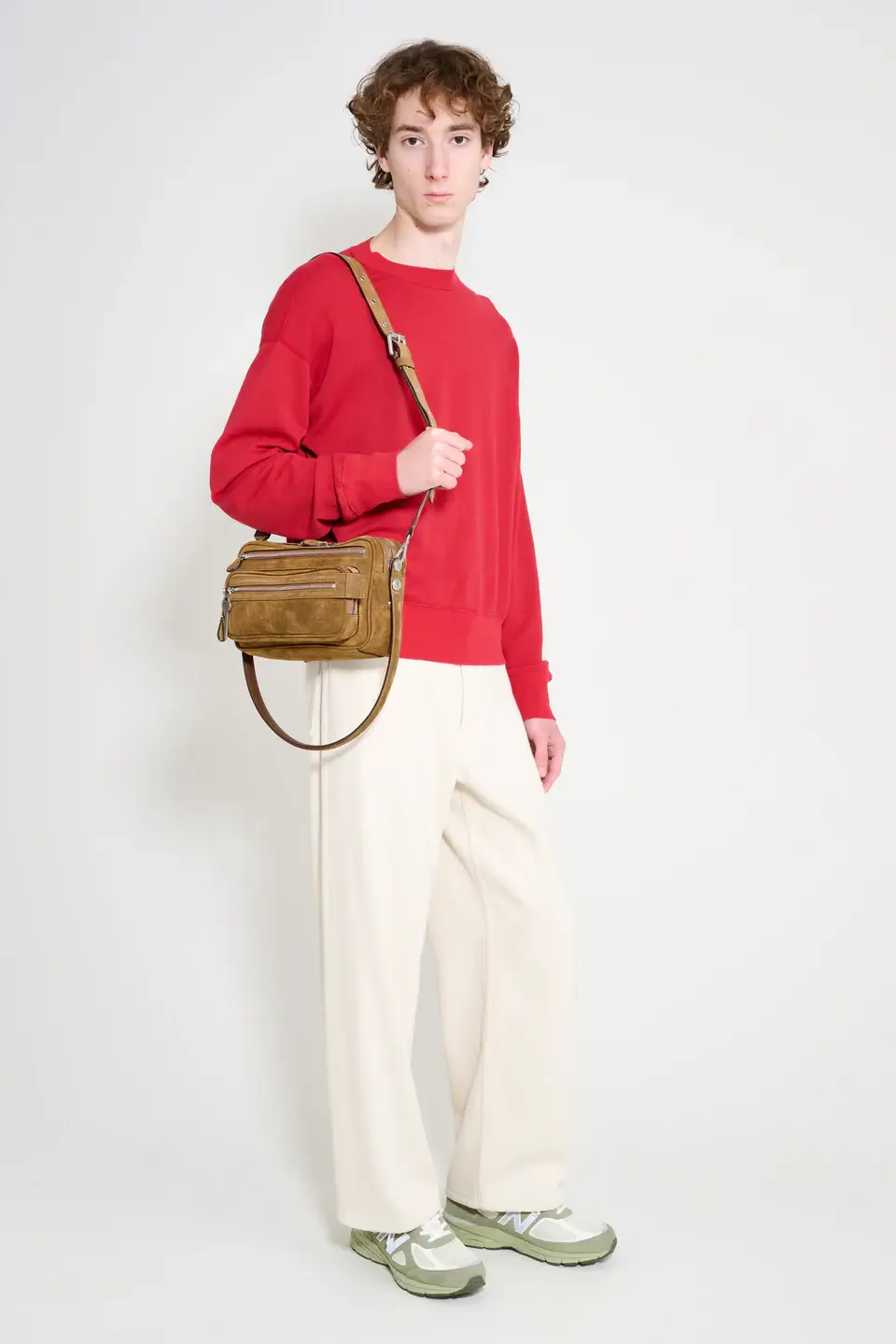
There is a precision to the way Acne Studios constructs objects—never overt, never indulgent in excess, but consistently attuned to proportion, tactility, and lived use. The Camero Party bag in cognac suede operates within this discipline.
It does not seek attention. It accrues it.
Where many contemporary accessories rely on immediate recognition—logos, hardware, exaggerated silhouettes—the Camero resists. It exists closer to architecture than ornament, shaped by necessity and softened by material. In that tension, between function and quiet expression, it finds its relevance.
stir
The Camero line originates not from a sketchbook fantasy, but from a practical object—a camera bag used by Acne Studios’ co-founder and creative director Jonny Johansson.
This lineage is essential. It explains everything from the compartmental logic to the scale. Unlike heritage luxury bags, which often begin as symbolic carriers of identity, the Camero begins with purpose. Its compartments are not decorative—they are inherited. Its structure is not imposed—it is functional.
Fashion, in this case, arrives later. And when it does, it refines rather than replaces.
lang
The cognac suede iteration transforms the Camero into something more intimate.
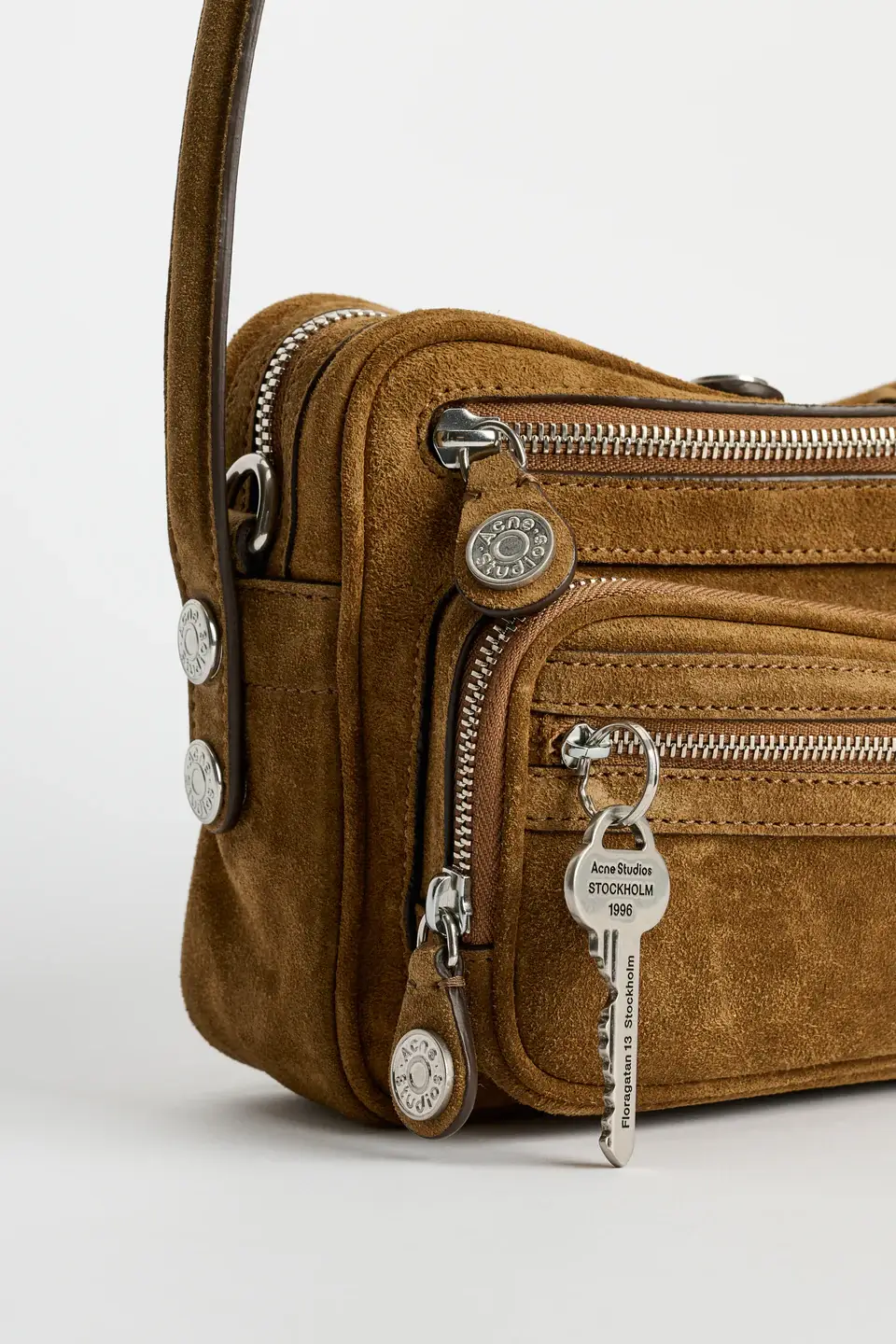
Suede behaves differently from smooth leather. It absorbs light, diffuses edges, and records touch. Over time, it develops a patina not through shine, but through deepening tone and softened grain. The cognac color amplifies this evolution—rich without being heavy, warm without becoming seasonal.
This is not a static material. It is responsive.
In use, the bag begins to mirror its owner: slight darkening at pressure points, subtle shifts in texture, a lived-in softness that cannot be manufactured. Where polished leather suggests permanence, suede suggests time.
struct
At its core, the Camero Party bag is defined by its multi-pocket architecture.
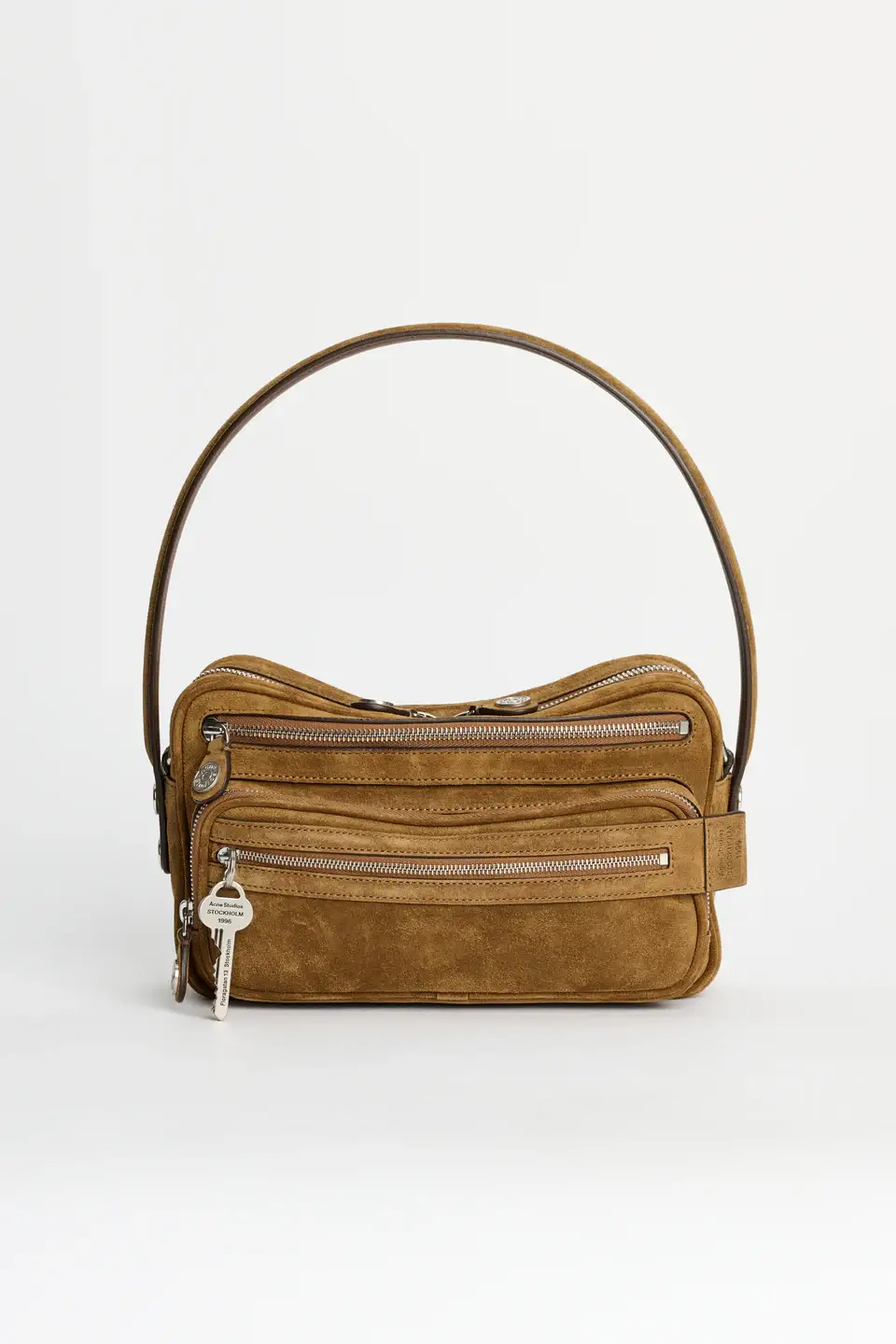
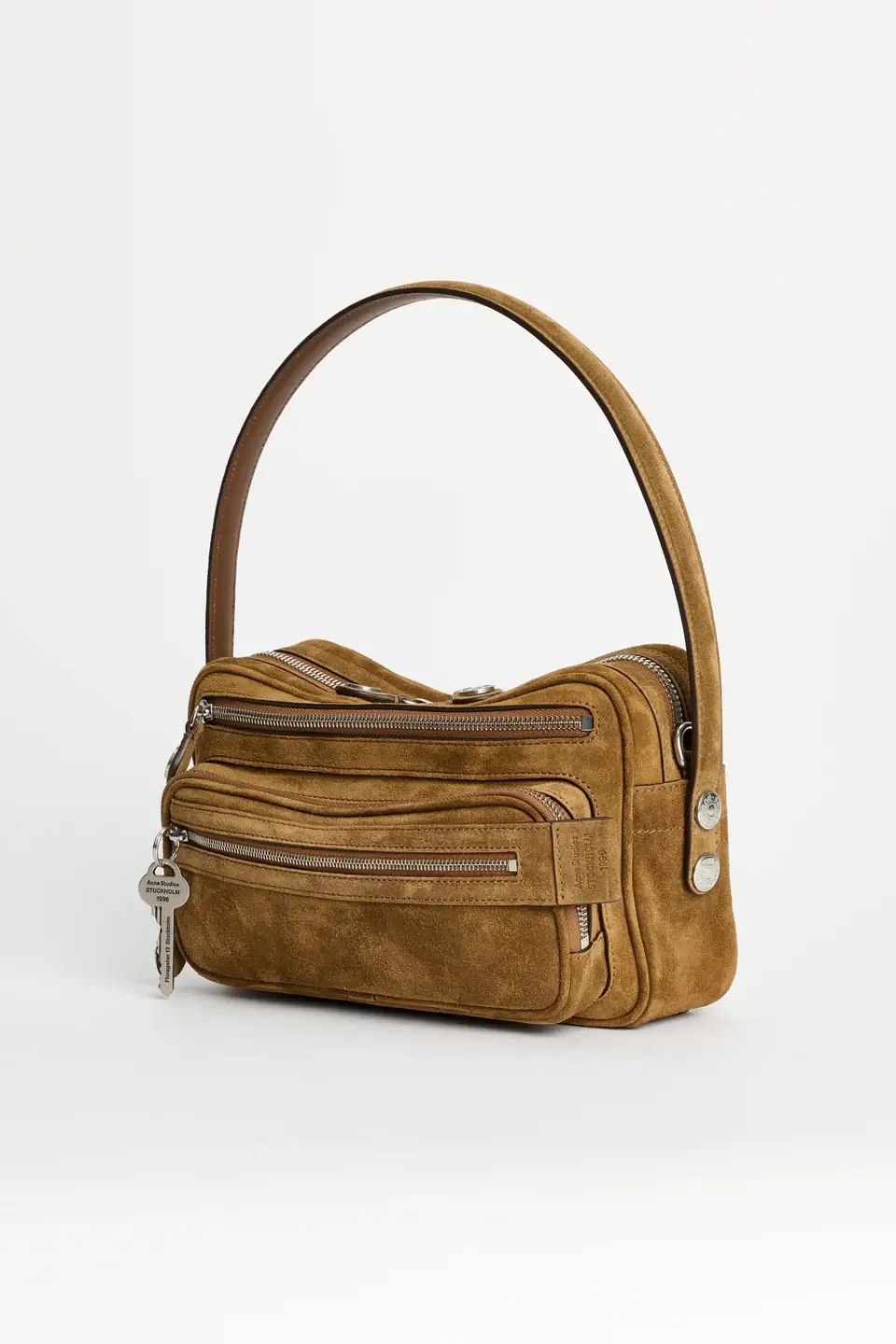
External zip compartments frame the silhouette, creating both visual rhythm and functional access. Slip pockets allow for immediate retrieval—phone, keys, transit cards—while the central compartment anchors the bag’s carrying capacity.
The dimensions—compact yet deliberate—position the bag in a rare middle ground. It is neither oversized nor reductively small. It accommodates the essentials of contemporary life without collapsing into minimalism for its own sake.
This is where the Camero distinguishes itself: it does not aestheticize utility. It preserves it.
flow
The Camero Party bag exists in motion. Its identity shifts depending on how it is worn.
Worn on the shoulder, it appears composed—almost archival, echoing vintage equipment bags. The shorter strap keeps it close to the body, controlled and intentional.
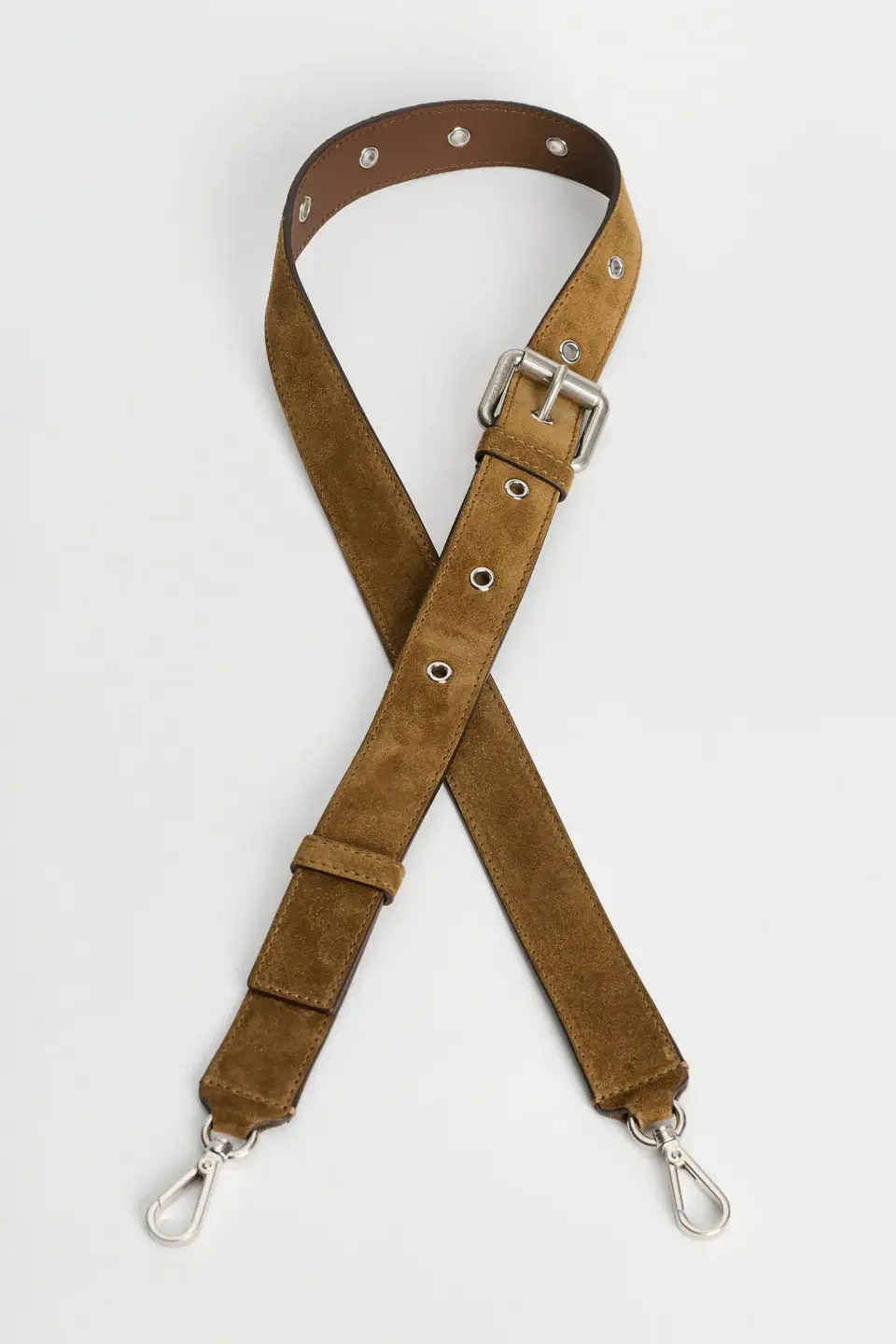
Worn crossbody, it relaxes. The longer strap introduces fluidity, aligning with contemporary streetwear and transitional dressing. The bag becomes less formal, more adaptive.
This duality is not incidental. It allows the same object to move across contexts—morning commute, afternoon errands, evening events—without requiring reinvention.
show
One of the Camero’s most compelling qualities is its ability to change form.
Unlike rigid luxury bags that maintain a fixed silhouette, the Camero responds to use. Empty, it softens—edges relax, structure loosens. Filled, it regains definition, echoing its camera-bag origins.
This elasticity introduces a rare dynamism. The bag is not static; it evolves throughout the day. It reflects weight, movement, and habit.
In this way, it becomes less of an accessory and more of an extension.
style
The Camero Party bag aligns with a broader recalibration in fashion—one that prioritizes material intelligence over visible branding.
It integrates seamlessly into multiple wardrobes:
- With tailored coats and wool trousers, it tempers formality with softness
- With denim and knitwear, it reinforces a relaxed, textural narrative
- With technical outerwear, it adds warmth to synthetic precision
Its cognac tone acts as a stabilizer—bridging monochrome palettes and tonal dressing alike.
Crucially, it does this without announcing itself. Recognition is reserved for those who understand proportion, fabrication, and nuance.
accessible
Within the landscape of luxury leather goods, the Camero Party bag occupies a considered position. It is an investment, but not an extreme one.
It functions as an entry point into Acne Studios’ accessories universe—more accessible than larger Camero iterations, yet still anchored in premium material and construction.
This positioning reflects a broader strategy: creating objects that are aspirational but not inaccessible, refined but not exclusionary.
relev
The Camero has quietly transitioned from a niche object to a cultural fixture. Its rise has not been driven by aggressive marketing or celebrity saturation, but by organic adoption—stylists, editors, and wearers who value discretion over display.
This trajectory is telling.
In a landscape saturated with visibility, the Camero’s restraint becomes its advantage. It offers a different kind of luxury—one rooted in familiarity, repetition, and daily use.
day
Beyond aesthetics, the Camero reflects a contemporary approach to production. The suede is sourced from certified tanneries, while the interior integrates recycled materials—subtle indicators of a shifting industry standard.
These choices are not foregrounded. They are embedded.
And in that embedding lies their significance: sustainability not as a statement, but as a baseline.
fin
The Camero Party bag in cognac suede does not attempt to redefine the category. It refines it.
Through material, proportion, and restraint, it offers an alternative to spectacle-driven luxury. It prioritizes use over image, tactility over gloss, evolution over immediacy.
In a moment where fashion often accelerates toward visibility, the Camero slows things down.
And in that slowing, it becomes essential.