Vite: Industrial Memory, Recast — Philippe Malouin’s Espresso Machine for Alessi

April 4, 2026
4 hours ago
a return
There are objects that arrive as novelties, and then there are objects that arrive as reminders—fragments of something cultural that never quite left, only receded. The Vite espresso maker, designed by Philippe Malouin for Alessi, belongs to the latter category. It does not attempt to revive a past era wholesale, nor does it indulge in overt nostalgia. Instead, it extracts the visual tension of late 20th-century design—particularly the language orbiting Memphis Group—and refines it through contemporary manufacturing logic.
To ask whether Memphis is “back” is to misunderstand the trajectory of design itself. Movements don’t return; they are reinterpreted through new materials, new constraints, and new cultural anxieties. The Vite operates precisely in this space: it is not revivalist, but referential—an object that understands history as material rather than mythology.
View this post on Instagram
idea
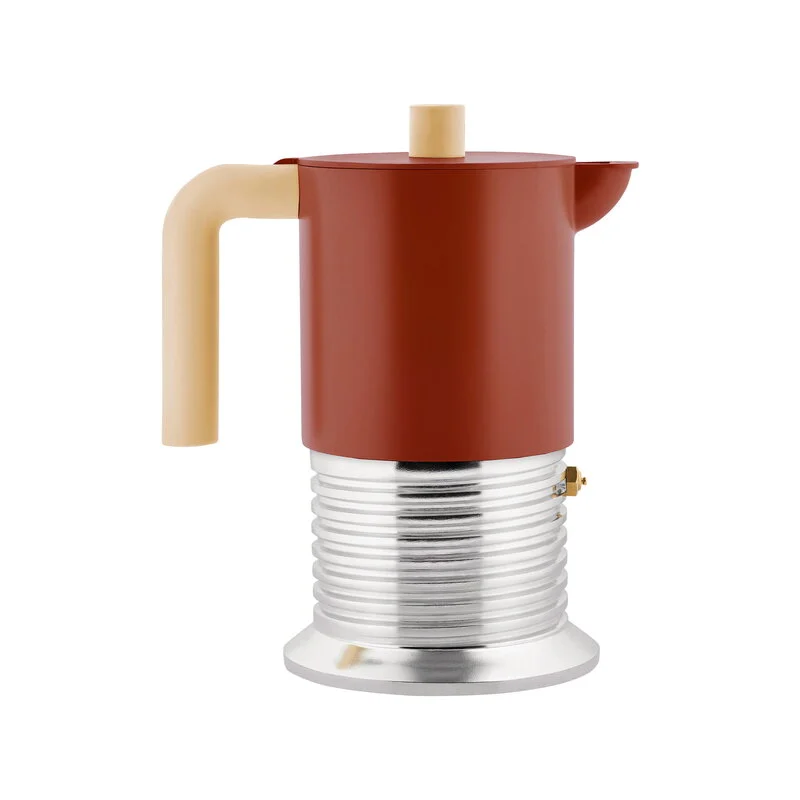
At first glance, the Vite espresso maker reads like an assembly of mismatched parts, almost provisional in its construction. The silhouette resists the smooth continuity associated with traditional stovetop espresso makers—like the archetypal Moka Express—and instead leans into segmentation. Each component feels articulated, as though it could be disassembled and reconfigured.
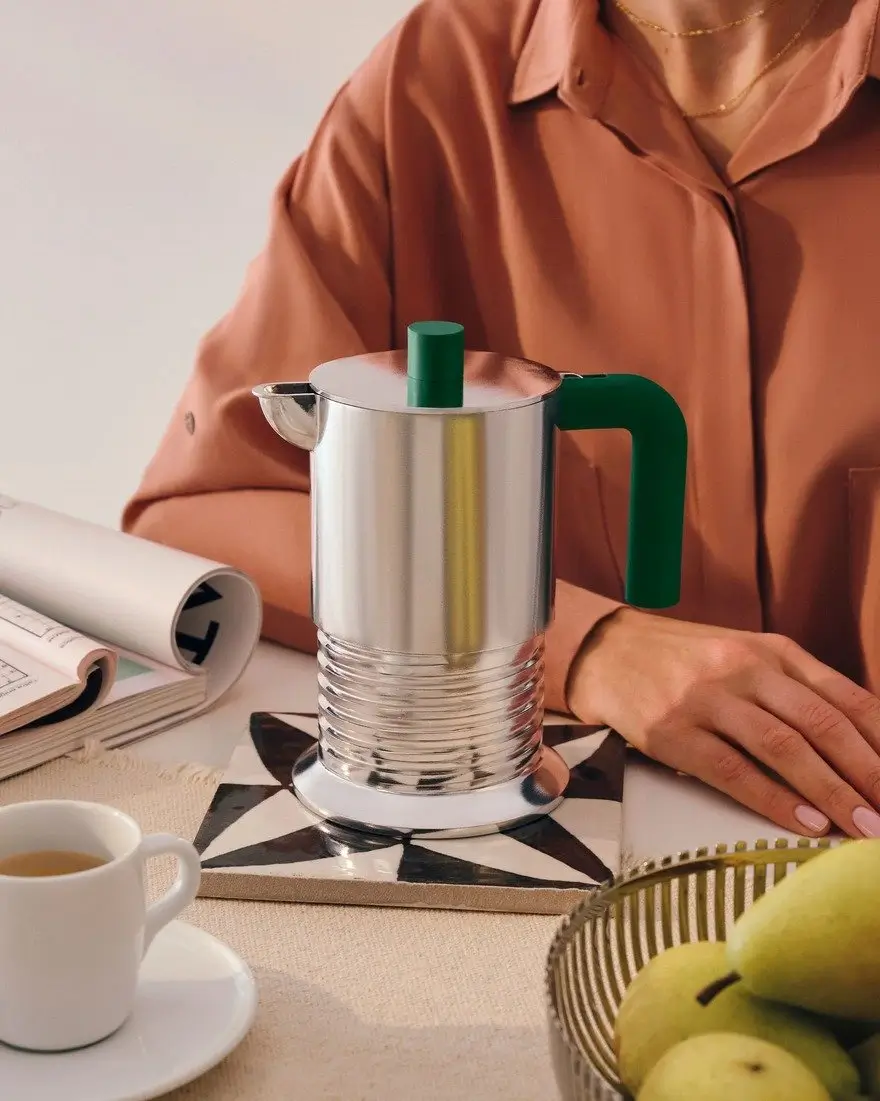
This is where the “junkyard-inspired” description begins to resonate, though not in a literal sense. The reference is less about scrap materials and more about an aesthetic of visible construction. Nothing is hidden. The cast aluminum body reveals its industrial origins through sharp edges and deliberate weight. The magnetic steel base, designed for induction compatibility, introduces a subtle functional shift—one that acknowledges the evolving domestic environment where gas stoves are no longer the default.
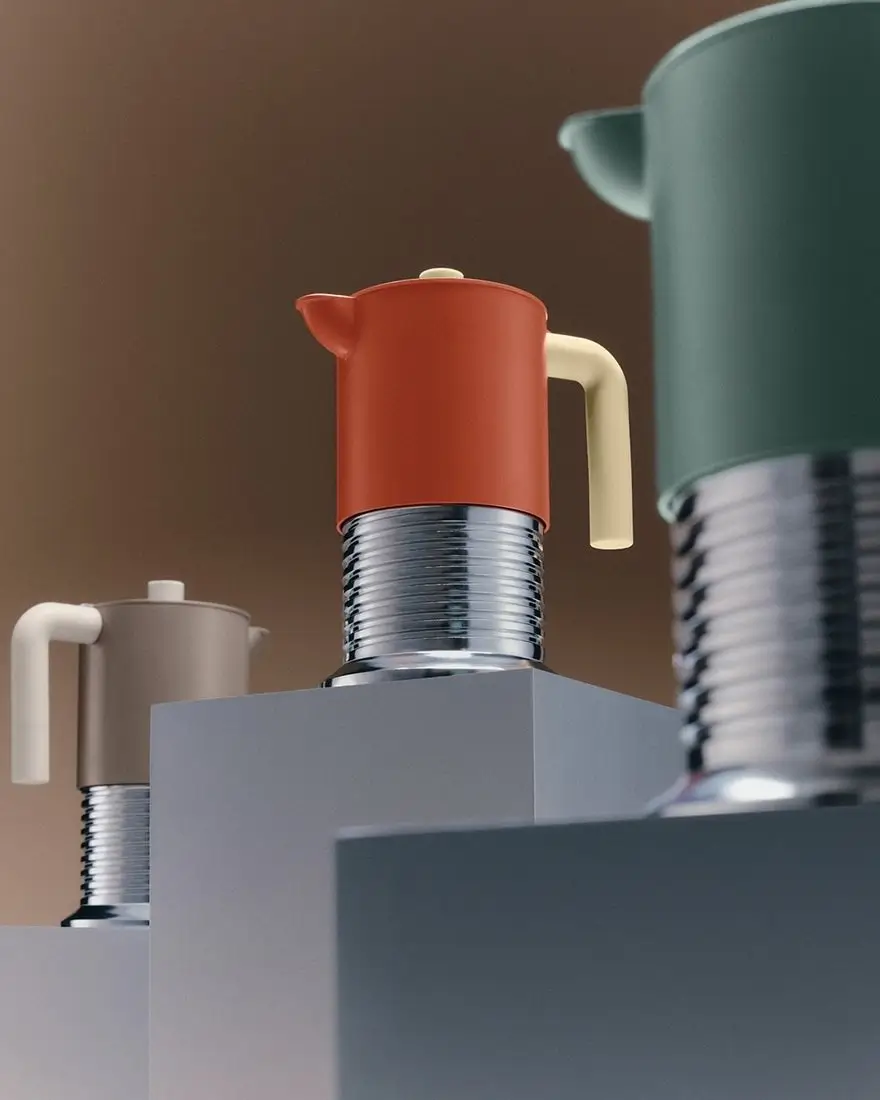
The thermoplastic resin handles, meanwhile, introduce a deliberate contrast. Where the metal components communicate permanence and mass, the handles inject color and tactility. They are the most overt nod to Memphis-era playfulness, yet even here, Malouin avoids excess. The geometry is controlled, almost restrained, suggesting that the designer is less interested in spectacle than in balance.
flow
Material choice in industrial design is never neutral. It is both a technical decision and a philosophical one. In the Vite, the combination of cast aluminum, magnetic steel, and thermoplastic resin forms a quiet argument about durability, adaptability, and sensory experience.
Aluminum, with its conductivity and lightweight strength, remains an obvious choice for espresso makers. But here, it is treated less as a background material and more as a primary visual element. The casting process leaves subtle irregularities—micro-textures that catch light differently depending on angle and finish. These are not flaws but traces of production, evidence of the object’s making.
The magnetic steel base is equally significant. Induction cooking, once a niche technology, is now becoming standard in contemporary kitchens. By integrating this feature, the Vite positions itself not as a retro artifact but as a forward-looking tool. It acknowledges that design must evolve alongside infrastructure.
The thermoplastic resin handles, finally, operate at the level of interaction. They are the points of contact—the places where the user’s hand meets the object. Their color and texture soften the otherwise industrial composition, introducing a human scale that prevents the design from becoming austere.
stir
The Vite exists in a liminal space between sculpture and tool. It is undeniably functional—designed to brew espresso with the efficiency expected of a stovetop maker—but it also demands to be seen. This duality is central to Malouin’s broader practice, which often navigates the boundary between utility and art.
In many ways, the object behaves like a small piece of architecture. Its segmented form recalls modular construction, where each element serves a distinct purpose while contributing to an overall composition. The result is an object that feels both grounded and experimental—anchored in function yet open to interpretation.
This is not incidental. Alessi has long positioned itself at the intersection of design and culture, commissioning designers who are willing to push the boundaries of everyday objects. From the anthropomorphic whimsy of past collections to the more restrained experiments of recent years, the company has consistently treated domestic tools as vehicles for design discourse.
The Vite continues this tradition, but with a different tone. Where earlier Alessi objects often leaned into overt playfulness, Malouin’s design is more introspective. It is less about delight in the immediate sense and more about sustained engagement—the kind of object that reveals itself gradually over time.
show
Founded in the early 1980s, the movement challenged the austerity of modernism with bold colors, unconventional materials, and a deliberate embrace of ornamentation.
The Vite does not replicate these characteristics directly. There are no overtly decorative patterns, no exaggerated forms that prioritize visual impact over function. Instead, the influence manifests in subtler ways: in the juxtaposition of materials, in the refusal of seamless continuity, in the willingness to treat an everyday object as a site of experimentation.
This is perhaps the most significant shift. Where Memphis often operated through excess, the Vite operates through reduction. It distills the movement’s core ideas—contrast, play, and disruption—into a more controlled expression. The result is an object that feels contemporary rather than retro, even as it echoes a specific historical moment.
consider
Espresso making, particularly in the context of a stovetop device, is a ritual as much as it is a process. It involves timing, attention, and a degree of sensory awareness. The sound of water heating, the aroma of coffee rising, the visual cue of steam—these are integral to the experience.
The Vite engages with this ritual not by altering it fundamentally, but by reframing it. Its form invites a different kind of interaction. The segmented body encourages the user to consider each component individually, while the contrasting materials create a more tactile experience.
This is where design becomes experiential. The object is not just a means to an end but a participant in the process. It shapes how the user perceives the act of making coffee, subtly shifting the focus from efficiency to engagement.
culture
The Vite also speaks to a broader question: what role does industrial design play in contemporary culture? In an era dominated by digital interfaces and intangible experiences, physical objects carry a different kind of weight. They are slower, more deliberate, and inherently tied to the body.
Malouin’s approach reflects this shift. Rather than chasing novelty for its own sake, the design focuses on material presence and tactile engagement. It acknowledges that objects still matter—not as status symbols, but as extensions of daily life.
Alessi, for its part, continues to operate as a platform for this kind of exploration. By commissioning designers with distinct perspectives, the company maintains a dialogue between tradition and innovation. The Vite is one iteration of this dialogue, but it also points toward a larger trajectory—one where design is less about defining trends and more about sustaining conversations.
resil
One of the more intriguing aspects of the Vite is its relationship to time. The “junkyard-inspired” descriptor suggests a certain impermanence, a connection to discarded materials and transient forms. Yet the object itself is built to last, with durable materials and a robust construction.
This tension is not accidental. It reflects a broader cultural ambivalence toward permanence in the age of disposability. On one hand, there is a growing awareness of sustainability and the need for long-lasting products. On the other, there is an aesthetic fascination with imperfection, with objects that appear provisional or incomplete.
The Vite navigates this tension by embodying both qualities simultaneously. It looks like something assembled from disparate parts, yet it functions as a cohesive whole. It suggests fragility while delivering durability. In doing so, it captures a distinctly contemporary sensibility—one that values both resilience and adaptability.
further
If there is a broader takeaway from the Vite, it is this: design does not need to announce itself to be meaningful. It can operate quietly, through material choices, proportions, and small shifts in form. It can engage with history without being constrained by it.
In this sense, the Vite is less about Memphis making a comeback and more about Memphis continuing to evolve. It is a reminder that design movements are not static—they are living frameworks, capable of adaptation and reinterpretation.
And perhaps that is the most compelling aspect of Malouin’s work here. He does not attempt to resolve the tension between past and present. Instead, he allows it to remain, using it as a source of energy rather than conflict. The result is an object that feels both familiar and new—a small but significant contribution to the ongoing conversation of design.
clue
The Vite espresso maker may sit on a kitchen counter, but it carries with it a broader narrative—one that spans decades of design history and extends into the present moment. It is an object that invites consideration, not through spectacle, but through subtlety.
In a world increasingly defined by speed and disposability, this kind of design feels almost radical. It asks the user to slow down, to notice, to engage. And in doing so, it reaffirms the enduring relevance of industrial design—not as a relic of the past, but as a vital part of contemporary culture.