Frontier Alchemy: Andy Martinez Bridges Airmax 95 and Western Form

April 3, 2026
55 minutes ago

think
In a city where speed dictates taste, Andy Martinez works against the grain—slowly, deliberately, and with a material sensitivity that feels almost culinary. From his New York studio, the designer approaches footwear not as a finished product, but as a set of ingredients waiting to be recomposed. His practice resists the idea of customization as mere surface embellishment; instead, he dissects, reconfigures, and reassigns function. The result is less “custom sneaker” and more object—something closer to sculpture that still insists on being worn.
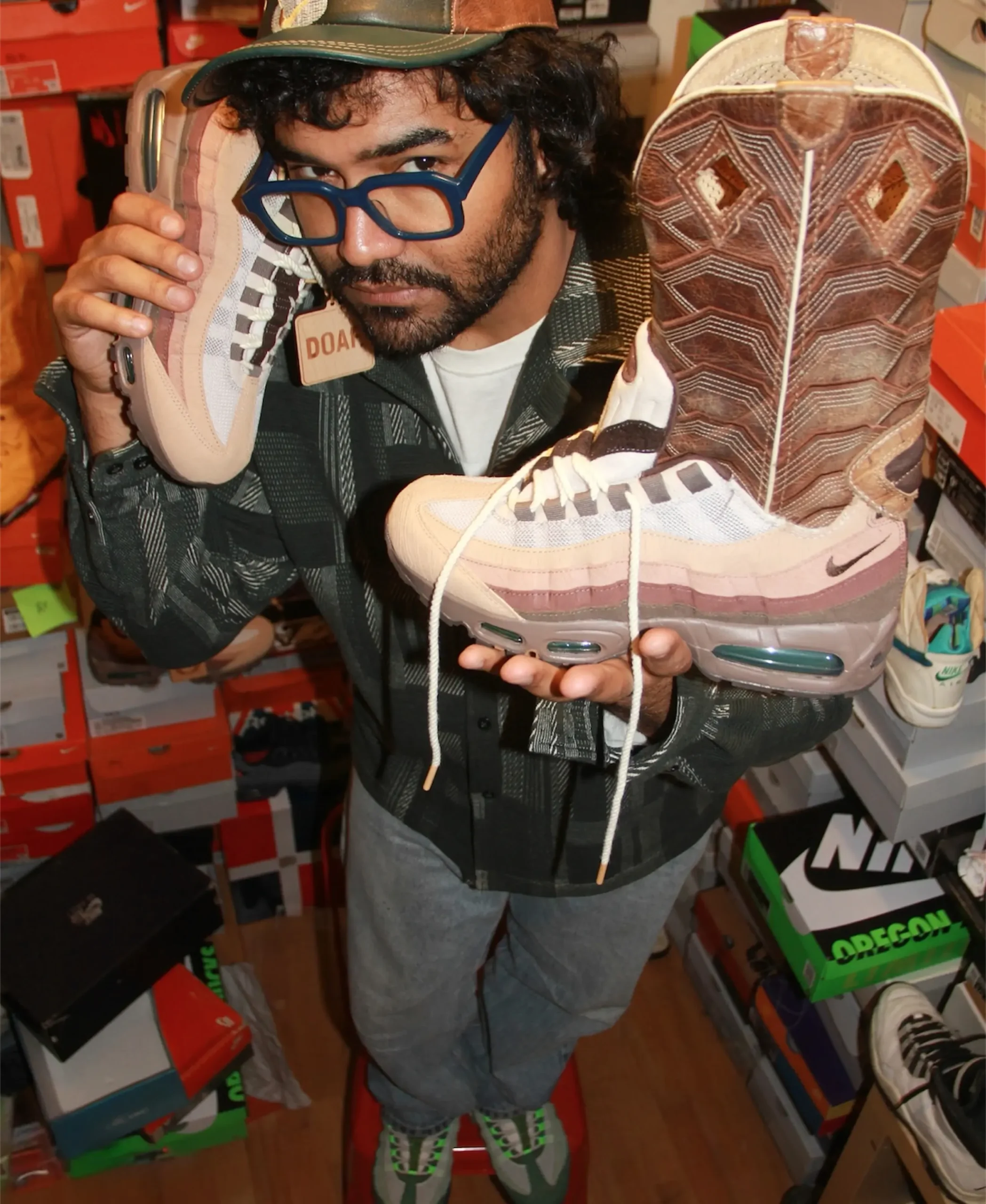
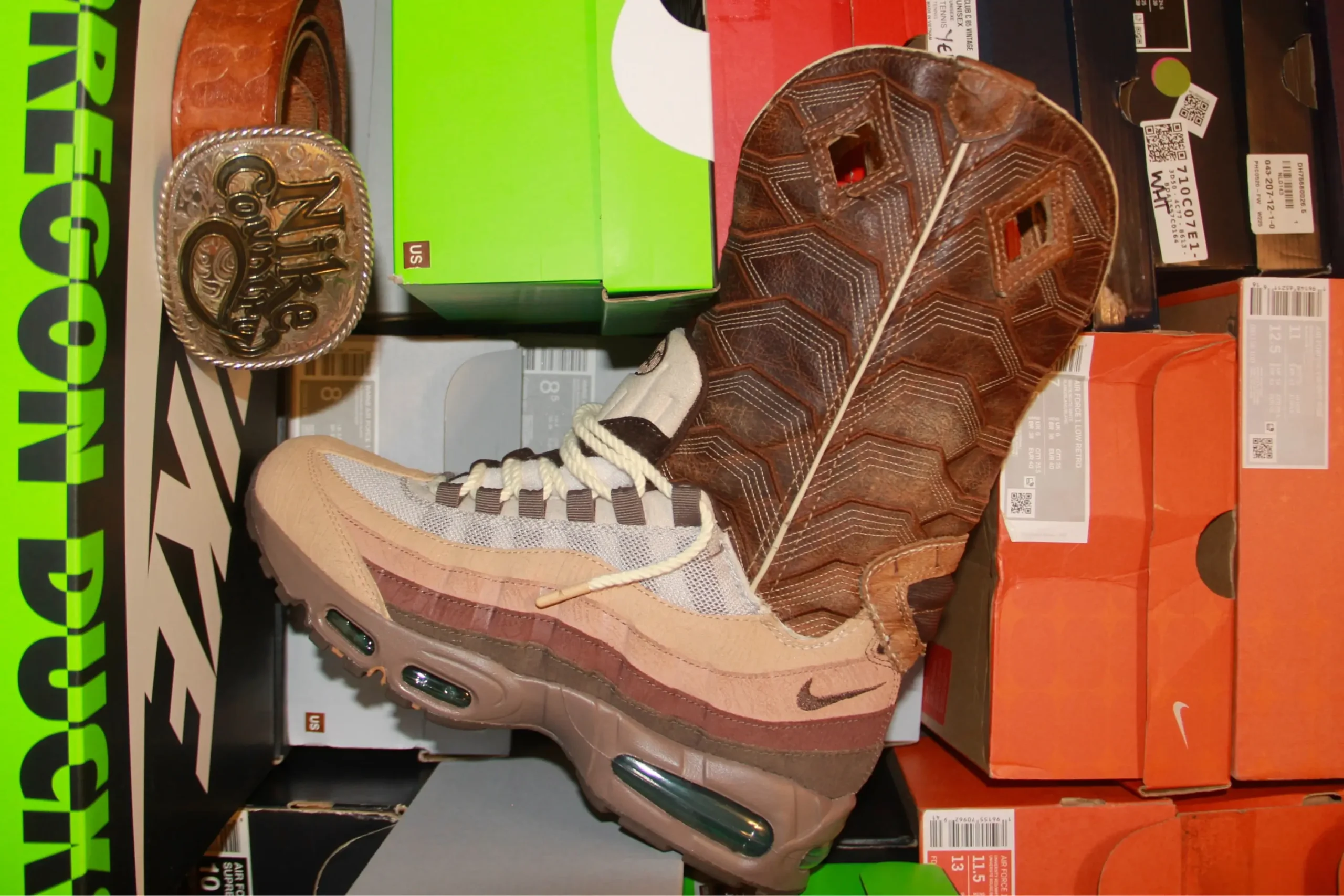
Martinez’s latest intervention centers on the Nike Air Max 95—specifically the Ducks of a Feather “Lumber Yard” iteration—and its unlikely transformation into a fully realized cowboy boot. It’s a gesture that feels both irreverent and reverent: irreverent in its disruption of a canonical runner, reverent in the care with which each component is handled, preserved, and recontextualized.
The project signals something deeper than novelty. It proposes that footwear—arguably one of the most technologically saturated consumer objects—can still be returned to the language of craft.
stir
Originally designed by Sergio Lozano in the mid-1990s, the Air Max 95 has long been understood as an anatomical study. Its layered upper references muscle fibers; its visible Air units mimic vertebrae. Martinez leans into this biological framework, but bends it toward a new narrative—one rooted not in the human body, but in terrain.
The “Lumber Yard” palette—earth-heavy, timber-toned—becomes a bridge between two visual languages: the engineered gradients of performance footwear and the weathered textures of Western wear. Panels that once implied speed and urban movement are repositioned to emphasize durability, weight, and groundedness. The sneaker’s original rhythm—horizontal striations moving laterally across the upper—is reoriented vertically, aligning with the shaft of a cowboy boot.
This shift is not purely aesthetic. It requires a recalibration of structure. The Air Max sole, with its segmented cushioning system, must now support a silhouette traditionally defined by a rigid shank and stacked heel. Martinez doesn’t force the sneaker into compliance; instead, he negotiates between systems, allowing tension to remain visible. The final form carries traces of both worlds—neither fully sneaker nor fully boot.
View this post on Instagram
mat
Martinez often describes his process as a “home-cooked meal,” a phrase that, on first hearing, risks sounding casual. In practice, it reveals a deeply considered methodology. Ingredients matter. Provenance matters. Texture matters.
His sourcing strategy is hyper-local, drawing from New York’s dense network of leather suppliers, hardware shops, and specialty fabric stores. Each material is chosen not just for durability, but for its ability to converse with the existing components of the shoe. Suede panels are matched to leather grades that can withstand the structural demands of a boot shaft. Stitching threads are selected for both tensile strength and tonal harmony.
There is a choreography to how these materials meet. The soft, layered complexity of the Air Max upper collides with the more assertive, sculptural language of Western bootmaking. Rather than smoothing over the seams, Martinez accentuates them. Transitions are deliberate, almost didactic, inviting the viewer to read the object as a sequence of decisions.
In this sense, the shoe becomes a narrative device. It tells the story of its own making.
west
The cowboy boot, long embedded in American mythology, carries its own set of expectations: pointed toe, high shaft, decorative stitching, a heel designed for stirrups. Martinez engages with these conventions selectively. He borrows the silhouette’s verticality and assertiveness, but reframes its symbolism.
In his hands, the Western reference is less about nostalgia and more about adaptability. The American West becomes a metaphor for transformation—a place where objects must evolve to meet the demands of environment and use. By grafting a performance shoe onto a cowboy boot form, Martinez collapses two distinct geographies: the hyper-urban and the mythic frontier.
This collision resonates within a broader cultural moment. Western aesthetics have reemerged across fashion, not as costume but as vocabulary—seen in elongated silhouettes, tactile materials, and an emphasis on durability. Martinez’s work feels aligned with this shift, yet distinct in its commitment to process over trend.
flow
Part of Martinez’s growing visibility stems from his clientele. When artists like Doechii commission pieces, the work enters a different circuit—one where objects become extensions of performance and persona. Similarly, attention from figures such as Timothée Chalamet and Carmelo Anthony positions his creations within a broader cultural dialogue.
Yet the appeal is not purely celebrity-driven. It lies in the tension between familiarity and disruption. Viewers recognize the Air Max 95 instantly, but are forced to reconsider its possibilities when it appears as a cowboy boot. The object invites double takes, then deeper inspection.
In a digital ecosystem saturated with rapid-fire imagery, this kind of pause is valuable. It creates space for engagement.
assemble
For now, Martinez’s practice is anchored in one-of-one creations. Each piece carries the weight of singularity, resisting replication. But there are signals of a broader ambition embedded within his &e brand—a move toward systematizing aspects of the process without losing its integrity.
This transition poses a challenge familiar to many craft-based designers: how to scale without diluting. Martinez’s answer appears to lie in modular thinking. By understanding each component—sole, upper, shaft—as a variable, he can experiment with recombination while maintaining a core philosophy.
The goal is not mass production in the traditional sense, but controlled expansion. Limited runs, iterative variations, and a continued emphasis on material storytelling suggest a path forward that honors both craft and accessibility.
philosophy
At its core, Martinez’s work is about second life. It asks what happens when an object is removed from its original context and given a new function. The Air Max 95, designed for running, becomes a boot designed for standing, walking, performing. Its meaning shifts accordingly.
This philosophy aligns with broader conversations around sustainability and reuse, though Martinez approaches it less as a mandate and more as an instinct. By reworking existing forms, he extends their lifespan—not just physically, but culturally.
There is also a conceptual dimension. The act of transformation becomes a critique of fixed identities. If a shoe can become a boot, what other categories might be more fluid than they appear?
endure
To encounter one of Martinez’s pieces in person is to notice the details that resist translation through images. The slight irregularity of a hand-cut edge. The density of a stitch line. The way materials age differently across the surface.
These qualities speak to time—not just the time required to make the object, but the time embedded within it. Each decision accumulates, creating a layered sense of authorship that cannot be replicated by automated processes.
In an industry increasingly oriented toward speed and scalability, this emphasis on time feels almost radical. It suggests that value can still be derived from slowness, from attention, from care.
idea
Martinez’s transformation of the Air Max 95 into a cowboy boot is not an isolated experiment. It is part of a larger inquiry into what footwear can be when freed from strict typologies. His work sits at the intersection of design, craft, and cultural commentary, proposing a language that is both hybrid and precise.
This language is still evolving. It will likely take new forms, incorporate new materials, and respond to new contexts. But its foundation—an insistence on material honesty and conceptual clarity—appears stable.
As Martinez continues to develop his &e brand, the question is not whether his work will influence the broader industry, but how. Will others adopt similar hybrid strategies? Will the boundary between sneaker and boot dissolve further? Or will his practice remain a singular outlier, valued precisely because of its specificity?
sum
The idea of the frontier has long been associated with expansion, with the pushing of boundaries. In Martinez’s work, it becomes a method—a way of thinking that embraces uncertainty and transformation.
By reimagining the Air Max 95 as a cowboy boot, he does more than create a striking object. He opens a conversation about form, function, and the possibilities that emerge when categories are allowed to blur.
In the end, his practice reminds us that even the most familiar objects can be re-seen, reworked, and redefined. All it takes is a willingness to take them apart—and the patience to put them back together again, differently.