Andy Warhol’s Moonwalk – (1987) Feldman & Schellmann II.405

April 11, 2026
6 hours ago
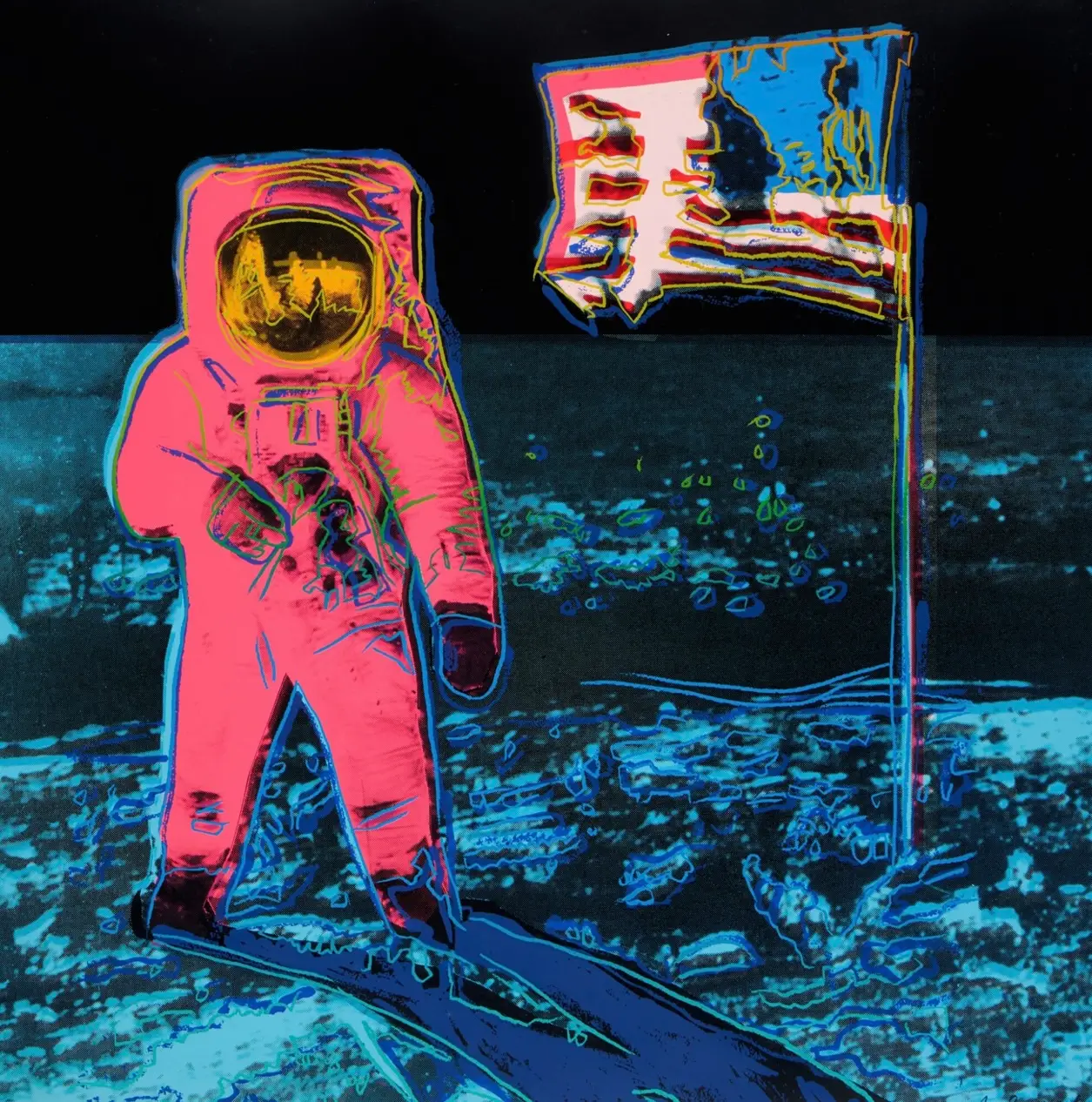
A figure stands planted on an uncharted surface—recognizable, yet estranged. The suit suggests protection, the visor reflection, the body containment. But in Moonwalk (Feldman & Schellmann II.405), Andy Warhol displaces expectation. This is not the moon landing as history remembers it; it is the moon landing as image, reprocessed through saturation, distortion, and detachment. The astronaut becomes less a person and more a broadcast signal.
The composition is immediate. A lone figure, centrally positioned, framed against a dark expanse that flattens depth into a nearly theatrical backdrop. To the right, a flag—tilted, unstable, its surface fractured into bands of color that resist coherence. The ground beneath is not lunar realism but a textured field of electric blues and scattered marks, suggesting debris, data, or residue. Warhol does not reconstruct the event; he destabilizes it.
fetch
Warhol’s approach to imagery has always hinged on removal—removal of context, of sequence, of origin. The moon landing, one of the most documented events of the twentieth century, arrives here stripped of its narrative arc. No rocket launch, no countdown, no national triumph. Only the afterimage remains: a figure and a flag.
This reduction aligns with Warhol’s broader treatment of icons. Whether rendering Marilyn Monroe or Elvis Presley, he isolates the moment where recognition becomes instantaneous. In Moonwalk, that recognition is collective. The astronaut does not need identification; the suit itself is enough. It operates as a universal sign, detached from any single mission or individual.
tincture
The most immediate rupture comes through color. The astronaut’s suit, rendered in a saturated, almost fluorescent pink, contradicts the expected neutrality of space gear. It does not describe reality—it overrides it. The visor glows with a metallic gold, reflecting an unseen environment that feels less like outer space and more like an interior projection.
Warhol’s palette functions less as aesthetic choice and more as intervention. By pushing color beyond plausibility, he interrupts the viewer’s instinct to read the image as documentation. The scene becomes synthetic, mediated, closer to television distortion than physical experience.
This aligns with the logic of the silkscreen process itself—where repetition, misregistration, and layering produce slight dislocations. Edges double, lines vibrate, contours refuse to settle. The astronaut appears outlined multiple times, as if caught between frames. The result is not motion in the cinematic sense but a visual echo, a residue of movement embedded within stillness.
show
The flag, positioned to the right, operates as a secondary focal point but carries disproportionate weight. Traditionally, it signifies conquest, presence, arrival. Here, its form is destabilized. The stripes fracture, the field warps, the entire object feels as though it is dissolving into the surrounding space.
Warhol does not remove the symbol; he corrodes it. The flag remains legible, but only just. Its authority is compromised by the same visual treatment that affects the astronaut. Both are subject to the same process of flattening and distortion, suggesting that no symbol—no matter how historically loaded—is immune to mediation.
In this sense, the print becomes less about the moon landing itself and more about how such events are consumed. The flag is not planted into lunar soil; it is embedded into visual culture, circulated, reproduced, altered.
process
Depth collapses across the composition. The background is a field of black, not infinite space but a void that refuses perspective. The ground, though textured, does not recede convincingly. Everything sits on the same plane, compressed into a single surface.
This flattening is central to Warhol’s practice. By eliminating depth, he removes hierarchy. Foreground and background become interchangeable. The astronaut does not occupy space; it exists on the same level as the ground, the flag, the void. The entire image reads as a surface to be scanned rather than a scene to be entered.
style
Produced in 1987, Moonwalk belongs to Warhol’s final year—a period marked by an increasing awareness of image overload. By this point, mass media had reached a saturation point where images no longer required context to be understood. Recognition was instantaneous, almost reflexive.
Warhol’s response is not to critique this condition directly but to mirror it. The print operates like a compressed media artifact. It delivers the essential elements—astronaut, flag, moon—without narrative scaffolding. The viewer completes the image through memory, filling in what has been omitted.
This strategy anticipates a future where images circulate independently of their origins, detached from the events they once represented. In this sense, Moonwalk feels less like a reflection on the past and more like a premonition of visual culture to come.
theory
By rendering the astronaut in this way, Warhol transforms it into a commodity form. The suit, once a tool of exploration, becomes a recognizable brand. Its contours, colors, and proportions are simplified into something that can be reproduced endlessly without losing meaning.
This aligns with Warhol’s longstanding interest in consumer goods—Campbell’s soup cans, Coca-Cola bottles—objects whose power lies in their repetition. The astronaut joins this lineage, not as an object of use but as an object of recognition.
shh
Despite its boldness, the image carries an undercurrent of absence. The astronaut’s face is hidden behind the visor, the body sealed within the suit. There is no access to interiority, no sense of the individual inside. The figure is present, yet inaccessible.
This tension mirrors Warhol’s broader engagement with celebrity and anonymity. View does not guarantee presence. The more recognizable the image, the less it reveals. The astronaut becomes a placeholder—a stand-in for an event, a history, a collective memory.
sum
Moonwalk (Feldman & Schellmann II.405) resists resolution. It does not offer a clear statement on the moon landing, nor does it attempt to reconstruct its significance. Instead, it operates at the level of the image itself—how it is formed, how it circulates, how it persists.
Warhol extracts the essentials and subjects them to his process: flattening, saturating, repeating. What remains is not the event but its afterimage—vivid, unstable, endlessly reproducible.
A figure in pink. A fractured flag. A surface that refuses depth.
The moon, not as place, but as picture.