Artemis II Restores Meaning to “To the Moon” as NASA Returns Humans Beyond Orbit

April 1, 2026
2 hours ago
The phrase “to the moon” has spent the better part of a decade transiently passing through digital culture—detached, inflated, and often trivialized. It became shorthand for speculative ascent, a meme of exponential promise tethered more to volatility than to velocity. Yet today, the phrase regains its original gravity. It returns to physics, to risk, to human ambition measured not in market caps but in trajectories and burn windows.
On this morning—weather permitting—NASA prepares to send four astronauts beyond low Earth orbit for the first time in over half a century. The mission, formally known as Artemis II, represents not only a technical rehearsal but a recalibration of what exploration signifies in 2026. Three Americans and one Canadian will trace a path around the Moon before returning home, marking a pivotal step in the broader Artemis program—a $100 billion undertaking designed to reestablish a sustained human presence on and around the lunar surface.
This is not spectacle for spectacle’s sake. It is infrastructure in motion.
stir
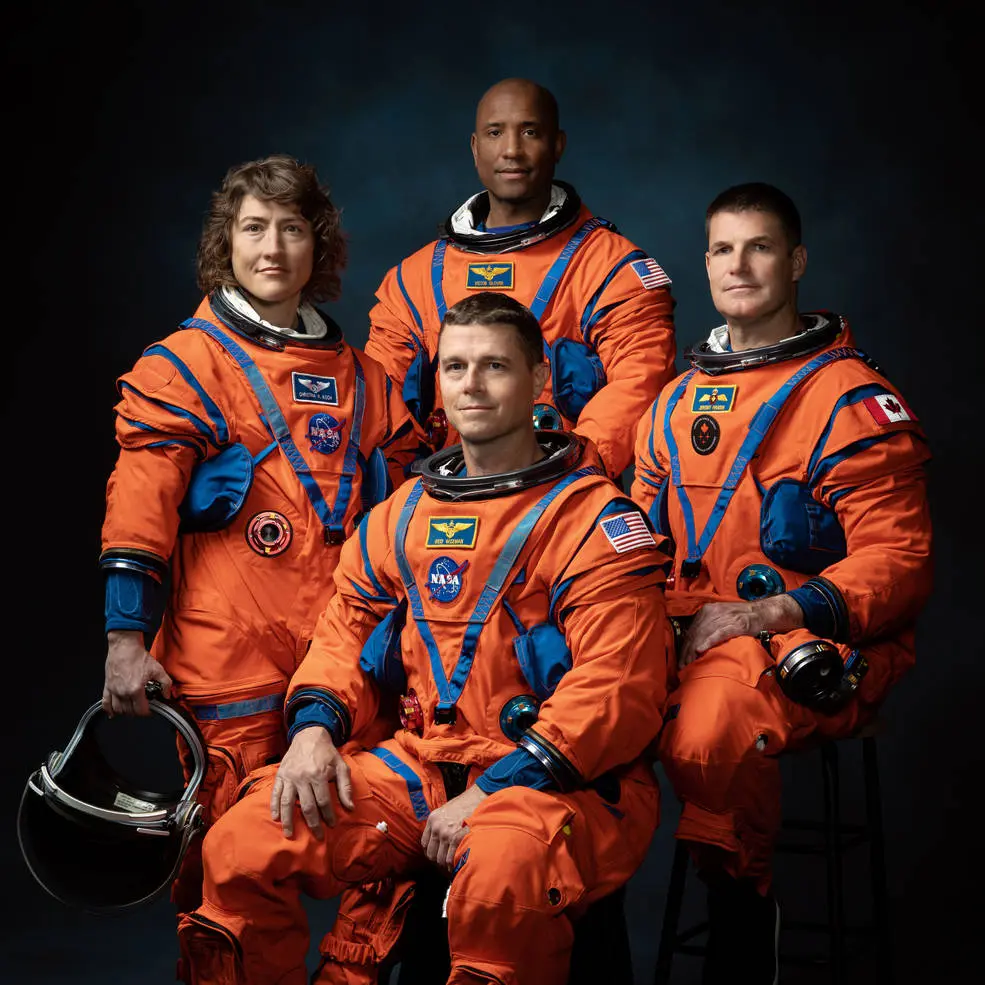
The four-person crew reflects a deliberate shift in how spacefaring nations narrate themselves. Commander Reid Wisemanleads the mission alongside pilot Victor Glover, mission specialist Christina Koch, and Canadian Space Agency astronaut Jeremy Hansen.
The composition is frequently framed in terms of milestones: the first woman, the first person of color, and the first non-American to travel beyond low Earth orbit. These distinctions are accurate, but they risk flattening the deeper transformation underway. The crew is less a collection of “firsts” than a reflection of a broadened operational baseline.
In prior eras, representation in spaceflight often followed symbolic logic—gestures that acknowledged change without fully embedding it into institutional practice. Artemis suggests something more structural. The inclusion of Hansen, for instance, underscores the evolving international architecture of exploration. The Moon is no longer framed as a national endpoint but as a shared domain, negotiated through alliances, technology transfers, and cooperative funding models.
Glover’s presence carries its own quiet weight. As a naval aviator and experienced astronaut, his role is defined by capability rather than narrative framing. Yet his participation inevitably resonates beyond the technical, reframing who is seen—and who sees themselves—as part of humanity’s outward expansion.
Koch, who previously set records for long-duration spaceflight, brings continuity between orbital endurance and deep-space ambition. Wiseman, as commander, anchors the mission in operational discipline, bridging past NASA experience with future-facing objectives.
Together, they form a crew that feels less like an exception and more like a preview.
Nothing but gratitude for the men and women of this great nation. It is time to fly. pic.twitter.com/n1TGuNt7s9
— Reid Wiseman (@astro_reid) March 31, 2026
flow
To leave low Earth orbit is to cross an invisible threshold—one that is both technical and psychological. Since the final Apollo 17 mission in 1972, human spaceflight has remained largely confined to orbital regimes: the International Space Station, shuttle-era trajectories, and commercial flights that skim the boundary of space without fully departing Earth’s gravitational conversation.
Artemis II breaks that pattern. Its trajectory will carry the crew into a distant retrograde orbit around the Moon before looping them back toward Earth. The journey will span approximately ten days, during which the Orion spacecraft must demonstrate life-support resilience, navigation precision, and communication integrity across deep-space distances.
Unlike Apollo, which operated under the urgency of geopolitical competition, Artemis unfolds within a more complex matrix of motivations. There is still national prestige, certainly, but it is interwoven with commercial partnerships, scientific agendas, and long-term habitation strategies. The mission is less about planting a flag than about establishing a corridor.
The distance itself remains unforgiving. At its farthest point, the spacecraft will travel hundreds of thousands of miles from Earth—far enough that real-time intervention becomes impossible. Autonomy, both human and machine, becomes essential. Every system must function not as a prototype but as a precursor to routine operation.
In this sense, Artemis II is both a rehearsal and a declaration. It asserts that deep space is no longer an episodic destination but an emerging environment.
a return
At the center of this effort is the Orion spacecraft, paired with the Space Launch System (SLS)—a configuration that has drawn both admiration and critique. The engineering challenge is immense: a vehicle capable of sustaining human life far beyond Earth’s protective magnetosphere, then surviving the intense heat of reentry at lunar-return velocities.
Yet the machinery also embodies the tensions that have shaped the Artemis program. Years of contractor delays, budget overruns, and shifting timelines have complicated the narrative. The program’s estimated cost—approaching $100 billion—has invited scrutiny from policymakers and analysts alike.
These challenges are not incidental; they are intrinsic to the scale of the endeavor. Artemis operates at the intersection of legacy aerospace practices and emerging commercial dynamics. It must reconcile the precision and safety requirements of government-led missions with the speed and cost pressures introduced by private-sector innovation.
The result is a program that sometimes appears contradictory: both methodical and ambitious, both delayed and urgent. Artemis II, therefore, functions as a moment of convergence. It is where accumulated investment meets visible execution.
If successful, it will validate not just a spacecraft but an approach—a way of organizing resources, partnerships, and expectations around the long arc of exploration.
theory
The ultimate objective of the Artemis program extends far beyond a single orbit. It aims to establish a sustained human presence on the Moon, particularly near the lunar south pole, where water ice deposits may enable in-situ resource utilization.
This is where the program’s ambition becomes most apparent. The Moon is no longer envisioned solely as a destination but as infrastructure—a staging ground for deeper missions, including eventual journeys to Mars. The planned Gateway station, a lunar-orbiting platform, will serve as a hub for logistics, research, and international collection.
In this context, Artemis II is less about reaching the Moon than about learning how to operate around it. The mission will test the rhythms of deep-space travel: communication delays, radiation exposure, and the psychological dimensions of distance.
These factors are often abstract in discussion but concrete in execution. The Moon, for all its familiarity in the night sky, remains an environment of extremes—temperature swings, regolith hazards, and gravitational conditions that challenge human physiology.
To engage with it meaningfully requires more than a landing. It requires systems that can endure, adapt, and scale.
stasis
There is also a cultural dimension to this moment, one that extends beyond aerospace engineering. The renewed focus on lunar exploration arrives at a time when space has become both more accessible and more commodified. Private companies offer suborbital experiences, satellites proliferate, and the language of space permeates everything from fashion to finance.
Against this backdrop, Artemis II reintroduces a different kind of gravity. It emphasizes continuity over disruption, patience over immediacy. The mission unfolds over years of preparation, culminating in a journey that, while brief in duration, carries decades of implication.
The crew’s voyage will be watched globally, not merely as a technical achievement but as a shared event. In an era of fragmented attention, such moments are rare. They offer a temporary alignment—a sense that humanity is, however briefly, oriented toward a common horizon.
The phrase “to the moon,” once untethered, regains specificity. It refers again to distance, to effort, to the fragile interplay between aspiration and execution.
fin
What follows Artemis II is both clear and uncertain. Subsequent missions aim to land astronauts on the lunar surface, deploy infrastructure, and extend the duration of human presence. Yet each step introduces new protean—technical, financial, and political.
Exploration, by its nature, resists linear narratives. It advances through iteration, adaptation, and occasional setback. The Artemis program embodies this dynamic, balancing long-term vision with near-term execution.
For the four astronauts aboard this mission, the experience will be immediate and personal. They will witness Earth from a vantage point few have seen—a small, luminous sphere suspended in darkness. They will navigate distances that render familiar scales irrelevant. They will return with data, insights, and perspectives that extend beyond the mission’s formal objectives.
In doing so, it restores a measure of clarity to a phrase that had become diffuse. “To the moon” is no longer a metaphor. It is, once again, a destination—one that demands precision, resilience, and a willingness to engage with the unknown.