A24’s Backrooms: Where Architecture Replaces Narrative and Fear Refuses Resolution

April 1, 2026
2 hours ago
a threshold
There is a particular kind of fear that does not announce itself with violence. It hums. It lingers. It repeats. The first full trailer for Backrooms, directed by Kane Parsons and produced under A24, leans fully into that quieter register of terror—the kind that unfolds not through spectacle but through disorientation.
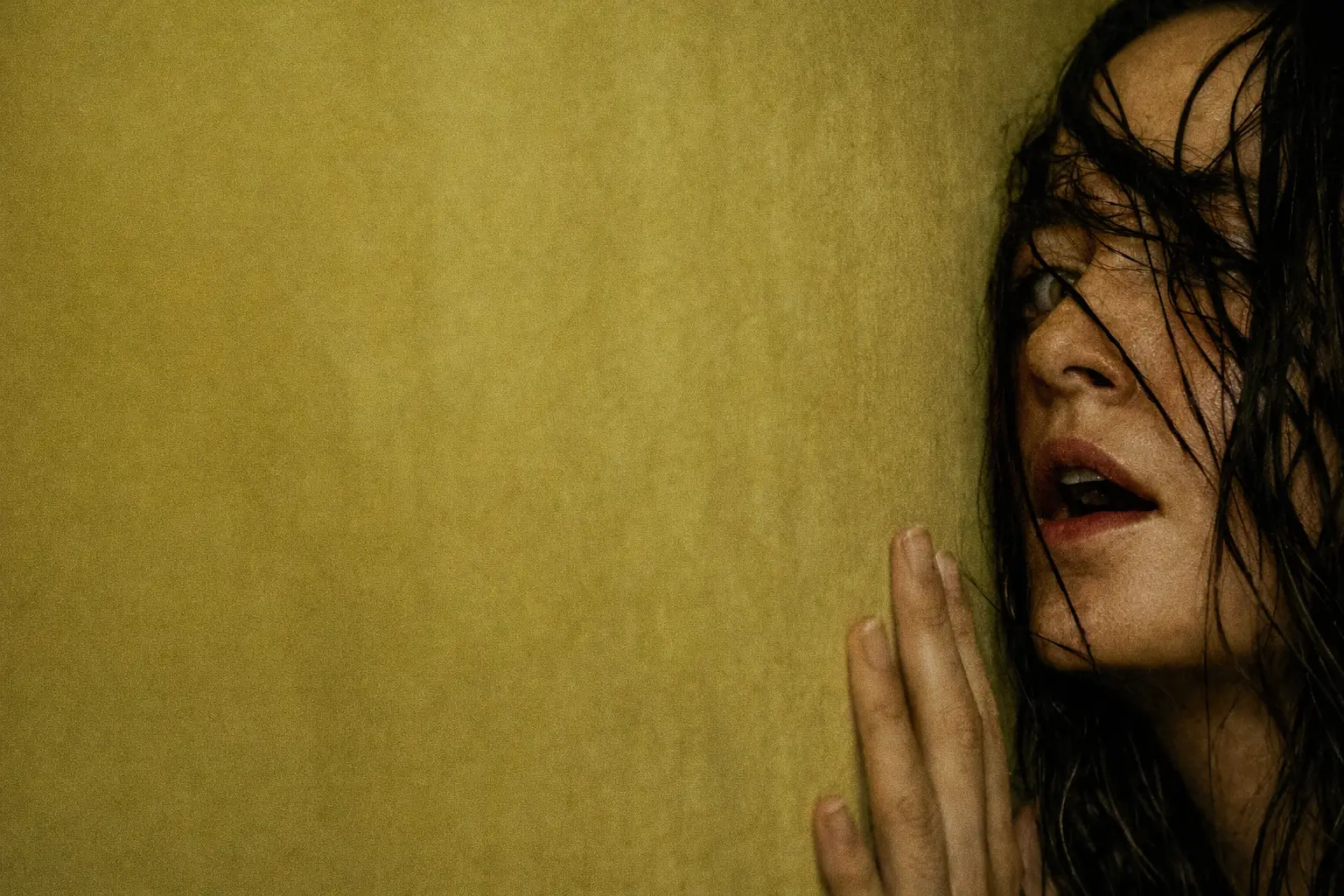
What begins as an almost banal visual—yellowed wallpaper, humming fluorescent lights, carpet stretching into vanishing points—gradually destabilizes. The camera does not rush. It drifts. It searches. And in doing so, it invites the viewer into a space that feels at once artificial and impossibly real.
At the center of this descent is Renate Reinsve, whose presence grounds the film in something human even as the environment resists comprehension. Opposite her, Chiwetel Ejiofor appears less as a stabilizing force than as another fragment within the maze—someone equally subject to its quiet unraveling logic.
View this post on Instagram
myth
The Backrooms concept emerged not from traditional literary or cinematic lineage, but from the diffuse, often anonymous ecosystem of internet folklore—specifically, a post on 4chan that described a hidden layer of reality accessible through “noclipping” out of the physical world.
The original description was deceptively simple: an endless expanse of empty office-like rooms, saturated in yellow tones, buzzing with fluorescent lights, and devoid of exit. It was not the presence of monsters that made it terrifying, but the implication of infinity without variation.
Kane Parsons, who first brought the concept into visual form through his viral analog horror shorts, understood that the terror of the Backrooms lies in its refusal to escalate. There is no narrative crescendo in the traditional sense. Instead, there is accumulation—of repetition, of unease, of spatial contradiction.
Under the stewardship of A24, the project evolves from internet curiosity into something closer to modern mythmaking. The studio, known for its deliberate approach to horror—seen in films like Hereditary and The Lighthouse—appears to treat the Backrooms not as a gimmick, but as a philosophical space.
protagonist
Reinsve’s casting is particularly telling. Her breakout performance in The Worst Person in the World was defined by emotional precision—an ability to convey internal fragmentation without overt dramatics. In Backrooms, that quality becomes essential.
The trailer offers glimpses of her character navigating the labyrinth with a growing sense of detachment. She touches the walls as if to confirm their materiality. She listens for something beyond the hum. She hesitates at intersections that look identical in every direction.
What emerges is not panic, but erosion. Identity itself seems to thin out in the face of spatial repetition. The question is no longer “How do I escape?” but “What remains of me if I cannot?”
people
If Reinsve embodies the dissolution of the self, Ejiofor’s presence suggests something more ambiguous. His character, glimpsed intermittently, appears both guide and anomaly.
There are moments in the trailer where he seems to understand the rules of the space—if rules can be said to exist at all. And yet, his composure is never reassuring. It hints at familiarity, perhaps even complicity.
This dynamic introduces a subtle tension: is the Backrooms an external phenomenon, or is it something generated—sustained—by those within it?
antagonist
The defining feature of Backrooms is not its characters, but its environment. The labyrinth is not merely a setting; it is the film’s central force.
The production design leans heavily into analog textures—grain, flicker, imperfection. Walls feel too close, ceilings too low, corridors too long. The geometry resists mapping. Corners lead back to themselves. Distances expand and contract without warning.
House of Leaves inevitably comes to mind—not as direct inspiration, but as a parallel exploration of impossible architecture. Both works treat space as something mutable, capable of reflecting psychological states while also existing independently of them.
Yet where House of Leaves fractures through language and typography, Backrooms does so through image and duration. The camera becomes a kind of witness, documenting a reality that refuses coherence.
show
The term “liminal” has, in recent years, become a shorthand for a specific visual and emotional register—spaces caught between functions, between times, between identities. Empty malls, abandoned offices, transitional hallways.
Backrooms distills this aesthetic to its purest form. There are no external references, no contextual anchors. The space exists in perpetual suspension.
This is where the film distinguishes itself from conventional horror. There is no catharsis in confrontation. No release in revelation. The fear is not that something will happen, but that nothing will change.
A24’s involvement suggests a commitment to preserving this restraint. Rather than amplifying the concept with excessive narrative scaffolding, the studio appears to allow the space to speak—or rather, to hum.
vibe
Though the trailer is primarily visual, its sound design is impossible to ignore. The constant buzz of fluorescent lighting becomes a kind of baseline anxiety—an auditory equivalent of the endless corridors.
Occasional disruptions—distant echoes, indistinct movements—do not resolve into identifiable threats. They remain ambiguous, resisting classification.
This approach aligns with the broader philosophy of analog horror, where the unknown is not revealed, but suggested. The absence of clear danger becomes its own form of menace.
different
One of the most intriguing aspects of Backrooms is its translation from digital artifact to physical production. What began as a low-resolution, internet-native concept is now rendered with cinematic precision.
And yet, the film resists the temptation to “upgrade” its aesthetic. The grain remains. The imperfections persist. The view language retains its analog roots, even within a high-budget framework.
This tension—between digital origin and physical execution—mirrors the thematic tension of the Backrooms itself: a space that feels both constructed and discovered.
new
Backrooms arrives at a moment when horror is increasingly defined by its ability to evoke rather than explain. The genre’s most resonant works in recent years have prioritized atmosphere over narrative closure, ambiguity over certainty.
In this context, the Backrooms feels less like an outlier and more like a culmination—a distillation of contemporary anxieties into a single, endlessly repeating space.
It speaks to a cultural moment defined by dislocation. By the sense that familiar environments can become alien without warning. That systems we rely on can reveal themselves as arbitrary, even hostile.
clue
The trailer does not offer answers. It does not even promise them. Instead, it presents a proposition: what if the most terrifying space is one that does not change, does not respond, does not end?
For audiences familiar with the original creepypasta, this adaptation represents both validation and transformation. For those encountering the concept for the first time, it offers something rarer—a horror that unfolds slowly, insistently, and without resolution.
As the camera adjusts away through yet another identical hallway, the realization settles in: escape may not be the point. The Backrooms is not a place to leave. It is a place to remain.
And in that permanence, it finds its deepest horror.