Banksy’s Barcode Leopard and the Art of Escapism From Vulnerable

March 9, 2026
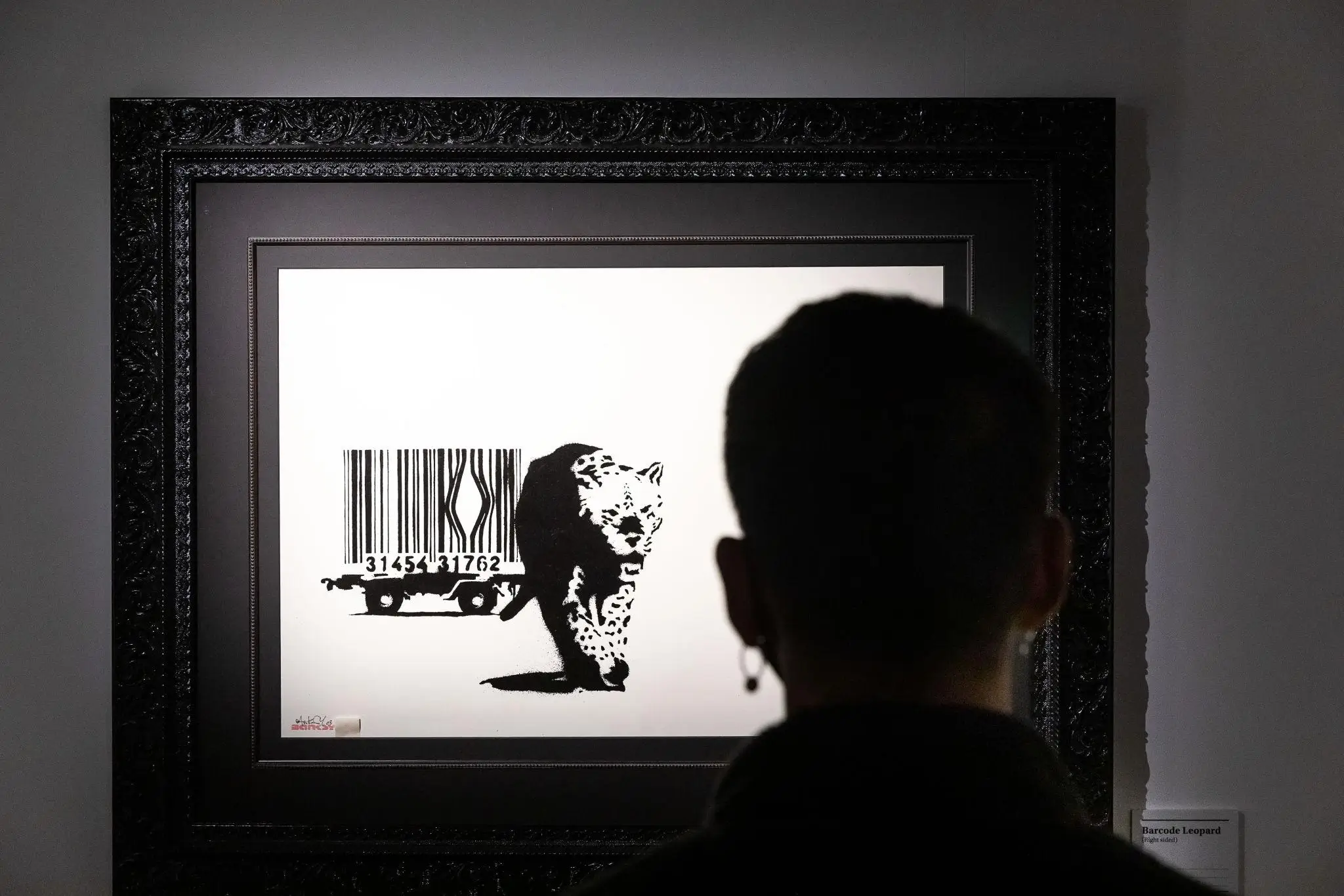
Among the many images that define the visual language of modern street art, few are as instantly recognizable as Barcode Leopard. Created by the elusive British artist Banksy in the early 2000s, the stencil depicts a wild leopard escaping from a barcode-shaped cage—an image that merges political commentary, pop iconography, and minimalist graphic design. Like much of Banksy’s work, the piece functions as both a critique and a provocation. It questions consumer culture, the commodification of nature, and the way capitalism reshapes the natural world into products and symbols.
Over the past two decades, Barcode Leopard has evolved from a simple graffiti stencil into one of Banksy’s most discussed visual metaphors. The artwork encapsulates a defining moment in the development of contemporary street art, when graffiti began shifting from underground rebellion toward global cultural relevance. In doing so, it also reflects Banksy’s broader artistic philosophy: art should confront power structures, challenge the viewer, and remain accessible to everyone.
banksy
The rise of Banksy occurred during the late 1990s and early 2000s, a period when urban street art was undergoing a major transformation. Originally associated with graffiti tagging culture, street art gradually expanded into more complex visual practices that blended graphic design, political messaging, and conceptual art.
Banksy, whose real identity remains unknown, began working in Bristol, England. The city’s vibrant underground scene encouraged experimentation, and Banksy quickly developed a distinctive style based on stencil techniques. Stencils allowed him to produce intricate images rapidly—an important advantage when painting illegally in public spaces.
By the early 2000s, Banksy’s work began appearing throughout London and other major cities. His imagery frequently combined humor, irony, and biting social critique. Soldiers painted with smiley faces, riot police holding balloons, and children interacting with symbols of authority became recurring motifs.
Within this evolving visual vocabulary, Barcode Leopard emerged as one of Banksy’s most striking conceptual pieces.
view
At first glance, Barcode Leopard appears deceptively simple. The composition features a leopard sprinting forward, its body partially emerging from a barcode that resembles the bars of a cage. The animal appears frozen mid-motion, its muscular body twisting as it escapes confinement.
The stark black stencil contrasts sharply with the white wall behind it. This minimalism gives the image graphic clarity and immediate readability—one of Banksy’s trademarks.
The barcode, meanwhile, functions as a powerful visual metaphor. Normally associated with retail goods, logistics, and mass production, the barcode here transforms into a prison-like structure. The implication is immediate: the natural world has been reduced to a commodity.
By placing a wild animal inside a barcode, Banksy collapses two worlds that rarely intersect—nature and commerce.
The leopard’s escape suggests resistance, survival, and the enduring power of the natural world.
flow
Like many of Banksy’s works, Barcode Leopard invites multiple interpretations. Yet its core message revolves around the relationship between consumer capitalism and nature.
Barcodes symbolize the infrastructure of modern commerce. They represent the systems that categorize, price, and distribute goods across global markets. Every item in a supermarket—from fruit to clothing—passes through this coded structure.
By turning the barcode into a cage, Banksy suggests that capitalism captures and transforms everything it touches.
Nature becomes merchandise.
Animals become logos.
Landscapes become commodities.
The leopard, however, refuses to remain contained. Its movement suggests rebellion against this system. The animal bursts out of the rigid lines of the barcode, reclaiming freedom.
In this sense, the artwork becomes a visual allegory for environmental resistance.
stir
Environmental themes have long appeared in Banksy’s work. While not always overtly ecological, many of his images critique humanity’s relationship with nature.
Barcode Leopard belongs to this tradition.
The piece reflects growing concerns about wildlife exploitation, habitat destruction, and the commercialization of natural ecosystems. Over the past century, wild animals have increasingly been transformed into marketing symbols—appearing on clothing, advertisements, sports logos, and luxury branding.
Leopards themselves carry strong associations with fashion and status. Leopard print has long been used in clothing, often representing luxury or exoticism.
Banksy’s image reverses this relationship.
Instead of humans appropriating the leopard as decoration, the animal breaks free from the commercial system itself.
The message becomes clear: nature cannot ultimately be controlled or reduced to product codes.
role
Despite its serious themes, Barcode Leopard also contains a layer of humor—a hallmark of Banksy’s artistic approach.
The idea of a leopard escaping from a barcode cage is both absurd and clever. It plays on visual logic while simultaneously subverting it. This mixture of wit and critique allows Banksy’s work to communicate complex ideas quickly.
Street art often relies on immediacy. Viewers encounter it unexpectedly while walking through urban environments. Unlike museum art, which invites slow contemplation, street art must deliver its message instantly.
Banksy achieves this through visual punchlines.
In Barcode Leopard, the joke arrives the moment the viewer recognizes the barcode as a cage.
show
The placement of Barcode Leopard in public space is essential to its meaning. Street art transforms ordinary urban environments into platforms for political and cultural commentary.
By painting on walls rather than gallery canvases, Banksy disrupts traditional art hierarchies. His work reaches audiences who might never enter museums.
Public art also introduces an element of risk and impermanence. Street artworks can be removed, painted over, or destroyed. Yet this fragility often enhances their cultural power.
In the case of Barcode Leopard, the image has appeared in multiple locations and formats over the years. Sometimes it appears as a stencil on walls; other times it circulates as prints, reproductions, or digital images.
The artwork therefore exists both physically and symbolically.
commodification and the art market paradox
Ironically, Banksy’s critique of consumer culture has itself become highly valuable in the art market.
Works by Banksy now sell for millions at major auctions. Murals have been cut out of walls and transported into galleries. Collectors compete for limited-edition prints.
This paradox—anti-capitalist art becoming luxury commodities—has become one of the defining tensions of Banksy’s career.
Barcode Leopard embodies this contradiction perfectly.
An artwork criticizing commercialization is now reproduced on posters, clothing, and art prints worldwide.
Yet this tension may actually reinforce Banksy’s message. The art market’s appetite for his work demonstrates precisely the mechanisms he critiques.
Even resistance becomes a product.
culture
Over time, Barcode Leopard has become one of the most widely recognized images in contemporary street art.
Its simplicity allows it to travel easily across cultures and contexts. The barcode is a universal symbol, instantly recognizable regardless of language.
The image has also inspired countless reinterpretations by other artists. Street artists frequently reference or remix Banksy’s motifs, expanding their meanings in new ways.
Beyond the art world, the piece resonates with broader cultural conversations about sustainability, corporate power, and environmental preservation.
In an era defined by climate anxiety and ecological crisis, the image of a wild animal escaping from the machinery of commerce feels especially relevant.
the arcane
Part of the fascination surrounding Barcode Leopard lies in the mysterious identity of its creator.
Banksy has remained anonymous for decades, communicating primarily through artworks and occasional statements. This anonymity allows the art itself to take center stage, rather than the personality of the artist.
It also reinforces Banksy’s anti-establishment stance. By refusing celebrity status, he resists the traditional mechanisms that elevate artists into marketable brands.
Ironically, this secrecy has only amplified his fame.
Banksy has become one of the most recognizable artists in the world without ever publicly revealing his face.
leg
Today, Banksy occupies a unique position in the global art landscape. His work bridges multiple worlds: street culture, political activism, contemporary art, and mass media.
Barcode Leopard stands as a key example of how simple imagery can communicate powerful ideas. The artwork distills complex critiques of capitalism and environmental exploitation into a single visual moment.
Few images manage to combine elegance, humor, and political commentary so effectively.
The piece also illustrates the power of street art to shape public discourse. What began as a stencil on a wall has evolved into an internationally recognized symbol of resistance against commodification.
fin
Barcode Leopard remains one of the defining works of Banksy’s career. Through a simple yet striking composition, the artwork exposes the tension between nature and consumer culture.
The leopard’s escape from the barcode cage serves as both metaphor and warning. It reminds viewers that the natural world cannot be fully contained within systems of commerce and control.
At the same time, the piece reflects the paradoxes of contemporary art: rebellion transformed into collectible, critique absorbed by the market.
Yet perhaps that is precisely the point.
Banksy’s work thrives in these contradictions. By confronting audiences with uncomfortable truths—delivered through humor, irony, and unforgettable imagery—he ensures that his art continues to spark conversation long after the paint dries.
More than two decades after its creation, Barcode Leopard still resonates with urgency. In a world increasingly defined by consumption and ecological strain, the image of a wild animal breaking free from a barcode cage feels not only clever but prophetic.


No comments yet.