Banksy’s Girl With Balloon (2004): The Print That Defined a Movement

March 5, 2026
myth
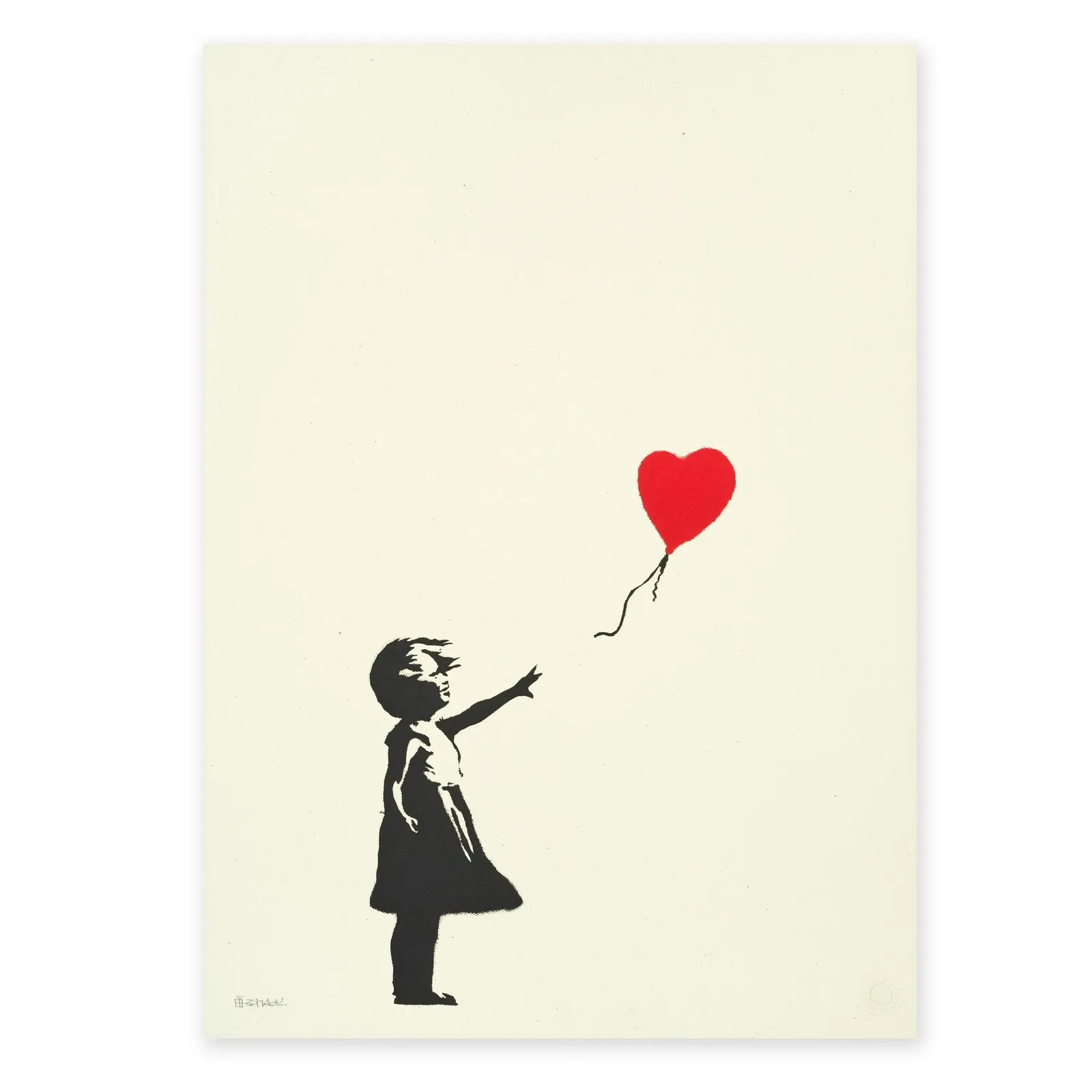
Few images in contemporary art carry the universal emotional weight of Girl With Balloon. Created in 2004 by the elusive British street artist Banksy, the work has transcended its origins as urban stencil graffiti to become one of the most recognized artworks of the 21st century. Its simple visual narrative—a small girl stretching toward a drifting heart-shaped balloon—communicates loss, hope, and fragility with remarkable immediacy.
The screenprint edition produced in 2004 represents one of the most coveted forms of the artwork outside of the original street murals. Printed in colors on wove paper and measuring 70 × 50 cm, the edition of 150 captures the aesthetic clarity of Banksy’s stencil technique while preserving the political poetry that made the image famous.
Today, these prints circulate in major auctions, galleries, and private collections, becoming a cornerstone of the modern street art market. Yet the story of Girl With Balloon is far more than an auction success. It reflects the transformation of graffiti into institutional art, the power of anonymity in contemporary culture, and the persistent resonance of a single image across generations.
stir
Banksy emerged from the underground graffiti scene of Bristol in the late 1990s. Like many artists associated with the city’s DIY culture, he experimented with stenciling as a way to produce complex imagery quickly while evading authorities.
The technique soon became central to his visual language. Crisp silhouettes, stark monochrome figures, and minimal color accents allowed his images to read clearly even on rough urban surfaces.
Girl With Balloon appeared in several public installations in London during the early 2000s, including along the South Bank near Waterloo Bridge. The original mural showed the girl reaching toward the balloon accompanied by the phrase:
“There is always hope.”
This phrase reinforced the emotional ambiguity of the image. Was the balloon slipping away? Or was it drifting toward the girl?
The 2004 screenprint edition allowed collectors to acquire a version of the image that retained its stencil-like immediacy while translating it into a gallery format. Published by Pictures On Walls, a legendary London print publisher associated with Banksy and other street artists, the edition helped elevate the artist’s reputation in the global art market.
The prints were produced using traditional screenprinting methods on wove paper, maintaining the texture and tonal quality associated with handmade editions.
symbol
The visual structure of Girl With Balloon is deceptively simple. The composition contains only three essential elements:
• the girl rendered in black stencil
• the red heart-shaped balloon
• the empty white space between them
This minimalist approach intensifies the emotional tension within the image.
The girl’s posture suggests movement—either reaching out or letting go. The balloon floats just beyond her grasp, caught mid-drift in a moment of suspension.
Critics often interpret the balloon as a symbol of hope, innocence, or fleeting happiness. The heart shape reinforces associations with love and vulnerability.
By contrast, the stark silhouette of the girl removes individual identity, turning her into an archetype rather than a specific person. This anonymity invites viewers to project their own emotions onto the scene.
This emotional openness is precisely what allows the image to resonate across cultures and contexts. Unlike many political works by Banksy that rely on satire or topical references, Girl With Balloon speaks in universal symbolic language.
style
The 2004 print edition is one of the most recognized versions of the artwork among collectors.
Key technical details include:
Medium: screenprint in colors on wove paper
Size: 70 × 50 cm (27 3/5 × 19 7/10 inches)
Edition: 150
Publisher: Pictures On Walls
Each print is signed and numbered by the artist and accompanied by authentication through the official Banksy verification authority, Pest Control Office.
Authentication has become a crucial aspect of Banksy’s market due to the proliferation of unauthorized reproductions. Pest Control was established specifically to verify genuine works by the artist, issuing certificates of authenticity required by major auction houses and galleries.
This official certification ensures that legitimate works maintain their value in the secondary market.
fwd
Collectors evaluating a Banksy print often pay close attention to condition details, especially for works produced on paper.
Typical issues include:
handling creases
edge wear
surface marks
faint border discoloration from framing
In the case described in the auction listing, the print remains in overall good condition, with minor handling creases and slight imperfections visible only upon close inspection.
There are also light markings on the verso of the sheet, likely caused by previous framing, and a restoration to the blindstamp on the lower right corner performed by Pest Control.
Such conservation work is not unusual for prints that have circulated among collectors for many years. In fact, professional restoration by the authentication authority often strengthens the credibility of the artwork.
show
The market for Banksy works has expanded dramatically over the past two decades.
Once viewed primarily as a guerrilla street artist, Banksy is now among the most commercially successful living artists in the world. His auction results rival those of major contemporary painters.
In 2021, a Banksy painting sold for £18.6 million at Sotheby’s, establishing a record for the artist and confirming his place in the upper tier of the art market.
The success of his prints—especially Girl With Balloon—has played a significant role in this trajectory.
Because the edition size is relatively small (150 prints), demand among collectors consistently outpaces supply. As interest in street art continues to grow, early Banksy prints have become increasingly desirable investment pieces.
hx
The mythology surrounding Girl With Balloon expanded dramatically in 2018 when a framed print of the artwork self-destructed during a live auction at Sotheby’s.
Moments after the hammer fell, the artwork began sliding through a concealed shredder built into its frame, partially destroying the print before the stunned audience.
Banksy later revealed that the mechanism had been installed years earlier as a statement about the commodification of art.
The partially shredded work was subsequently retitled Love Is in the Bin and eventually resold for more than £18 million.
The stunt instantly became one of the most famous moments in art auction history, reinforcing Banksy’s reputation as both artist and provocateur.
More importantly, it demonstrated how the artist continues to manipulate the art market even while participating in it.
idea
When Banksy first began producing stenciled graffiti, street art existed largely outside institutional recognition.
Today, the situation is dramatically different.
Museums, galleries, and major auction houses regularly exhibit and sell works by artists once considered outsiders.
Banksy’s own interventions have included illegally hanging his artwork inside institutions such as the Louvre and the Museum of Modern Art in New York.
These acts blurred the boundaries between street art and traditional exhibition spaces, raising questions about who decides what counts as art.
Over time, the answer has shifted. Institutions that once ignored graffiti now actively collect and display it.
The print editions of Girl With Balloon symbolize this transformation: a street image reproduced as a collectible object within the art market.
why
Despite its commercial success, the emotional power of Girl With Balloon remains intact.
Part of its strength lies in its openness. The artwork never fully resolves whether the balloon represents hope or loss.
This ambiguity invites viewers to interpret the scene according to their own experiences.
In times of political uncertainty or social upheaval, the image often appears again in public discourse—on posters, murals, and digital media.
During the Syrian refugee crisis, Banksy reworked the image to depict a child floating with the balloon, emphasizing humanitarian themes.
These reinterpretations demonstrate how the image functions as a cultural symbol rather than a static artwork.
leg
Two decades after its creation, Girl With Balloon remains the defining image of Banksy’s career.
It encapsulates the essential qualities that make his work compelling:
clarity of message
visual simplicity
political undertones
emotional resonance
Few contemporary artworks achieve this level of cultural penetration while maintaining artistic credibility.
The 2004 screenprint edition stands as a particularly significant artifact within this history. It represents the moment when Banksy’s street interventions began to intersect with the global art market, creating a bridge between underground culture and institutional recognition.
For collectors, the print offers more than aesthetic appeal. It captures a pivotal moment in the evolution of contemporary art.
For audiences, the image continues to function as a quiet meditation on hope.
The girl’s outstretched hand and the drifting red balloon remain suspended in time—an eternal moment of reaching, losing, and believing.
No comments yet.