Barack Obama and Anthony Edwards: When Generations Meet on the Court

March 19, 2026
a cross
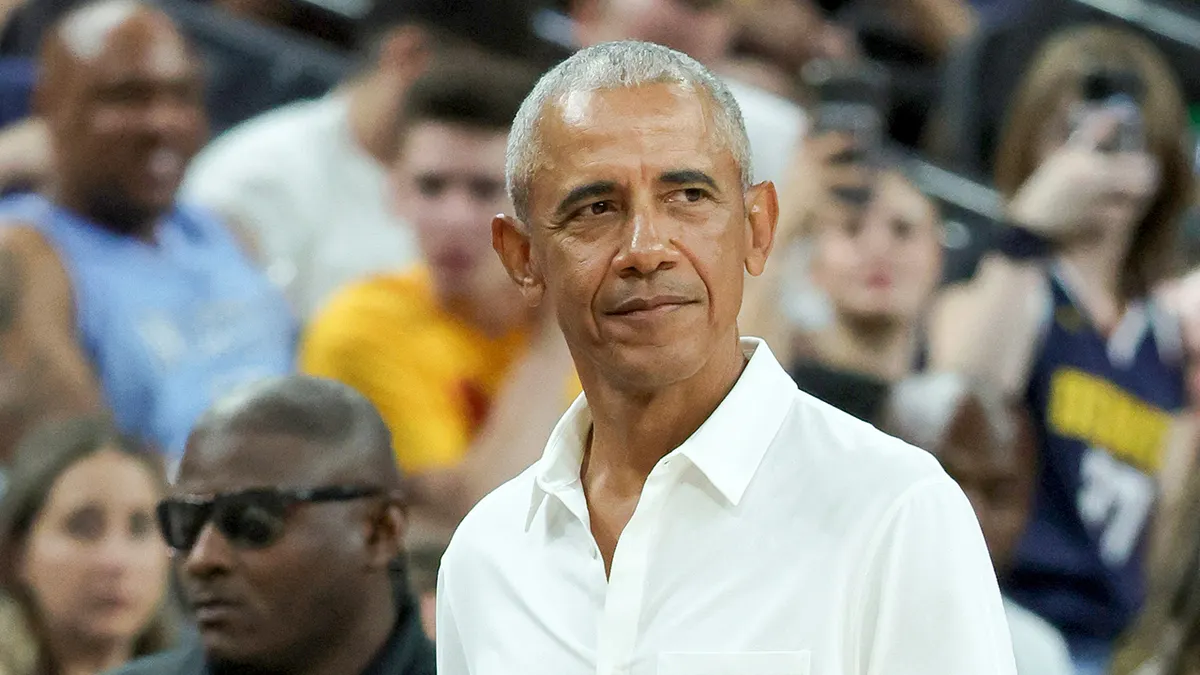
There are moments in sports culture that transcend the scoreboard—moments where timelines collapse, where legacy meets momentum, and where the past and present share the same hardwood. That’s exactly what unfolded when Barack Obama linked up with Anthony Edwards during NBA All-Star Weekend.
The clip, now circulating widely across social platforms, captures something deceptively simple: a shootaround. No official game, no stakes beyond pride. Yet the energy within it feels larger—charged by the weight of Obama’s cultural presence and Edwards’ rising star power. It’s not just basketball. It’s a dialogue between eras.
endure
Basketball has always been central to Barack Obama’s public identity. Long before the presidency, the sport was a constant—played on courts in Hawaii, Los Angeles, Chicago. Even during his time in the White House, pickup games became part of his routine, a ritual of both competition and clarity.
Obama didn’t just like basketball. He understood it.
His jump shot—smooth, left-handed, deliberate—became almost symbolic. It represented discipline, composure, and a certain cool under pressure. In many ways, it mirrored his political persona: measured, controlled, yet quietly confident.
So when he steps onto a court—even now—it doesn’t feel like a novelty. It feels like continuity.
And during All-Star Weekend, that continuity was on full display.
anthony
If Obama represents basketball’s cultural past, Anthony Edwards embodies its present—and possibly its future.
Explosive, charismatic, and unapologetically confident, Edwards has quickly become one of the NBA’s most compelling figures. His game is built on athleticism and instinct, but his personality is what elevates him beyond highlight reels.
He talks. He laughs. He competes.
And crucially, he brings an authenticity that resonates with a new generation of fans. There’s no filter, no over-calibration. What you see is what you get.
So when Edwards shares the court with Obama, the dynamic is instantly intriguing. It’s not just respect—it’s interaction. A blend of admiration and playful challenge.
View this post on Instagram
flow
The now-viral clip captures a sequence that feels almost cinematic. Obama, composed and relaxed, lines up shots with the ease of someone who’s done this thousands of times. Edwards, by contrast, moves with the kinetic energy of a player in his prime—quick, expressive, engaged.
There’s laughter. There’s chatter. And yes, there’s a hint of trash talk.
It’s not aggressive. It’s playful. But it matters.
Because in that exchange, the hierarchy dissolves. Obama is no longer just a former president. Edwards is no longer just a young star. They’re simply two competitors sharing a court.
That equality—brief but real—is what makes the moment resonate.
ball
What makes basketball unique among sports is its accessibility. Courts exist everywhere—urban parks, suburban schools, international arenas. The game travels easily, adapting to different contexts while maintaining its core identity.
That universality is what allows moments like this to happen.
A former president can step onto the same court as a current NBA star and immediately find common ground. The language is shared: dribbles, jump shots, movement, rhythm.
No translation required.
In this sense, the Obama–Edwards interaction is more than a viral clip. It’s a reminder of basketball’s role as a cultural bridge—connecting generations, professions, and perspectives.
all-star weekend
NBA All-Star Weekend has evolved far beyond its original purpose. What began as a showcase of talent has become a multi-layered cultural event—part sport, part entertainment, part networking ecosystem.
Celebrities, musicians, athletes, and public figures converge in one space, creating unexpected intersections.
Obama’s presence fits naturally within this environment. He’s long been aligned with the NBA’s cultural orbit, from filling out March Madness brackets to hosting championship teams at the White House.
Edwards, meanwhile, represents the league’s current trajectory—young, global, personality-driven.
Their interaction feels almost inevitable within this context. All-Star Weekend isn’t just about who scores the most points. It’s about who shows up—and what happens when they do.
view
In a pre-social media era, this moment might have lived only in memory. A few witnesses, a passing anecdote, perhaps a mention in a recap article.
Today, it becomes something else entirely.
The clip circulates instantly, reaching millions within hours. It’s dissected, shared, remixed. It becomes content—but also conversation.
Fans analyze Obama’s form. They react to Edwards’ energy. They debate who “won” the exchange, even if that wasn’t the point.
This amplification transforms a casual interaction into a cultural artifact.
And in doing so, it reinforces the idea that modern sports moments are no longer confined to arenas. They exist across platforms, shaped as much by audience engagement as by the event itself.
leg
There’s a subtle narrative thread running through the interaction: legacy meeting momentum.
Obama represents a completed arc—a figure whose impact is already cemented in history. Edwards represents an unfolding story, one still being written game by game, season by season.
When they share the court, those trajectories briefly align.
It’s not about comparison. It’s about contrast.
The calm assurance of experience versus the restless energy of youth. The precision of a practiced jumper versus the explosiveness of a rising star.
Together, they create a moment that feels both grounded and dynamic—rooted in history, yet oriented toward the future.
why
At first glance, it’s easy to dismiss the clip as light entertainment. A former president shooting hoops with an NBA player—interesting, but ultimately trivial.
But that reading misses the deeper significance.
Moments like this humanize figures who are often seen only through formal roles. Obama becomes less distant, more relatable. Edwards becomes more than just stats and highlights—he becomes part of a broader cultural narrative.
They also remind us of the connective power of sport.
In a fragmented media landscape, where audiences are divided across platforms and perspectives, shared moments still have the ability to cut through. They create common reference points, however brief.
And sometimes, that’s enough.
fin
What lingers after the clip isn’t a specific shot or a particular exchange. It’s the image itself: two figures from different worlds, united by a simple act of play.
No podium. No press conference. No scoreboard.
Just a basketball, a court, and a moment.
In an era defined by complexity and noise, that simplicity feels almost radical.
And perhaps that’s why it resonates so strongly.
Because at its core, basketball—like all great cultural forms—is about connection. Between players. Between generations. Between people who, for a moment, share the same space and the same rhythm.
Barack Obama and Anthony Edwards found that rhythm during All-Star Weekend.
And for a brief, compelling moment, the world watched them play.