Bardot By Warhol: Surface, Seduce, and the Mechanics of Fame

April 9, 2026
3 hours ago
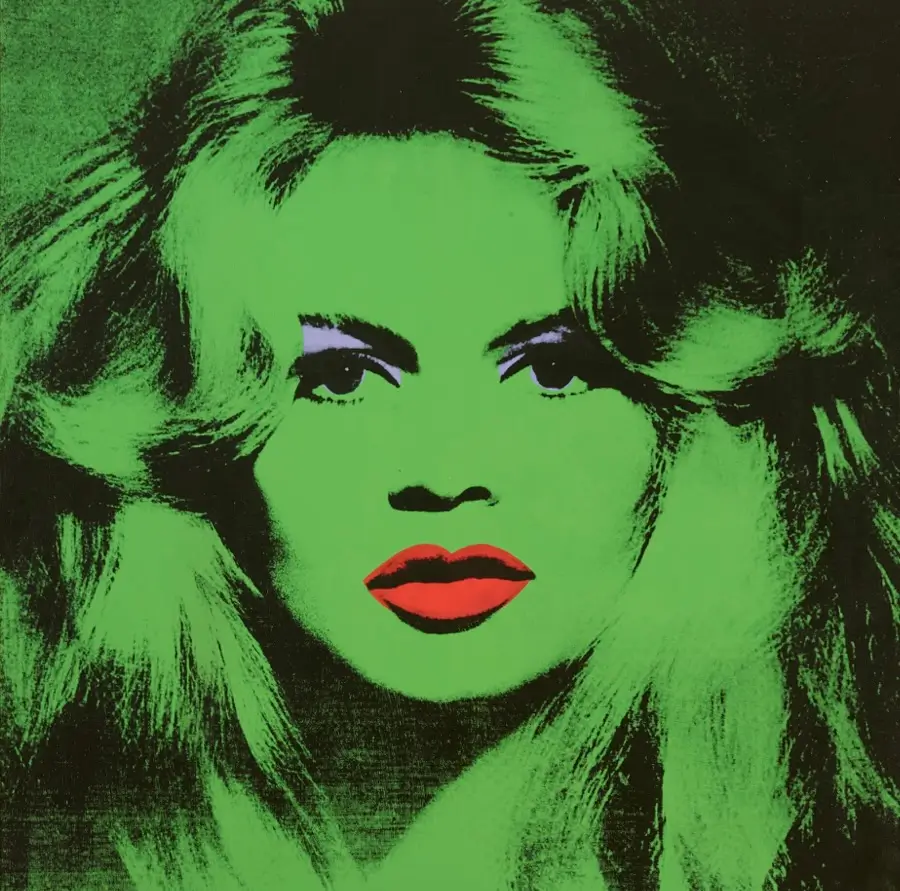
There are images that document a person, and then there are images that replace them. The portraits of Brigitte Bardot by Andy Warhol belong to the latter category. They do not attempt to capture Bardot as she was, nor even as she appeared to the public. Instead, they stage her as a surface—an endlessly reproducible image, suspended somewhere between myth and mechanical reproduction.
Within the context of the Gunter Sachs collection, these works acquire a different gravity. Sachs was not simply a collector of Warhol; he was part of the same orbit of glamour, wealth, and spectacle that Warhol both observed and consumed. Bardot, Sachs, Warhol—three figures bound not by medium but by a shared understanding of visibility as currency.
To look at Bardot through Warhol is to look at a system that produces icons rather than individuals.
stir
The significance of the Sachs collection lies not only in its holdings but in its proximity. Gunter Sachs was deeply embedded in the visual culture that Andy Warhol distilled into art. His brief marriage to Brigitte Bardot—a union as public as it was fleeting—cemented his place within the mythology of European celebrity.
Sachs collected Warhol not as an outsider but as a participant. His acquisitions were less about ownership and more about proximity to a language that mirrored his own life. In Warhol’s portraits, Sachs could recognize the grammar of fame: repetition, stylization, and the flattening of personality into sign.
This is what gives the Bardot series its particular resonance within the collection. Bardot is not simply another subject; she is a figure who already existed within Sachs’ personal narrative. Warhol’s intervention transforms her into something else entirely—no longer a person remembered, but an image that refuses to settle into memory.
method
Warhol’s silkscreen process is often described in technical terms, but its real function is philosophical. The screen is not simply a tool; it is a filter that strips away the illusion of uniqueness. In the Bardot portraits, this becomes immediately visible. Her face is repeated, recolored, slightly misaligned—a sequence rather than a singularity.
Where traditional portraiture seeks to stabilize identity, Warhol destabilizes it. Bardot’s features—her eyes, her lips, the architecture of her hair—become modular elements that can be rearranged through color and repetition. Each iteration feels both identical and estranged, as though the image is attempting to remember itself and failing.
This is not a flaw but the point. Warhol’s Bardot is not an individual but a system of appearances.Color as Distortion, Color as Truth
One of the most striking elements of the Bardot series is Warhol’s use of color. It is never descriptive; it does not aim to replicate the natural tones of Bardot’s skin or hair. Instead, color functions as a form of distortion—a way of emphasizing the artificiality of the image.
A face rendered in electric pink or acid green does not invite recognition; it demands interpretation. Warhol understood that color, when detached from realism, becomes a signal rather than a representation. In the Bardot works, color operates like a language of excess, amplifying the already heightened nature of her public persona.
But there is also a strange honesty in this distortion. By refusing naturalism, Warhol reveals the constructed nature of Bardot’s image. The colors may be artificial, but so is the idea of Bardot as a fixed identity. What Warhol offers instead is a series of possibilities—a spectrum of Bardots, each one equally valid and equally unstable.


bardot
By the time Warhol turned his attention to Brigitte Bardot, she was already an icon. Her image had circulated through film, photography, and media to the point where it no longer belonged to her. Warhol’s contribution was not to elevate Bardot to icon status but to expose the mechanics of that status.
In this sense, Bardot occupies a similar position to Marilyn Monroe within Warhol’s oeuvre. Both women exist as images that have been detached from their original contexts and reassembled into something larger than themselves. Yet there is a subtle difference.
Monroe’s image, in Warhol’s hands, often carries a sense of fragility—a tension between glamour and mortality. Bardot, by contrast, feels more resistant. Her gaze, even when flattened by the silkscreen process, retains a kind of defiance. If Monroe’s image dissolves under repetition, Bardot’s seems to push back against it.
This tension is what gives the Bardot series its edge. It is not simply about the production of an icon but about the friction between image and identity.
flow
Warhol’s studio, known as The Factory, is often mythologized as a site of chaotic creativity. But in the context of the Bardot portraits, it functions more like a production line. Images are sourced, processed, and reproduced with a level of detachment that mirrors the media systems Warhol was critiquing.
The Factory allowed Warhol to maintain a certain distance from his subjects. Bardot was not present during the creation of these works; her image was. This distinction is crucial. Warhol was not interested in Bardot as a person but in Bardot as an image that could be manipulated, repeated, and circulated.
This distance is what enables the work to operate on multiple levels. It is both a celebration of celebrity and a critique of it. The Bardot portraits do not resolve this contradiction; they inhabit it.
idea
Repetition is one of Warhol’s most recognizable strategies, but its effect is often misunderstood. It is not simply about creating visual rhythm; it is about eroding meaning.
In the Bardot series, repetition transforms the image from something singular into something ambient. The more times Bardot appears, the less each individual image seems to matter. And yet, paradoxically, the overall presence of Bardot becomes more powerful.
This is the logic of mass media. Individual images are disposable, but the accumulation of images creates a persistent presence. Warhol understood this dynamic intuitively. His Bardot is not meant to be looked at once but encountered repeatedly, until the distinction between image and identity collapses.
frame
Returning to the Sachs collection, the Bardot portraits take on an additional layer of meaning. For Gunter Sachs, Bardot was not just an icon but a person he had known intimately. Warhol’s transformation of her image into a reproducible surface introduces a tension between memory and representation.
What does it mean to see someone you once knew rendered as an object of mass reproduction? The question lingers within the collection. Sachs’ role as both participant and observer complicates the narrative, blurring the line between personal history and cultural artifact.
In this context, the Bardot portraits are not just works of art; they are acts of translation. They translate a person into an image, a relationship into a symbol, a memory into a surface.
imply
The Bardot series also exemplifies the broader ambitions of Pop Art. Warhol’s work collapses the distinction between high art and popular culture, treating images from mass media as legitimate subjects for artistic exploration.
Bardot, as a figure of popular culture, becomes a vehicle for this collapse. Her image, already saturated with cultural meaning, is recontextualized within the gallery space. The result is a kind of feedback loop: the image of Bardot, shaped by media, is reshaped by art, only to return to the realm of media with renewed intensity.
This cyclical movement is central to Warhol’s practice. The Bardot portraits are not static objects but nodes within a network of images that extend far beyond the canvas.
show
Perhaps the most radical aspect of Warhol’s approach is his insistence that surface is not superficial. In the Bardot series, surface becomes the primary site of meaning. There is no hidden depth to uncover, no psychological interior waiting to be revealed.
This can be unsettling. Traditional art often invites viewers to look beyond the surface, to search for deeper truths. Warhol denies this possibility. Bardot’s image is all there is—and yet, it is enough.
By focusing on surface, Warhol aligns his work with the realities of modern media culture, where images are consumed quickly and repeatedly. The Bardot portraits do not resist this mode of consumption; they embrace it, turning it into a subject of reflection.