An End State Garment — The DEAD END Shirt by Beach Brain

April 3, 2026
1 minute ago
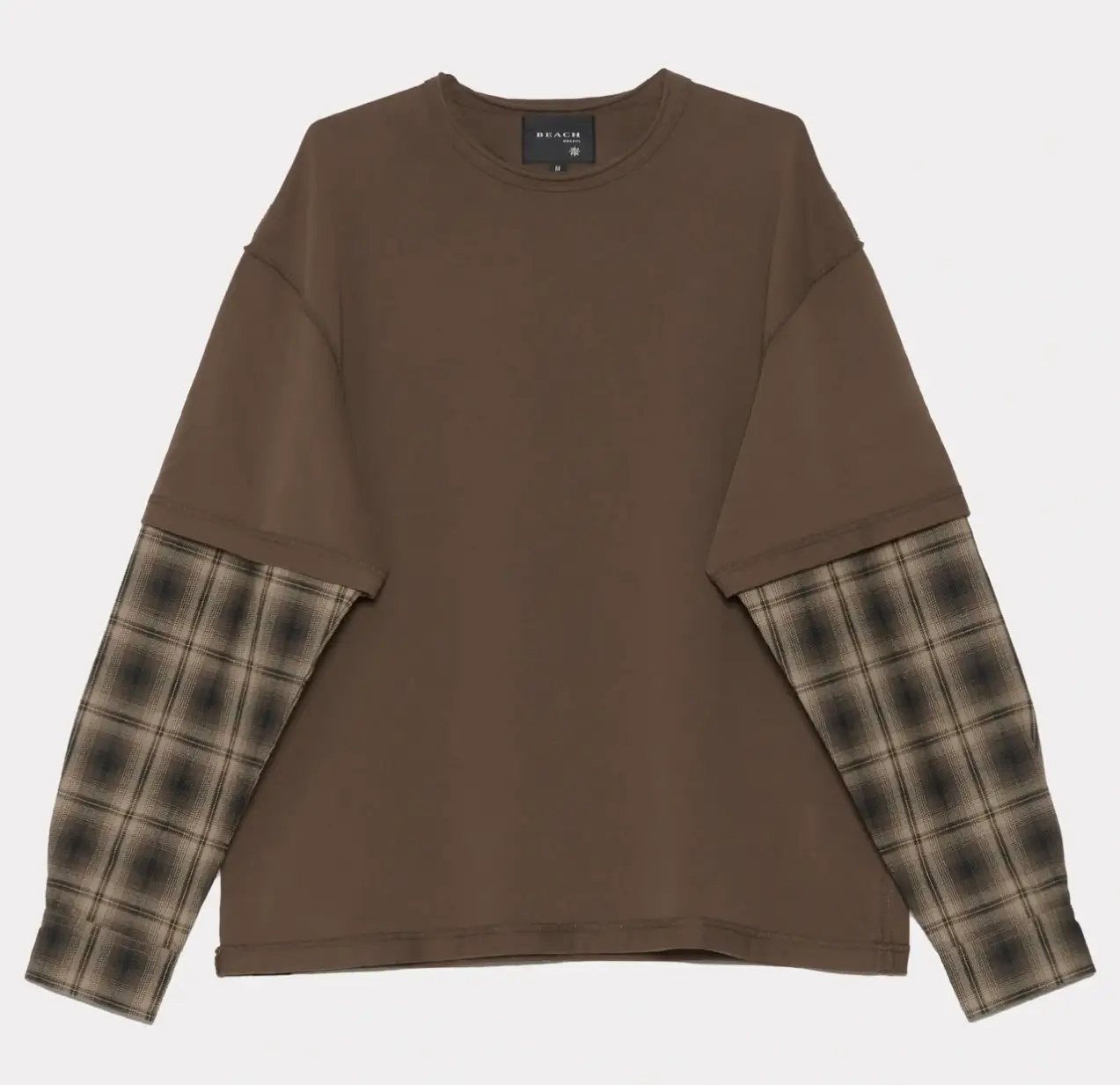
There’s a quiet refusal embedded in the DEAD END SHIRT — BROWN / CHECK from Beach Brain. Not a refusal to move, but a refusal to perform movement for the sake of it. It’s a piece that leans into stillness—into the idea that style doesn’t always need escalation, just presence.
At first glance, the construction is simple: a brown oversized short-sleeve tee layered over integrated check-pattern sleeves. But that simplicity is deliberate. It’s not about hybridization as novelty—it’s about merging two familiar garments into a single, resolved form that feels lived-in rather than designed.
amb
The brown tone sits somewhere between earth and backdrop. It avoids richness in favor of something flatter, more grounded—almost matte in its emotional register. This isn’t chocolate or espresso; it’s closer to worn wood, softened leather, or the muted tone of late afternoon light hitting concrete.
That choice matters. Brown, in this context, doesn’t function as a trend color. It acts as a neutral with weight. It absorbs attention instead of reflecting it.
The check sleeves interrupt that surface—not aggressively, but enough to shift the rhythm. A washed plaid pattern, slightly desaturated, moves underneath the solid body like a second layer of thought. It introduces texture without breaking cohesion.
flow
What makes the DEAD END SHIRT effective is its refusal to rely on actual layering. Instead, it simulates the language of layering through construction.
The oversized tee drapes wide, with dropped shoulders that soften the silhouette. Underneath, the check sleeves extend cleanly, creating the illusion of a flannel or shirting piece worn beneath. But there’s no tension between layers—no bunching, no adjustment. It’s fixed. Resolved.
This approach speaks to a broader shift in contemporary streetwear:
- Less about stacking garments
- More about embedding complexity into a single piece
It removes the need to style, replacing it with something already complete.
ratio
The proportions lean intentionally oversized, but not exaggerated. The body carries width, while the sleeves—visually slimmer due to the plaid—anchor the silhouette.
That contrast creates balance:
- Top layer: volume, softness, openness
- Under layer: structure, direction, subtle compression
The result is a garment that feels relaxed but not shapeless. It holds its own outline.
This is where Beach Brain’s sensibility becomes clear. The brand doesn’t chase distortion for effect. Instead, it tunes proportion until it feels natural, even when it’s technically oversized.
mat
Though exact fabrication details remain understated, the visual cues suggest a cotton-heavy composition for the tee body—something with enough weight to maintain structure but soft enough to fall without stiffness.
The check sleeves, by contrast, appear lighter, possibly brushed or flannel-adjacent. That contrast in texture reinforces the layered illusion:
- Smooth, continuous surface above
- Slightly tactile, patterned surface below
It’s not just visual layering—it’s textural layering embedded into the garment.
nomenclature
“Dead End” isn’t aggressive. It’s observational.
In streetwear, names often push forward—speed, energy, direction. This one does the opposite. It pauses. It suggests a point where movement stops and reflection begins.
That naming aligns with the garment itself:
- No excessive branding
- No forced detailing
- No overt statement
Just a piece that exists, fully formed, without needing to announce itself.
stir
The DEAD END SHIRT doesn’t require styling—it resists it. But it does allow for context.
It sits naturally within:
- Loose denim or washed black jeans
- Workwear-adjacent trousers
- Minimal sneakers or heavier footwear
The palette keeps everything grounded. Nothing competes. The shirt becomes the anchor point, not through loudness, but through consistency.
It’s the kind of piece that looks the same in motion as it does at rest. No transformation, no reveal—just continuity.
emotive
Beach Brain operates in a space where streetwear intersects with something quieter—less about drops, more about objects with intent.
The DEAD END SHIRT fits into that space as a transitional garment:
- Between seasons
- Between layering and singularity
- Between statement and absence
It doesn’t chase attention. It holds it, briefly, before letting it pass.
fin
There’s a precision to restraint here. Every decision—color, proportion, layering—feels reduced to what’s necessary.
No added graphics.
No unnecessary contrast.
No excess narrative.
Just a controlled interplay between form and texture.
That’s what gives the piece longevity. It’s not tied to a moment—it’s tied to a feeling of resolution.