BEAMS BOY x TIMEX Recast the Camper as Military Ornament

March 19, 2026
There are few objects in modern design that can claim both utilitarian purity and cultural longevity with the quiet authority of the TIMEX Original Camper. Born from the practical demands of military specification, the Camper has long existed as a symbol of clarity: lightweight, legible, unpretentious. It is a watch that does not attempt to perform luxury—it performs function. And yet, over decades, that restraint has become its own kind of aesthetic language.
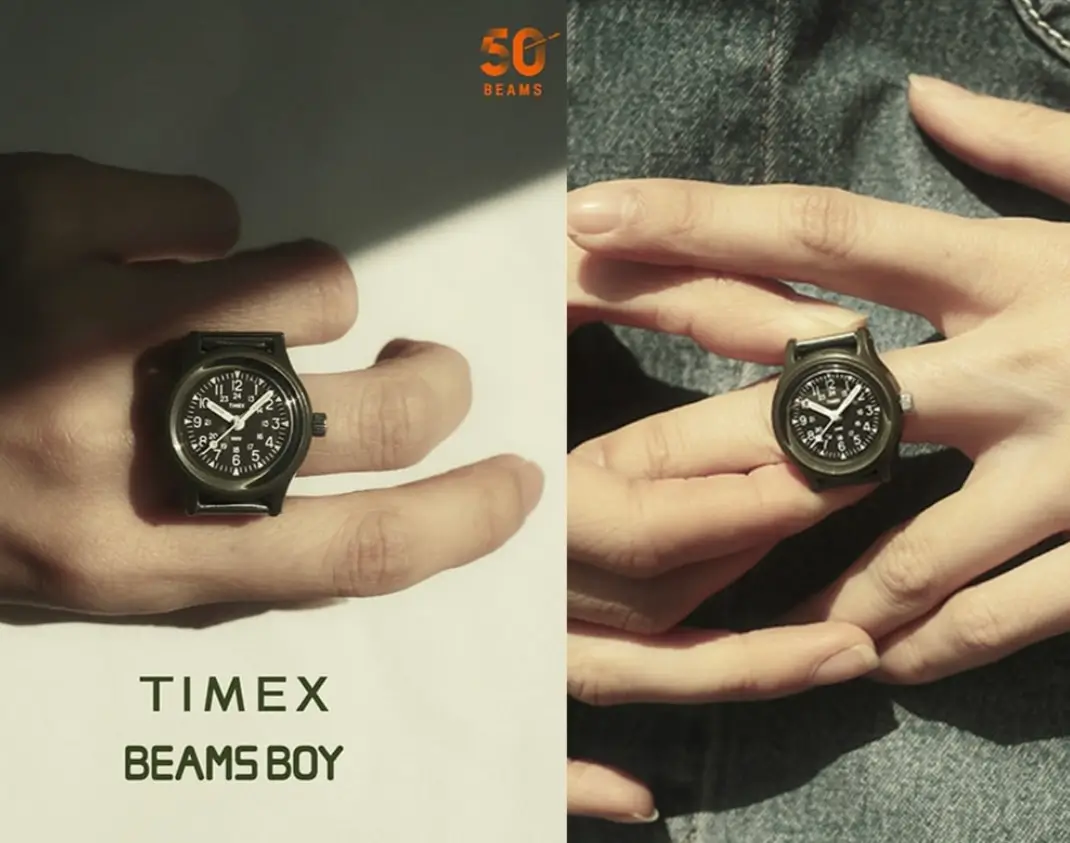
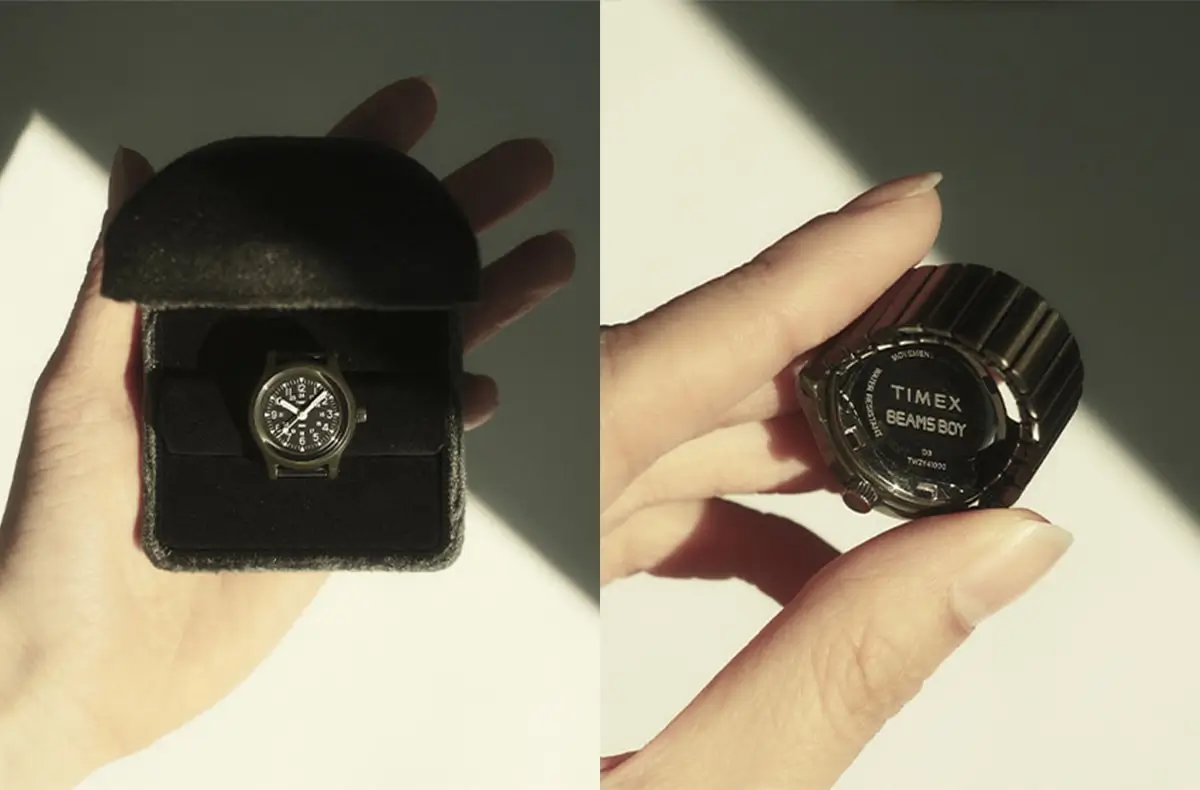
Now, in a gesture that feels both unexpected and entirely inevitable, BEAMS BOY has taken that language and translated it into something altogether more intimate. To celebrate fifty years of BEAMS, the women’s line—known for its coltish interrogation of menswear archetypes—has reinterpreted the Camper not as a wristwatch, but as a ring.
The result is not merely a novelty. It is a recalibration of scale, meaning, and wearability. A military instrument becomes jewelry. A tool becomes adornment. Time itself becomes something you wear not on your wrist, but on your hand—closer, more immediate, more personal.
stir
Since its founding in 1976, BEAMS has functioned less like a store and more like a lens, filtering global fashion, music, and design through a distinctly Japanese sensibility.
Fifty years on, its influence is difficult to overstate. The concept of the “select shop,” now ubiquitous, owes much to BEAMS’ early insistence on curation over production. It was never about creating from scratch—it was about reframing, recombining, and elevating what already existed.
BEAMS BOY, launched in 1998, embodies this philosophy with particular clarity. Its premise is deceptively simple: take classic menswear—military jackets, workwear trousers, Ivy League staples—and reinterpret them for women, not by feminizing them, but by preserving their integrity while adjusting proportion and context.
The “tomboy” aesthetic that emerges is not about rejection of femininity, but about expansion of it. It suggests that softness can coexist with structure, that heritage can coexist with play.
In this context, the decision to collaborate with TIMEX feels almost predetermined. Both brands operate within a space where history is not static—it is material to be reshaped.
View this post on Instagram
origin
The TIMEX Original Camper is, at its core, a product of necessity. Its design traces back to disposable watches developed for the U.S. military—timepieces intended to be lightweight, affordable, and easily replaceable in the field.
Everything about it reflects that origin. The case is compact. The dial is stripped to essentials. Arabic numerals are clear and bold. There is no extraneous detail, no decorative flourish. Even the signature nylon strap speaks to durability over display.
And yet, this very absence of ornament has allowed the Camper to transcend its initial purpose. Over time, it has been adopted by civilians, stylists, collectors—individuals drawn not to what the watch says, but to what it refuses to say.
In a fashion landscape often dominated by excess, the Camper offers a counterpoint. It is a reminder that design can be powerful precisely because it is restrained.
idea
What BEAMS BOY has done with this collaboration is deceptively simple: it has reduced the Camper.
But reduction, in design, is never just about size. It is about proportion, about relationship, about how an object interacts with the body.
By transforming the watch into a ring, the collaboration alters not only how the piece is worn, but how it is experienced. A wristwatch is peripheral—you glance at it. A ring watch is central—you live with it. It exists within your field of vision, integrated into gesture, into movement.
The dial, now miniature, retains the essential codes of the Camper. The legibility remains. The clarity remains. But there is a new layer of intimacy. Time is no longer something you check—it is something you carry.
This shift also introduces a subtle tension. The original Camper was designed for rugged environments, for function under pressure. As a ring, it becomes delicate, almost playful. And yet, the DNA of utility persists, creating a piece that exists somewhere between tool and ornament.
flow
The inspiration for this reinterpretation is not entirely new. Ring watches experienced a brief moment of visibility in the 1990s, appearing as novelty items that blurred the line between gadget and accessory.
Often associated with early digital culture, these pieces carried a certain futurist charm—small, unexpected, slightly irreverent. They were not meant to replace traditional watches, but to complement them, to add an element of surprise.
BEAMS BOY’s approach, however, feels more considered. Rather than leaning into novelty, it anchors the concept in heritage. By using the Camper as its foundation, the design gains a sense of legitimacy, a lineage that extends beyond trend.
The result is something that feels both nostalgic and new. It recalls the playful experimentation of the 1990s, but filters it through a contemporary lens—one that values authenticity as much as innovation.
theme
At the mid of this collision lies a quiet inversion.
Traditionally, watches have occupied a space between utility and status. They tell time, yes, but they also signal identity—luxury, taste, profession. Jewelry, on the other hand, has been primarily symbolic, its value rooted in aesthetics and meaning rather than function.
The ring watch collapses this distinction. It is both functional and decorative, both practical and expressive. It suggests that utility can be intimate, that function can be beautiful.
For BEAMS BOY, this aligns perfectly with its broader ethos. The brand has always operated within the tension between masculine and feminine codes, between structure and softness. The ring watch becomes an extension of that dialogue.
It is a piece that does not conform to traditional categories. It does not ask whether it is a watch or a piece of jewelry. It simply exists as both.
lang
One of the most compelling aspects of this release is its attention to scale.
Miniaturization has long been a fascination in design. There is something inherently compelling about seeing familiar objects reduced, their proportions altered, their functions recontextualized.
In the case of the Camper ring watch, this reduction amplifies certain qualities while softening others. The boldness of the original dial becomes delicacy. The ruggedness becomes charm. The utilitarian becomes almost whimsical.
And yet, the piece avoids slipping into gimmickry. This is largely due to the integrity of the source material. The Camper’s design is so fundamentally sound that it can withstand transformation without losing its identity.
This speaks to a broader principle: good design is adaptable. It can be scaled, reinterpreted, reimagined—and still remain recognizable.
style
In practice, the ring watch opens up a range of styling possibilities.
It can be worn as a statement piece, drawing attention through its novelty and craftsmanship. It can be layered with other rings, integrated into a broader jewelry composition. Or it can function as a subtle detail, a quiet nod to those who notice.
Within the BEAMS BOY universe, it pairs naturally with oversized jackets, vintage denim, military shirting—pieces that carry their own histories. The ring becomes another layer of narrative, another reference point.
There is also an inherent versatility in its design. While conceived within a women’s line, its aesthetic is not gendered. Like much of BEAMS BOY’s output, it invites reinterpretation, encouraging wearers to define its meaning for themselves.
design
TIMEX has long occupied a unique position within the watch industry. It is not a luxury brand in the traditional sense, nor does it aspire to be. Its strength lies in accessibility, in the ability to produce well-designed, reliable timepieces at a price point that remains inclusive.
This democratization of design is part of what makes the Camper such an enduring icon. It is a watch that can be owned by anyone, worn by anyone, integrated into any wardrobe.
By collaborating with BEAMS BOY, TIMEX extends this philosophy into new territory. The ring watch, while more niche, retains that spirit of accessibility. It is not about exclusivity—it is about reinterpretation.
In a market often driven by scarcity and hype, this approach feels refreshing. It suggests that innovation does not have to come at the expense of inclusivity.
fifty
Anniversaries in fashion often lean toward spectacle. They are marked by grand gestures, limited editions, elaborate campaigns.
This collaboration, by contrast, feels almost understated. And yet, it is precisely this restraint that gives it resonance.
By choosing to reinterpret an existing icon rather than create something entirely new, BEAMS BOY acknowledges its own history. It recognizes that its strength lies not in reinvention for its own sake, but in its ability to see familiar objects differently.
The ring watch becomes a symbol of this perspective. It is not about looking forward or backward—it is about looking again.
clue
The BEAMS BOY x TIMEX Original Camper ring watch is, in many ways, a small object. Its scale is modest. Its presence is subtle.
And yet, within that smallness, it contains a multitude of ideas. It speaks to the fluidity of design, to the permeability of categories, to the ways in which objects can be reimagined without losing their essence.
It reminds us that timepieces do not have to be confined to the wrist. That military heritage can be softened without being diluted. That jewelry can be functional, and function can be beautiful.
Above all, it suggests that design is not about invention in the strictest sense. It is about perspective. About taking what exists and seeing it differently.
Fifty years on, BEAMS continues to do exactly that.