about
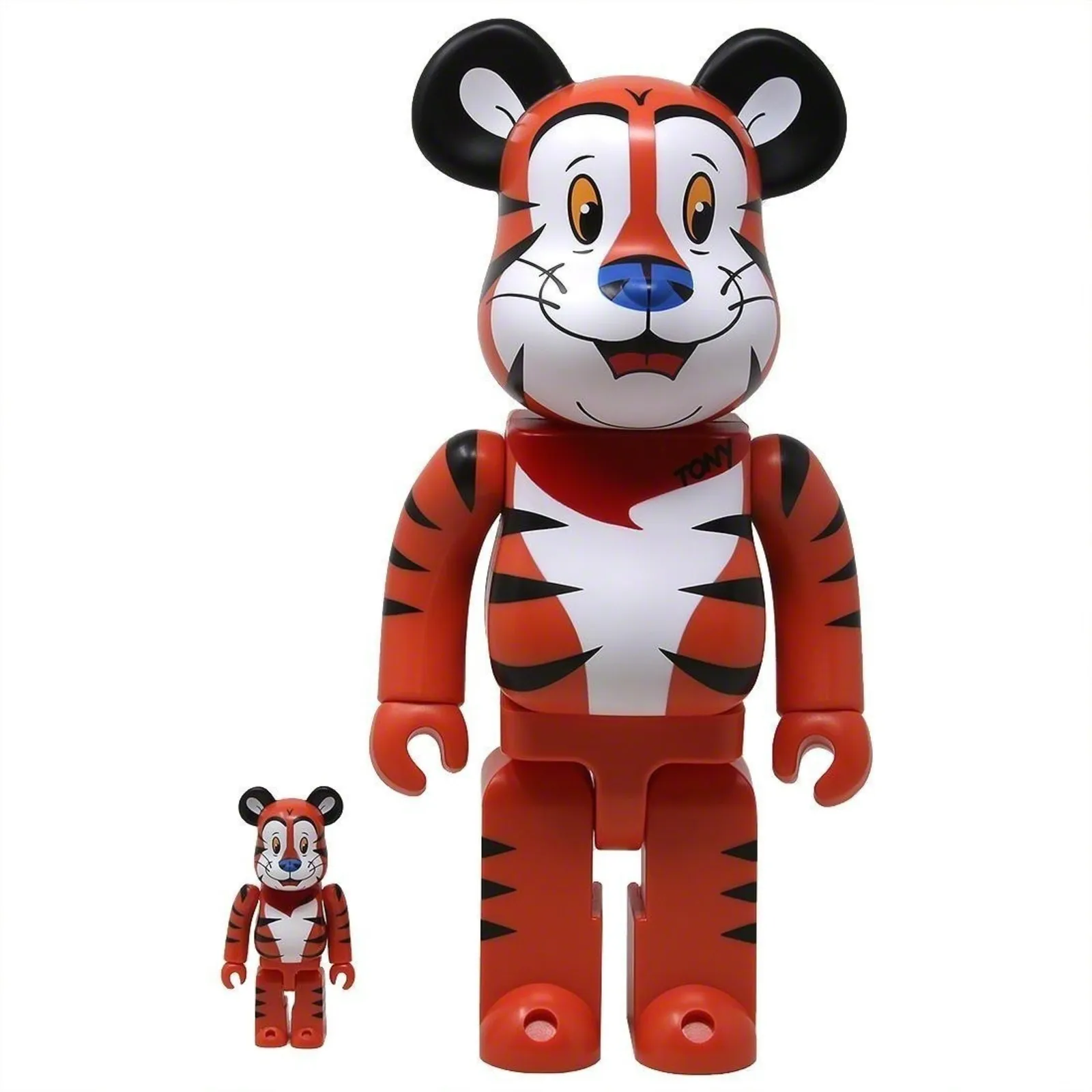
The BE@RBRICK TONY THE TIGER 100% + 400% Set (Orange), released in 2019, captures the essence of pop nostalgia filtered through the sleek, modular form of one of the world’s most recognizable designer toys. Produced by Medicom Toy, the set consists of two plastic figures measuring approximately 11 × 2 4/5 inches (28 × 7 cm) for the 400% version, accompanied by its smaller 100% counterpart.
Rendered in vibrant orange with the unmistakable striped markings and confident grin of Tony the Tiger, the mascot long associated with Kellogg’s Frosted Flakes, this edition transforms a commercial icon into collectible ephemera. The work is fabricated in plastic, unsigned, and issued with a certificate of authenticity from the gallery. Its edition size remains undisclosed, placing it within the category of unknown rarity—an ambiguity that often heightens intrigue among collectors.
Classified as ephemera or merchandise, the piece occupies a space between fine art and consumer object. That tension lies at the core of BE@RBRICK’s global appeal.
be@rbrick
Established in 2001 in Japan, BE@RBRICK quickly evolved from novelty toy to cultural artifact. Its defining feature is its standardized bear-shaped silhouette—minimalist, modular, and instantly recognizable. The format remains constant: a rounded head with circular ears, cylindrical limbs, and a neutral stance. What changes is the surface.
Over the years, BE@RBRICK has served as a canvas for artists, fashion houses, haute brands, and pop culture franchises. Connections have featured the visual language of Jean-Michel Basquiat, Keith Haring, and KAWS, as well as brand iconography from Chanel, A Bathing Ape, and Disney.
Each edition becomes both object and artifact. While some BE@RBRICKs retail at accessible prices, others have achieved high five-figure auction results, particularly rare artist collaborations or limited runs. The appeal spans industries and generations, with collectors including music producer Pharrell Williams and former Vogue creative director Grace Coddington.
The Tony the Tiger set sits within this lineage, bridging corporate mascot history and designer toy culture.
stir
Tony the Tiger is one of advertising’s most enduring characters. First introduced in 1952, the mascot became synonymous with energetic optimism and American breakfast-table nostalgia. His bold stripes and self-assured catchphrase—“They’re Grrreat!”—cemented him in pop consciousness.
In the BE@RBRICK iteration, Tony’s image is mapped onto the bear’s smooth geometry. The transformation is subtle yet significant. The bear’s expressionless sculptural form becomes a vessel for a character rooted in personality. This duality—anonymous structure paired with vivid branding—creates a compelling visual contrast.
The 400% figure, standing at approximately 28 cm, offers enough scale to command presence in a display setting. Its smaller 100% companion reinforces the collectible tradition of paired formats, a hallmark of BE@RBRICK releases. Together, they create a visual dialogue between scale and repetition.
material
Constructed in plastic, the Tony the Tiger BE@RBRICK embraces industrial material as aesthetic choice. The smooth surface enhances the saturation of orange and the crisp delineation of stripes and facial details. Unlike resin or metal variants found in other collectible lines, the plastic finish emphasizes accessibility and mass-culture roots.
The gloss or semi-gloss finish interacts with light in subtle ways, highlighting the contours of the standardized bear silhouette. This interplay between form and graphic application underscores BE@RBRICK’s conceptual core: a fixed body transformed endlessly through surface intervention.
rare
The edition size of this 2019 release is categorized as unknown. In the BE@RBRICK ecosystem, rarity is influenced by production numbers, collaborator prestige, and market demand. Corporate mascot editions often gain traction through nostalgia and cross-generational appeal.
Although not signed, the inclusion of a certificate of authenticity issued by the gallery ensures legitimacy within secondary markets. As with many BE@RBRICK releases, long-term value depends on collector interest and broader cultural trends.
Designer toys have matured into a recognized collecting category. Exhibitions such as “KAWS & BE@RBRICK” at Ground Effect Gallery and other curated showcases underscore the transition of these objects from niche hobby to institutional display.
flow
BE@RBRICK’s enduring success lies in its hybrid identity. It exists at the intersection of streetwear, art, and merchandising. The Tony the Tiger set exemplifies this blend. It draws from commercial branding yet participates in gallery presentation and auction circulation.
The standardized bear shape functions like a blank canvas. Each collaboration—whether with a fine artist, fashion label, or entertainment property—transforms the object into a cultural snapshot. In this sense, BE@RBRICK operates as a living archive of contemporary iconography.
The Tony the Tiger edition reflects a broader cultural fascination with retro branding. It elevates a supermarket mascot into a collectible artifact. This repositioning challenges hierarchies between “high” and “low” culture, aligning with postmodern art practices that blur such distinctions.
show
The 100% + 400% pairing is central to BE@RBRICK’s identity. The 100% figure, approximately 7 cm tall, functions almost as a miniature token—compact, collectible, and display-friendly. The 400% version commands attention without overwhelming a room.
Displayed together, the pair creates visual rhythm. The repetition of form in two scales emphasizes design continuity. For collectors, this format is both traditional and symbolic—a nod to BE@RBRICK’s origins while reinforcing its contemporary status.
Whether positioned on a shelf, within a vitrine, or alongside other designer toys, the Tony the Tiger set contributes vibrant color and nostalgic resonance.
exhibit
The Tony the Tiger BE@RBRICK has appeared within curated gallery contexts such as AYNAC Gallery and Ground Effect Gallery, as part of broader BE@RBRICK-focused presentations. These exhibitions position the object within art discourse rather than toy retail alone.
By exhibiting BE@RBRICK in gallery settings, curators acknowledge its cultural weight. It becomes part of a lineage that includes street art, pop art, and design objects. The presence of certificates and documented provenance further strengthens its art-market legitimacy.
fwd
Since its establishment in 2001, BE@RBRICK has proven resilient amid shifting trends in street culture and collectibles. The brand’s adaptability—partnering with artists, haute houses, and global franchises—ensures continued relevance.
The Tony the Tiger edition benefits from brand recognition and cross-market appeal. Food mascots, once relegated to packaging, now hold nostalgic value for adult collectors. In the BE@RBRICK format, that nostalgia gains sculptural permanence.
As the boundaries between art, design, and merchandising continue to blur, objects like this set remain emblematic of contemporary collecting. They are neither purely toys nor traditional sculptures. They exist in a fluid middle ground.
sum
The BE@RBRICK TONY THE TIGER 100% + 400% Set (Orange), 2019, encapsulates the designer toy’s unique cultural position. Crafted in plastic, unsigned, and accompanied by gallery-issued certification, it merges commercial iconography with collectible design.
Through its standardized bear silhouette and bold orange finish, the set reimagines a breakfast mascot as an art-adjacent object. It participates in a global network of connection that have elevated BE@RBRICK from novelty to cultural institution.
For collectors, it offers a blend of nostalgia, pop vibrancy, and design clarity. For observers, it stands as a testament to the evolving relationship between street culture and fine art—where a tiger from a cereal box can find new life as a sculptural collectible.