Bernard Buffet’s Damier et cartes à jouer and the Aesthetics of Play

March 31, 2026
2 hours ago
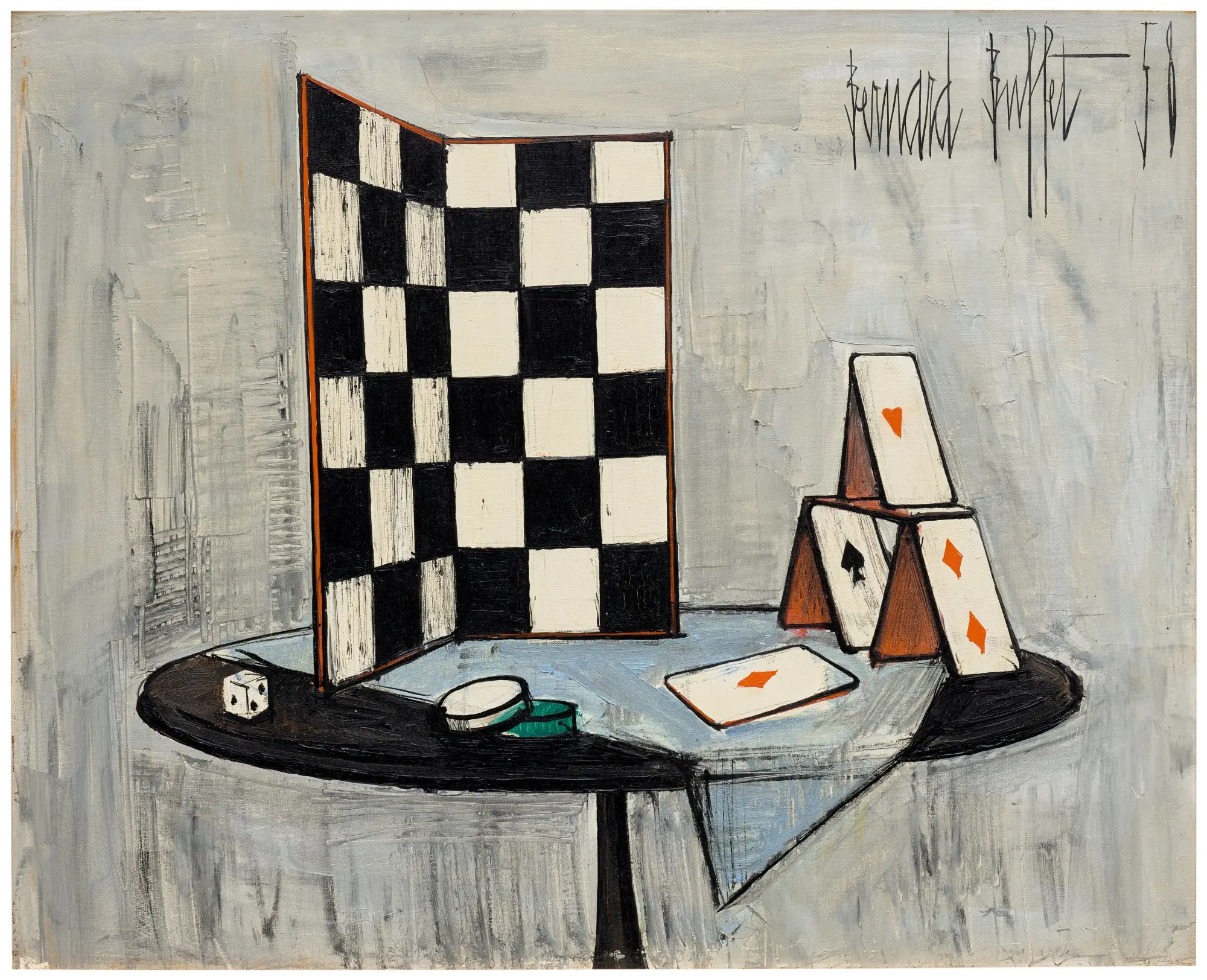
There is a certain austerity that defines the work of Bernard Buffet—a discipline so unwavering it borders on obsession. His lines are not merely drawn; they are incised, etched into the surface like declarations. His world is stripped of softness, rendered instead in a syntax of rigidity and repetition. Within this view language, Damier et cartes à jouer emerges as both subject and thesis: a still life that resists stillness, a composition that interrogates the very idea of chance within a framework of order.
At first glance, the painting appears deceptively simple. A checkerboard. Playing cards. A table. Yet nothing in Buffet’s oeuvre is incidental. Each object is positioned with surgical precision, locked into a grid that recalls not only the logic of games but the architecture of thought itself. The damier—the checkerboard—serves as both stage and structure, a field of alternating black and white that echoes Buffet’s own viewable dialect. It is here, within this binary, that the cards unfold their quiet drama.
the discip
Buffet’s line is famously unforgiving. Unlike the fluid gestures of his contemporaries in postwar abstraction, his approach is almost architectural. In Damier et cartes à jouer, the outlines of each object are sharply defined, bordering on severe. The cards are not casually placed; they stand upright, almost defiant, as though asserting their presence against the flat inevitability of the board beneath them.
This insistence on line transforms the still life into something closer to a constructed space. The objects do not dissolve into atmosphere; they resist it. Silhouettes are not softly blended but delineated with the same clarity as the objects themselves. The result is a composition that feels both compressed and expansive—compressed in its density of line, expansive in its conceptual reach.
Buffet’s technique here can be understood as a form of resistance: against softness, against ambiguity, against the dissolution of form. In a period when many artists were embracing abstraction as a means of liberation, Buffet chose instead to refine representation to its most austere essentials. The checkerboard becomes not just a motif but a manifesto.
vs
The juxtaposition of the damier and the playing cards introduces a tension that is central to the painting’s meaning. The checkerboard is a system—ordered, predictable, governed by rules. It is the domain of strategy, where every move is calculated and every outcome theoretically knowable. The conjure cards, by contrast, belong to the realm of chance. They are shuffled, dealt, subject to randomness and fate.
In bringing these elements together, Buffet constructs a visual paradox. The cards are arranged with the same rigidity as the board itself, their randomness subdued by the artist’s compositional control. Chance is domesticated, rendered inert within the grid. Yet the implication of unpredictability lingers. The viewer is aware that these cards could have been otherwise—that their arrangement, while fixed in paint, suggests an infinite series of possible configurations.
This tension reflects a broader philosophical concern. In the aftermath of war, questions of control and chaos were not merely abstract but deeply lived. Buffet’s work often engages with this uncertainty, presenting a world that appears ordered but is haunted by the possibility of disruption. In Damier et cartes à jouer, the interplay between system and randomness becomes a metaphor for existence itself.
consider
Traditionally, the still life has been a genre of quiet contemplation. Objects are arranged to showcase texture, light, and composition, inviting the viewer into a moment of pause. Buffet disrupts this tradition. His still lifes are not serene; they are confrontational. The objects seem almost too present, their outlines too sharp, their placement too deliberate.
In this painting, the table surface becomes a stage upon which the drama of form unfolds. The checkerboard pattern flattens the space, eliminating any illusion of depth. The cards, though upright, do not recede into perspective but remain anchored to the surface. This flattening effect reinforces the painting’s graphic quality, aligning it more closely with design than with illusionistic representation.
Yet there is a paradox here as well. Despite its flatness, the painting conveys a sense of tension, as though the objects are pressing against the limits of their own containment. The rigidity of the composition does not lead to calm but to a kind of view pressure.
show
Color in Damier et cartes à jouer is restrained, almost ascetic. The dominant palette of black and white is punctuated by subtle variations—muted tones that serve to emphasize the starkness of the composition. This limited palette reinforces the binary logic of the checkerboard, creating a visual rhythm that echoes across the surface.
Buffet’s use of black is particularly notable. It is not merely a color but a structural element, defining the contours of objects and anchoring the composition. The black lines that outline the cards and the squares of the board create a network of divisions, segmenting the space into discrete units. This segmentation mirrors the conceptual divisions within the painting—the contrast between order and chance, between control and unpredictability.
White, in turn, is not empty but active. It serves as a field against which the lines assert themselves, a space that is both neutral and charged. The interplay between black and white creates a dynamic tension, a visual oscillation that keeps the eye in constant motion.
mind
Buffet’s objects are never merely objects. They carry a psychological weight, a sense of presence that transcends their material form. In Damier et cartes à jouer, the conjure cards take on an almost anthropomorphic quality. Their upright stance suggests a kind of vigilance, as though they are aware of being observed.
This anthropomorphism is subtle but significant. It transforms the still life into a scene of quiet drama, where the objects themselves become actors. The cards, with their faces and symbols, hint at narratives that remain just out of reach. They are both specific and universal, recognizable yet enigmatic.
The checkerboard, meanwhile, functions as a kind of psychological ground. Its repetitive pattern can be seen as a metaphor for thought, for the ways in which the mind organizes and categorizes experience. The painting thus operates on multiple levels: as a visual composition, as a philosophical inquiry, and as a psychological landscape.
flow
To fully appreciate Damier et cartes à jouer, it is essential to situate it within Buffet’s broader practice. Throughout his career, Buffet returned repeatedly to themes of structure and repetition. Either depicting urban landscapes, portraits, or still lifes, he maintained a consistent viewable language defined by sharp lines and controlled compositions.
This consistency was both his strength and his point of contention within the art world. While many of his contemporaries embraced experimentation and change, Buffet remained committed to his established style. This commitment can be seen as a form of integrity, a refusal to be swayed by trends. It also positions his work as a counterpoint to the dominant narratives of postwar art.
In this sense, Damier et cartes à jouer is not an isolated work but part of an ongoing exploration. It reflects Buffet’s enduring interest in the relationship between form and meaning, between the visible and the conceptual. The painting can be read as a distillation of his concerns, a concise yet profound statement of his artistic philosophy.
sum
Damier et cartes à jouer stands as a testament to Bernard Buffet’s singular vision. It is a painting that transforms the ordinary into the extraordinary, using the language of line and form to explore fundamental questions about order, chance, and existence. Through its austere composition and disciplined execution, it reveals a world that is both controlled and uncertain, structured yet open to interpretation.
In the end, the painting’s power lies in its ability to hold these contradictions in balance. The checkerboard and the cards, the lines and the spaces, the order and the chance—all coexist within a single, unified composition. It is a work that resists resolution, instead offering a continuous interplay of forces.