Better With Age Hoodie: Magic Zip-Up Design, Origins & Aged Aesthetic Breakdown

April 11, 2026
2 hours ago
where it begins: a brand Built on time, not season
Every garment carries a history, but not every brand chooses to foreground it. Better With Age positions itself differently. Rather than building identity through seasonal novelty or rapid iteration, it constructs its language around a singular premise: time as value.
The name itself is not metaphor—it is instruction. It frames every garment as a process rather than a product. Within this framework, the Magic Zip-Up Hoodie is not just an item in a collection; it is a thesis statement. A garment designed to exist across durations, not drops.
Unlike legacy sportswear houses whose histories are anchored in industrial production, or luxury brands whose narratives are tied to ateliers and archives, Better With Age emerges from a contemporary condition—one where vintage, streetwear, and digital-era immediacy converge. Its origin is less about a founding date and more about a founding idea: that garments should feel temporally dense from the moment they are encountered.
stir
By the late 20th century, the hoodie had already transitioned from utilitarian workwear into cultural symbol—embedded within hip-hop, skate culture, and athletic systems. It carried anonymity, mobility, and neutrality.
Better With Age does not reject this inheritance. It absorbs it—but without nostalgia. There is no attempt to recreate a specific decade, no archival reproduction. Instead, the brand extracts the underlying principle: the hoodie as a surface that gains meaning through use.
Where earlier iterations required time to reach that state, Better With Age compresses the timeline. It introduces garments that appear already lived-in—washed, faded, structurally softened—while remaining materially new.
This is not imitation of the past.
It is acceleration of it.
View this post on Instagram
flow
What distinguishes Better With Age is its role as editor rather than originator. The brand does not claim to invent the hoodie. Instead, it intervenes in its temporal trajectory.
Through processes like garment washing, pigment fading, and controlled distressing, it selects specific moments from a garment’s potential lifespan and brings them forward. The hoodie arrives at retail already carrying the visual language of mid-life wear—softened color, irregular surface, exposed seams that suggest stress and release.
In this sense, the brand operates like a literary editor—cutting, rearranging, compressing. The narrative of wear is not erased; it is restructured.
View this post on Instagram
idea
Within this framework, the Magic Zip-Up Hoodie functions as a central object. It encapsulates the brand’s philosophy in full.
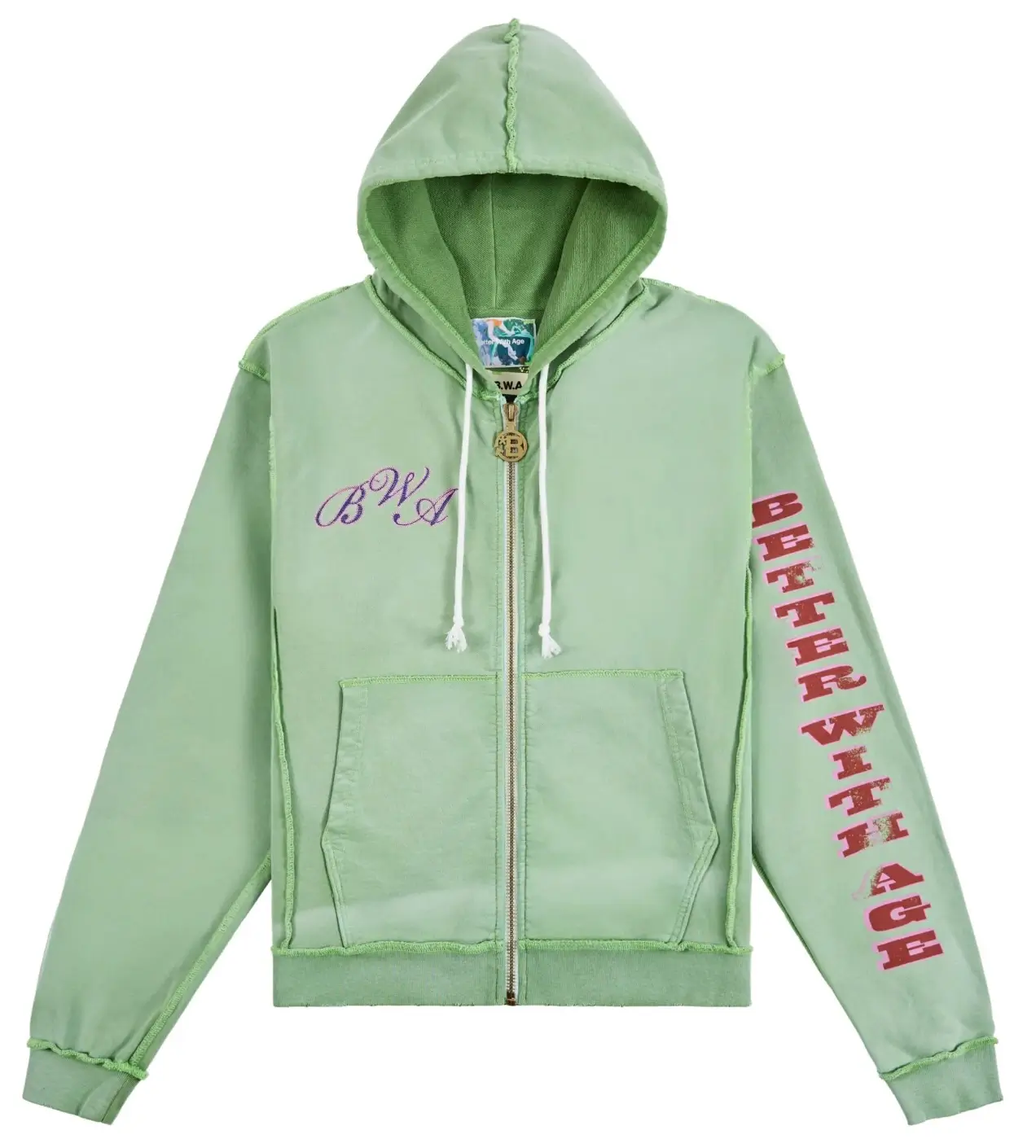
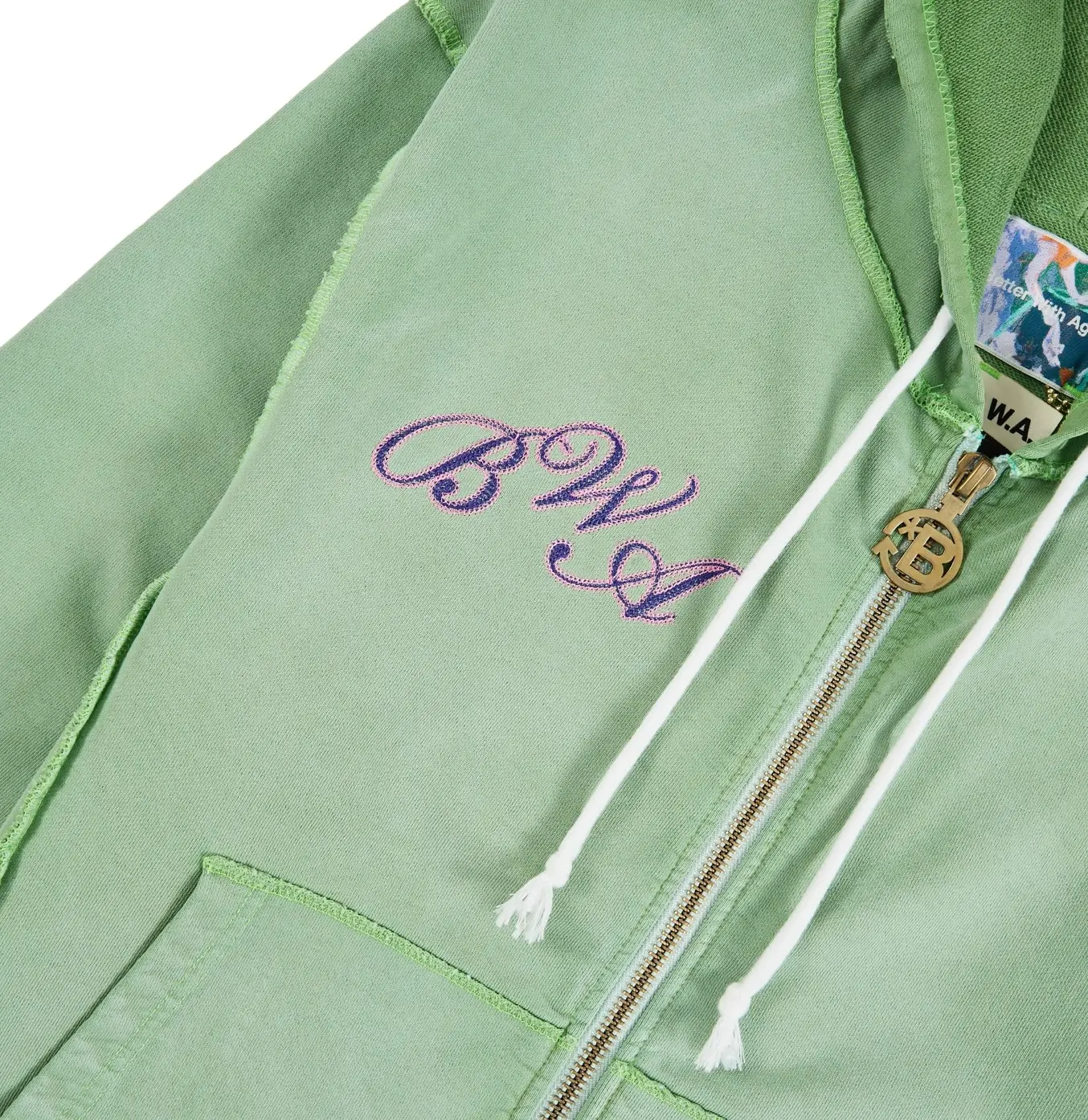
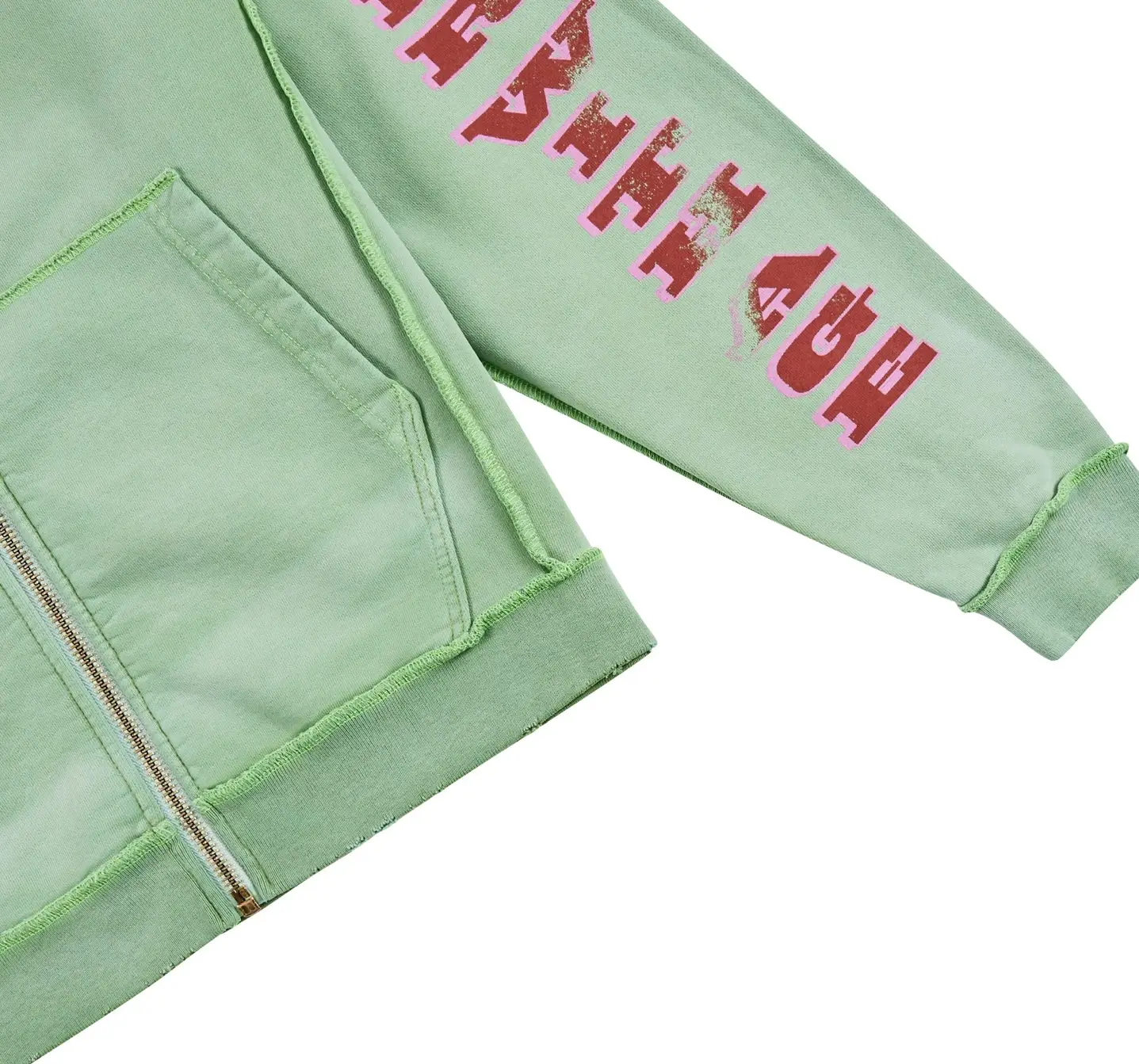
The washed green body establishes the temporal baseline—neither new nor truly aged, but suspended between. The exposed seams reveal construction, aligning with contemporary fashion’s interest in process visibility. The sleeve text—“BETTER WITH AGE”—acts as both declaration and demonstration, its distressed execution reinforcing the concept.
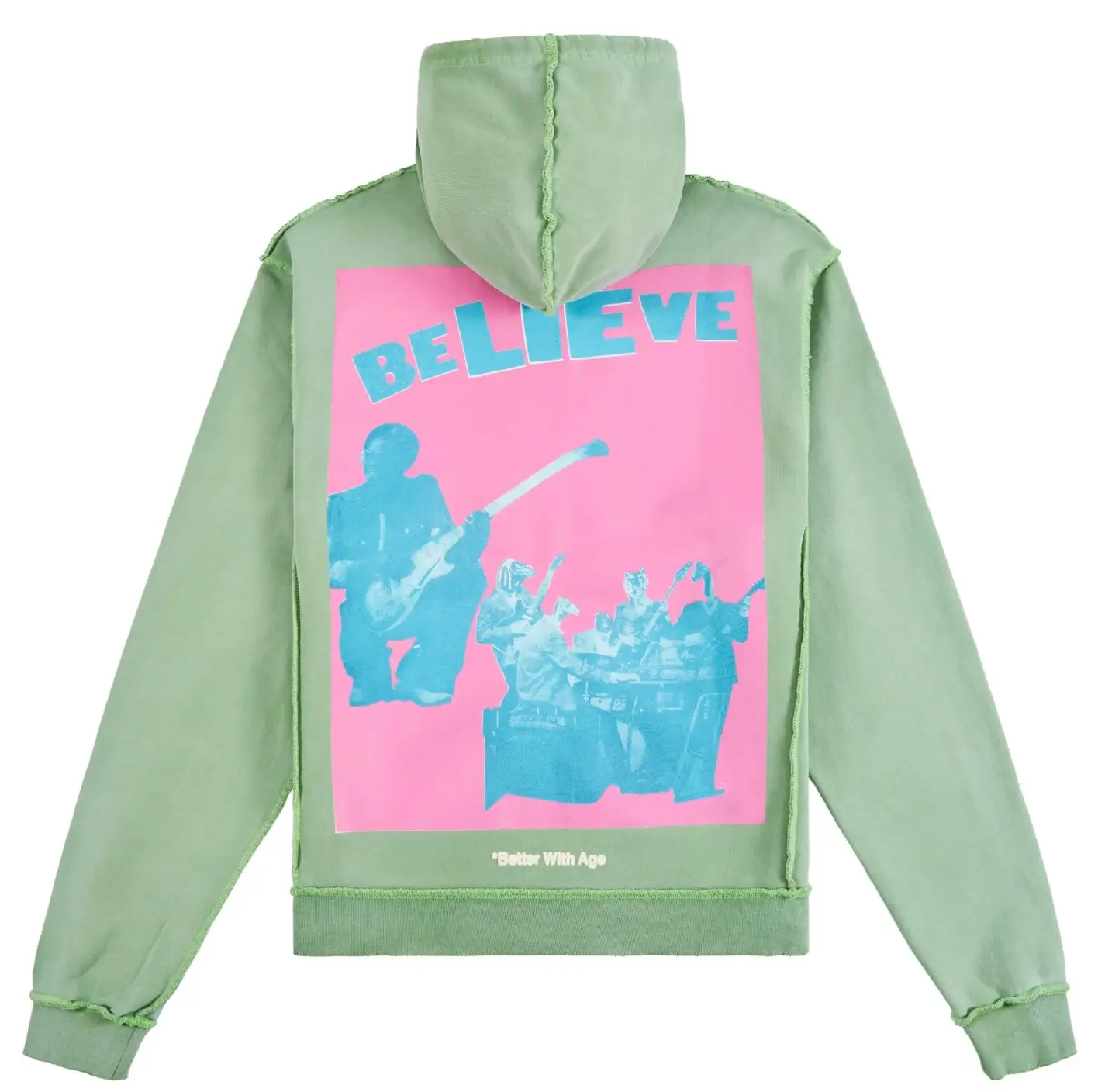
On the back, the “BELIEVE” graphic introduces a different register—bold, immediate, culturally resonant. It echoes the visual language of music merchandise and street graphics, but without direct reference. It feels familiar without being traceable.
The chest embroidery, subtle and script-based, anchors the garment at a human scale. The custom zipper pull introduces a moment of precision—metal against matte fleece, permanence against softness.
Each element operates independently.
Together, they form a system.
contempo
Better With Age enters a landscape already defined by saturation. Streetwear has moved through cycles of logo maximalism, collaboration-driven hype, and minimalist recalibration. Brands like Yeezy and Yeezy Gap have stripped garments down to form, while others continue to amplify surface through graphics and branding.
Better With Age occupies a hybrid position. It does not fully embrace minimalism, nor does it return to overt maximalism. Instead, it introduces density—multiple layers of meaning coexisting on a single garment.
Graphics are present, but distressed.
Color is expressive, but muted through washing.
Construction is visible, but controlled.
This balance allows the brand to operate outside strict trend cycles. It does not follow a singular direction—it synthesizes multiple ones.
consider
A central tension in the brand’s approach lies in authenticity. Traditionally, the value of an aged garment comes from lived experience—years of wear, environmental exposure, personal history. Better With Age disrupts this by introducing garments that appear aged from inception.
This raises an essential question: can authenticity be designed?
The brand’s answer is not definitive, but positional. It suggests that authenticity is not solely derived from time elapsed, but from how convincingly a garment can embody the conditions of time. The Magic Zip-Up Hoodie does not claim to have lived—it claims to understand how living looks.
And yet, it remains open. The pre-designed patina is not an endpoint. It is a starting layer, one that will continue to evolve through actual wear.
wear
Despite its constructed surface, the hoodie does not eliminate the role of the wearer. It reframes it.
Where traditional garments begin as blank canvases, this one begins as a partially written text. The wearer does not start from zero—they enter mid-narrative. Their role is to extend, to modify, to add specificity.
New creases will form.
Further fading will occur.
The garment will diverge from its initial condition.
In this way, Better With Age maintains a connection to the original principle of the hoodie: that meaning is not fixed at production, but developed through use.
cont
Unlike brands that rely on constant reinvention, Better With Age builds identity through continuity. Its focus on aging, wear, and temporal density provides a stable conceptual core.
This allows individual pieces—like the Magic Zip-Up Hoodie—to function as variations within a consistent framework rather than isolated statements. Each garment reinforces the same idea: that clothing is not static, but evolving.
This approach aligns with a broader shift in contemporary fashion, where longevity and adaptability are increasingly valued over rapid turnover.
fin
Better With Age situates itself at a unique intersection—between history and immediacy, authenticity and construction, object and process. It acknowledges the hoodie’s lineage—from industrial origins to cultural symbol—but chooses not to replicate it directly.
Instead, it compresses that lineage into a single surface, allowing the garment to carry multiple temporal references at once.
The Magic Zip-Up Hoodie becomes the clearest expression of this strategy. It is not just a hoodie—it is a model for how the brand operates. A garment that begins with the appearance of age, but remains open to actual time.
In a landscape defined by speed and novelty, Better With Age proposes an alternative:
that the most compelling garments are not those that are new,
but those that are built to continue.