Bradley Theodore Eternal Queen (2022): Relief Printing & Skeletal Iconography

February 12, 2026
2 months ago
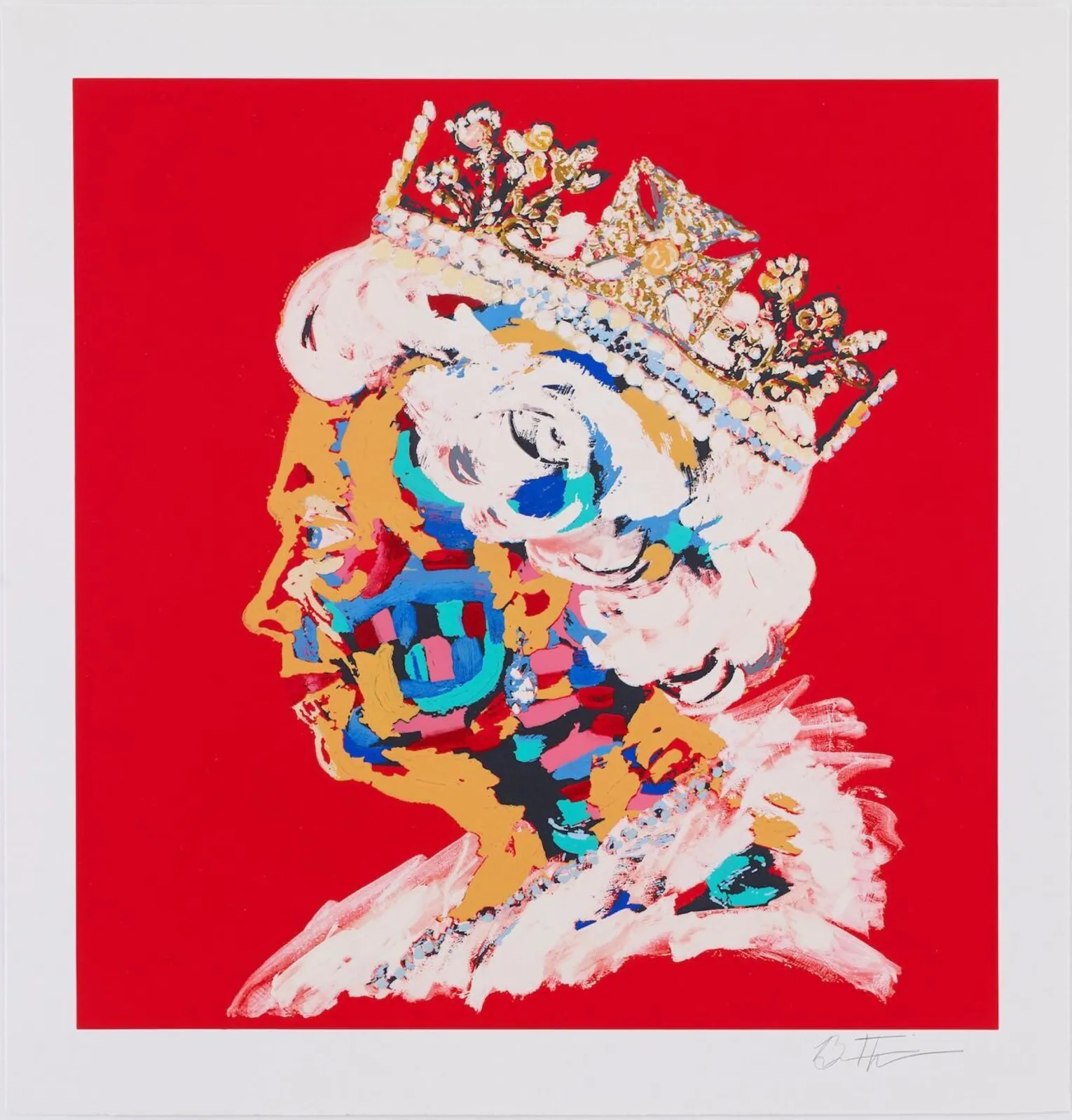
In Eternal Queen (2022), Bradley Theodore returns to the skeletal iconography that has become his unmistakable signature. Executed through etching and six layers of relief printing, the work sits at a compelling intersection of painting, printmaking, fashion portraiture, and memento mori. It is at once celebratory and sobering, ornamental and existential. The limited-edition piece translates Theodore’s bold chromatic language into a tactile, editioned format that deepens the conceptual weight of his practice.
Theodore’s art has long revolved around a deceptively simple gesture: stripping cultural icons down to their bones. In doing so, he reframes celebrity not as an untouchable surface phenomenon but as a layered construction—one that ultimately rests on the same fragile skeletal architecture shared by all human beings. In Eternal Queen, this gesture feels particularly resonant. The title alone suggests reverence, legacy, and permanence. Yet the skeletal form reminds us that eternity in the cultural sense is built upon mortality in the biological sense.
the skel
The skeletal motif in Theodore’s work is neither macabre nor nihilistic. Instead, it functions as both equalizer and amplifier. It equalizes because it collapses hierarchies. Whether the subject is a fashion editor, a pop icon, or a royal figure, the bones beneath remain fundamentally the same. Fame dissolves into anatomy.
At the same time, the skeleton amplifies individuality. Theodore’s subjects are recognizable not because of facial detail—there is none—but because of silhouette, hairline, posture, and styling. A tilt of the head, a dramatic collar, a signature hairstyle: these elements endure even when flesh is removed. Identity becomes graphic, distilled, iconic.
In Eternal Queen, the skeletal figure is not diminished by this exposure. On the contrary, she is elevated. The bones are rendered in luminous hues—electric pinks, saturated blues, high-contrast whites—transforming mortality into spectacle. The skull becomes a crown. The ribcage reads like armor. The queen’s power lies not in denying death but in transcending it symbolically.
mem
Theodore’s work can be situated within a long tradition of memento mori—art that reminds viewers of life’s transience. From medieval danse macabre frescoes to Dutch vanitas still lifes, artists have historically used skulls to evoke the inevitability of death. Yet Theodore reframes this tradition through the lens of contemporary celebrity culture.
Where seventeenth-century painters juxtaposed skulls with wilting flowers and extinguished candles, Theodore juxtaposes them with couture silhouettes and editorial glamour. The message shifts subtly. Rather than warning against vanity, he explores how image persists beyond the body. In a media-saturated world, photographs and digital reproductions allow figures to achieve a form of afterlife. Cultural memory becomes a second skeleton—an enduring structure supporting collective imagination.
Eternal Queen thus occupies a fascinating conceptual space. It acknowledges mortality while simultaneously constructing immortality through print. As a limited edition, the work exists in multiple impressions, each one carrying the same image forward into different collections and contexts. Reproduction becomes a metaphor for legacy.
from
Bradley Theodore’s trajectory from New York graffiti artist to internationally exhibited fine artist informs the visual tension in Eternal Queen. His early years tagging walls and painting in urban spaces cultivated a bold, graphic sensibility. Lines are confident, colors unapologetic. There is an immediacy that recalls street culture’s urgency.
Yet Theodore also studied at the School of Visual Arts, refining his understanding of art history and technique. In Eternal Queen, these influences converge. The raw energy of graffiti meets the disciplined craft of printmaking. The skeletal form is outlined with graphic clarity, but the layered printing process introduces depth and nuance.
This synthesis mirrors Theodore’s broader career, which spans gallery exhibitions in New York and London and collaborations with brands such as Puma, Google, Rolls-Royce, and Lego. He moves fluidly between commercial and fine art spheres, challenging outdated distinctions between high and low culture. Eternal Queen embodies that hybridity. It is at once collectible art object and pop-cultural statement.
etch
The technical construction of Eternal Queen deserves close attention. Etching involves incising lines into a metal plate, which is then inked and pressed onto paper. The process yields delicate yet decisive linear marks—perfect for articulating skeletal structure. Each contour of skull and clavicle carries the authority of incision.
Layered atop this etched foundation are six layers of relief printing. Relief printing transfers ink from the raised surface of a carved block onto paper. By layering six distinct passes, Theodore builds chromatic density and subtle shifts in texture. The result is neither flat nor purely painterly. It is constructed.
This accumulation of layers mirrors the conceptual layering of the work itself. Celebrity identity is built through repetition, exposure, and styling. Cultural myth is constructed over time. Similarly, the queen’s image emerges through sequential impressions, each one reinforcing and complicating the last.
The physicality of the print—its embossed lines, its saturated pigment—anchors the work in material reality. In an era dominated by digital imagery, this tangible process asserts the continued relevance of hand-crafted production.
protect
Fashion has always played a central role in Theodore’s skeletal portraits. Clothing becomes armor, insignia, declaration. Even stripped of flesh, his figures remain dressed in attitude. In Eternal Queen, the styling carries regal connotations. The silhouette may suggest structured tailoring, dramatic shoulders, or iconic coiffure.
Fashion here operates as language. It communicates status, era, and personality. By rendering garments alongside bones, Theodore underscores fashion’s paradoxical relationship to mortality. Couture is ephemeral—seasonal, trend-driven—yet archival garments become museum artifacts. They outlive the bodies that wore them.
The queen’s skeletal form suggests vulnerability, but her styling asserts dominance. This tension animates the work. Mortality and majesty coexist. The bones do not undermine her authority; they reinforce it by reminding viewers that true legacy transcends flesh.
idea
Color in Theodore’s work is rarely naturalistic. Instead, it is expressive and symbolic. Neon pinks, acidic greens, cobalt blues: these hues electrify the skeletal form, preventing it from slipping into morbidity.
In Eternal Queen, color becomes emotional amplifier. Saturated pigment conveys vitality, even in the absence of living tissue. The queen glows. She vibrates against the paper’s surface. The chromatic intensity suggests that memory itself is vivid, heightened, larger than life.
This approach aligns with Theodore’s graphic design background. He understands how bold color commands attention. In a gallery setting, Eternal Queen does not recede politely into the wall. It confronts the viewer. It insists on presence.
leg
Theodore has often depicted figures such as David Bowie, Kate Moss, Audrey Hepburn, and Anna Wintour. Though Eternal Queen may not explicitly name its subject, it participates in this lineage of iconic portraiture. The queen archetype evokes both literal royalty and metaphorical queens of culture—women whose influence shapes aesthetics and discourse.
By reducing such figures to skeletal form, Theodore democratizes them while simultaneously mythologizing them. The absence of flesh erases specific age, blemish, and vulnerability. What remains is structure—both anatomical and symbolic.
In a broader sense, Eternal Queen comments on how culture constructs eternity. Public figures achieve a form of immortality through repetition: magazine covers, social media feeds, museum retrospectives. Printmaking echoes this repetition. Each editioned impression extends the queen’s presence into another space, another collection.
flow
Eternal Queen occupies a scale that is substantial yet intimate. It commands wall space without overwhelming it. The near-square format enhances frontal confrontation. The queen faces us directly, her skeletal gaze unflinching.
This format intensifies the memento mori dimension. The viewer stands eye to eye with mortality. Yet the bright palette and regal posture prevent the encounter from feeling grim. Instead, it feels reflective—almost celebratory.
stir
The association with Maddox Gallery situates Eternal Queen within an international gallery network. Maddox Gallery has exhibited Theodore in shows such as The Coronation and Breaking Boundaries, underscoring his thematic engagement with royalty and iconography.
Gallery representation formalizes Theodore’s once-subversive skeletal portraits. What began on urban walls now circulates through curated exhibitions and collector markets. This transition mirrors broader shifts in contemporary art, where street aesthetics have been absorbed into institutional frameworks.
Yet Theodore retains the raw immediacy of his origins. Eternal Queen does not feel sanitized. Its colors pulse with street-born vitality. Its bones remain unapologetically exposed.
impression
Ultimately, Eternal Queen revolves around a central paradox. Eternity is constructed from impermanence. Legacy emerges from fragility. The skeletal form embodies this tension perfectly. Bones endure longer than flesh, yet even they eventually decay. Cultural memory, however, can extend far beyond physical lifespan.
By combining traditional etching with layered relief printing, Theodore materializes this paradox. The work is both delicate and durable. It acknowledges mortality while asserting persistence.
In Eternal Queen, Bradley Theodore does not merely depict a skeleton. He stages a meditation on what it means to endure in an image-driven age. The queen’s bones are not a warning but a revelation. Beneath glamour lies structure. Beneath fame lies humanity. And within that shared humanity lies the possibility of collective memory—our closest approximation of eternity.