Kris Gebhardt’s Brother John’s Elephant: Holding Its Ground

April 8, 2026
3 hours ago
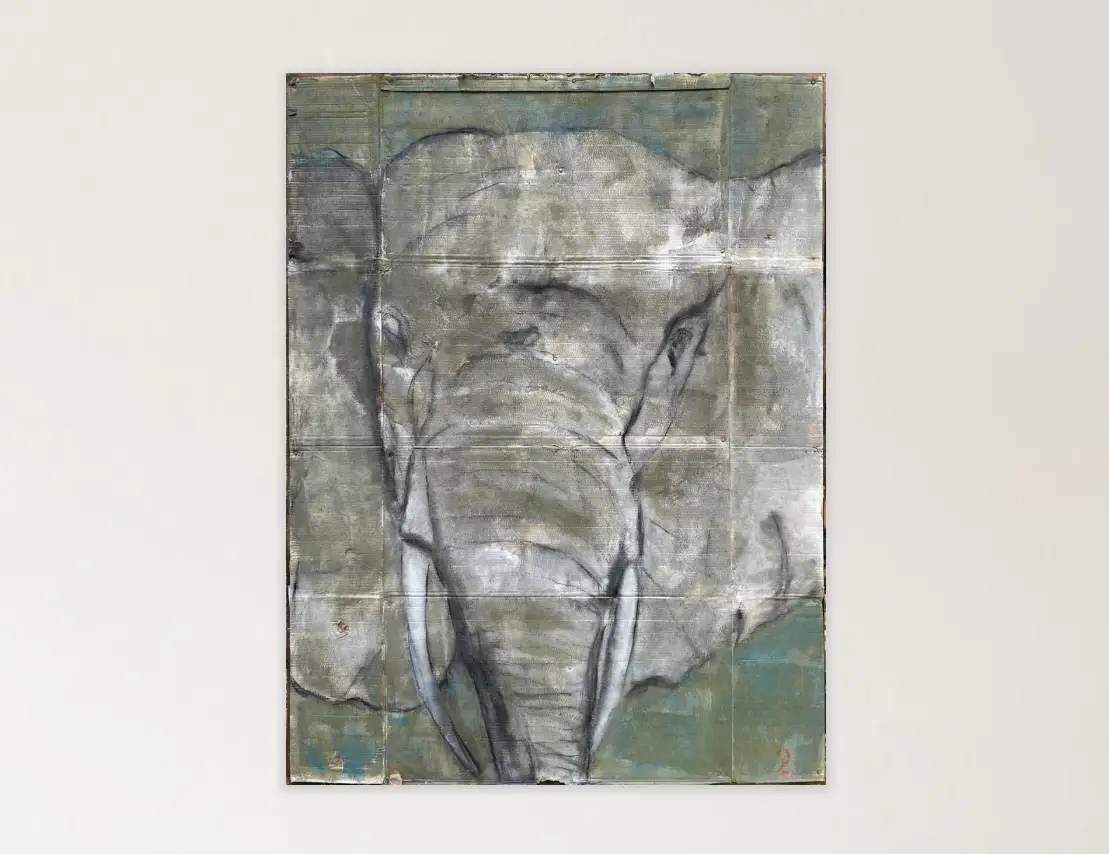
There is something immediately disarming about an elephant rendered at this scale—not because of spectacle, but because of proximity. In Brother John’s Elephant, Kris Gebhardt does not stage the animal as distant myth or safari emblem. Instead, he brings it forward—closer than expected, closer than comfortable—until the figure begins to occupy not just space, but attention itself.
The painting resists easy narrative. It does not announce itself as political, ecological, or allegorical, though it quietly contains all three. What it offers first is presence: a body, heavy with implication, suspended within a painterly field that feels at once controlled and unsettled. The elephant is not just depicted; it is insisted upon.
And in that insistence, something begins to shift.
scale
The work operates beyond domestic viewing. It requires distance, but also rewards closeness. From afar, the composition resolves into a singular image—recognizable, almost iconic. Up close, however, the surface fractures into gesture: layered acrylic, dragged pigment, interruptions of texture that resist smooth reading.
Gebhardt gravitates scale not as enlargement, but as pressure. The elephant does not feel “big” in a decorative sense; it feels heavy, as though its mass presses outward from the canvas. The 3-inch depth reinforces this sensation—the painting becomes object-like, a slab rather than a window.
This matters. Because the elephant, historically, is a loaded image.
It carries with it centuries of symbolic residue: memory, wisdom, empire, burden. In Western viewed culture, it often oscillates between curiosity and conquest—an exotic body to be displayed, controlled, or mythologized. Gebhardt sidesteps these traditions by refusing spectacle. His elephant is not performing. It is simply there.
And that “there” is not neutral.
stir
Acrylic, in Gebhardt’s hands, becomes less a medium than a method of interruption. The surface does not glide—it catches. Areas of opacity collide with translucent passages, creating a rhythm that feels almost stuttered. The paint appears worked, reconsidered, at times even resisted.
This friction is essential. It prevents the image from settling into illustration.
Instead, the painting operates in a space between representation and abstraction. The elephant is legible, but not fixed. Edges dissolve. Forms blur. There are moments where the body seems to emerge from the background, and others where it recedes, as if being absorbed back into the field.
This instability mirrors something deeper: the difficulty of holding onto meaning.
What does an elephant signify now? Conservation crisis? Cultural memory? Personal symbol? The painting does not answer. It allows these possibilities to coexist, unresolved.
flow
Brother John’s Elephant is a title that introduces intimacy, even familiarity. It suggests ownership, or at least association. But who is Brother John? A real figure? A fictional construct? A spiritual reference?
The ambiguity is deliberate.
By naming the elephant in relation to “Brother John,” Gebhardt shifts the focus from universal symbol to personal narrative. The elephant is no longer just an elephant—it belongs to someone, or is remembered by someone. It becomes specific, even if that specificity remains opaque.
This move destabilizes the viewer’s position. We are no longer looking at a generalized image; we are encountering something that feels already claimed, already embedded in a story we are not fully privy to.
And yet, the painting remains open.
show
There is a tendency in contemporary figurative painting to lean into storytelling—to anchor images in explicit narratives or cultural references. Gebhardt resists this. His work feels more like memory than story.
Fragments, impressions, partial recognitions.
The elephant, in this sense, operates as a mnemonic device. Not a literal recollection, but a trigger—something that activates associations without fully articulating them. The viewer is invited to project, but not to resolve.
This is where the painting gains its quiet power. It does not tell you what to think. It asks you to remain with what you cannot fully name.
tinct
Though the exact palette shifts across the surface, the overall tonality leans toward muted, earthy registers—grays, browns, perhaps interrupted by unexpected accents. The color does not decorate; it conditions the space.
There is a sense of weather within the painting. Not literal weather, but atmospheric pressure—something heavy, lingering, unresolved. The elephant does not exist in a clear environment. It is surrounded by ambiguity, as though emerging from fog or memory.
This lack of environmental clarity further isolates the figure. It is not grounded in landscape. It is suspended.
And in that suspension, it becomes more than animal.
between
One of the most compelling tensions in Brother John’s Elephant is its oscillation between presence and absence. The elephant is undeniably there—large, central, unavoidable. And yet, parts of it seem to fade, to dissolve into the surrounding field.
This creates a paradox: the more you look, the less stable the image becomes.
It is a reminder that visibility does not guarantee understanding. That even the most apparent forms can remain elusive.
In this way, the painting aligns with a broader tendency in contemporary art to question perception itself. What do we actually see? And what do we project onto what we see?
theory
There is an ethical dimension to the work that remains understated but persistent. To look at an elephant—especially at this scale—is to engage with a history of looking that is not neutral.
Zoos, colonial exhibitions, wildlife photography, conservation campaigns—all of these shape how elephants are seen and understood. Gebhardt does not explicitly critique these frameworks, but his painting subtly disrupts them.
By removing context, by refusing narrative clarity, he interrupts the habitual ways of seeing. The elephant is not presented for consumption. It is not explained. It is not made accessible in the usual sense.
Instead, it remains slightly out of reach.
This distance is not alienating; it is necessary. It creates space for reflection.
idea
The use of acrylic on “other” suggests a support that is not standard canvas. This choice matters, even if it remains unspecified. It introduces an element of material resistance—something that affects how the paint behaves, how it adheres, how it builds.
The surface, then, is not just view—it is physical.
You can almost feel the drag of the brush, the layering of pigment, the moments where the artist has pushed against the material rather than simply applied it. This tactile quality reinforces the painting’s sense of weight.
It is not a smooth image. It is worked.
And that labor is visible.
relev
Within the broader landscape of contemporary painting, Gebhardt’s work occupies an interesting position. It engages with figuration, but resists narrative illustration. It embraces scale, but avoids spectacle. It uses recognizable imagery, but destabilizes its meaning.
This places it in dialogue with a lineage of painters who explore the tension between image and surface—artists who understand that what is depicted is only part of what is at stake.
In this context, Brother John’s Elephant feels both familiar and distinct. It draws on established visual languages, but recombines them in a way that feels personal, even idiosyncratic.
stay
Perhaps the most important quality of the painting is its refusal of immediacy. It does not reveal itself quickly. It requires time—time to look, to adjust, to reconsider.
In an era of accelerated image consumption, this slowness is significant.
The painting does not compete for attention through shock or novelty. It holds attention through persistence. The longer you stay with it, the more it shifts—not in content, but in perception.
This is not a work that resolves. It accumulates.
stance
The elephant functions less as subject and more as threshold. It is the point through which the viewer enters the painting, but not where the experience ends.
Beyond it lies a network of associations—memory, history, materiality, perception—that cannot be fully mapped. The painting does not guide you through this network. It leaves you within it.
And that is its strength.
resolve
Brother John’s Elephant does not offer closure. It does not provide a clear message or a singular interpretation. Instead, it holds open a space—one defined by ambiguity, by tension, by the coexistence of multiple meanings.
This openness is not a lack. It is a choice.
In refusing to resolve, the painting remains alive. It continues to shift, to suggest, to resist. It asks the viewer not for agreement, but for attention.
And in that attention, something quiet but persistent emerges:
Not understanding, exactly.
But awareness.