Bruno Mars: The Romantic Tour Lands at MetLife Stadium — A Two-Night Spectacle in East Rutherford

March 22, 2026
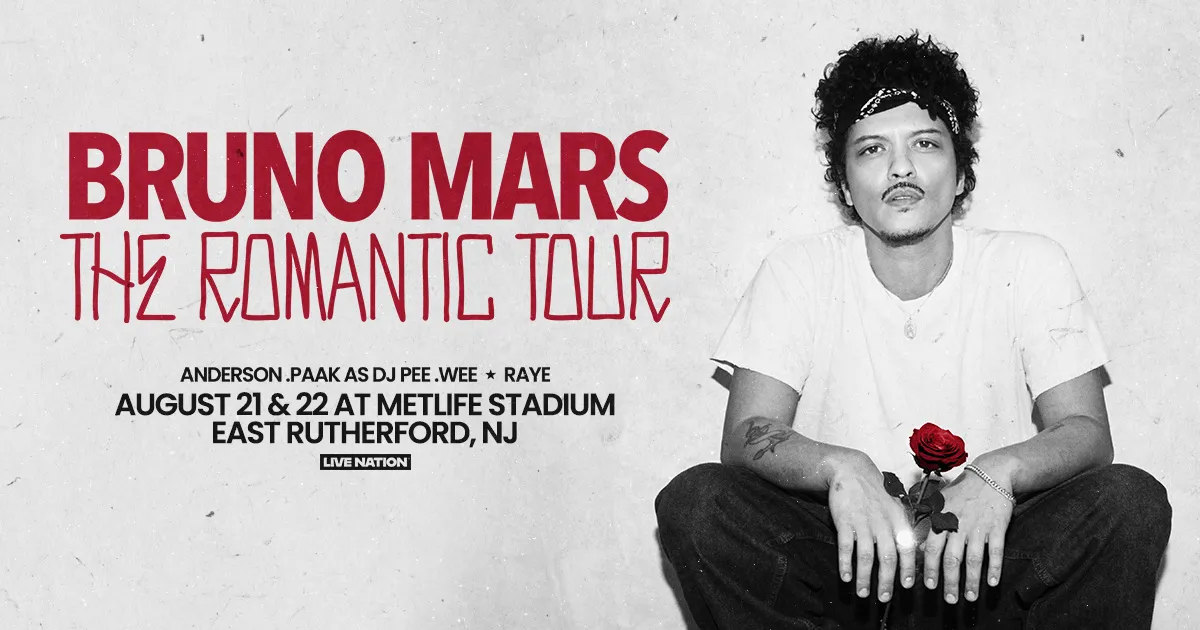
When Bruno Mars announces a stadium run, it rarely feels like just another tour. It arrives more like an event—one that merges nostalgia, precision showmanship, and a kind of theatrical romance that few contemporary performers can replicate. This summer, The Romantic Tour expands that legacy, touching down at MetLife Stadium for two consecutive nights: August 21st and August 22nd.
Positioned just across the Hudson from New York City, the East Rutherford venue becomes a gravitational center for fans across the tri-state area—transforming what is already one of the largest stadiums in the country into a cathedral of modern pop, funk, and soul.
stir
Bruno Mars has always understood scale—not just in terms of venue size, but emotional reach. From the tightly choreographed intimacy of his Las Vegas residencies to the explosive, broadcast-defining performance at the Super Bowl XLVIII Halftime Show, his artistry thrives when precision meets excess.
The Romantic Tour leans directly into that duality. Expect a setlist that bridges eras seamlessly: early hits like “Just the Way You Are” and “Grenade” reinterpreted with richer instrumentation, alongside Silk Sonic-era standouts like “Leave the Door Open” and “Smokin Out the Window.” The throughline is clear—romance, not as cliché, but as a sonic language rooted in funk basslines, vintage synth textures, and gospel-adjacent vocal layering.
Mars doesn’t simply perform songs; he stages them. Every beat is accompanied by movement, every chorus supported by a band that functions less like backing musicians and more like a tightly wound extension of his own rhythm.
View this post on Instagram
flow
Opening the night—but not in the traditional sense—is Anderson .Paak in his DJ persona, DJ Pee Wee. It’s a role that reframes the idea of an opening act entirely.
Rather than a warm-up, DJ Pee Wee acts as a curator of energy. His sets are known for blending hip-hop classics, funk deep cuts, and unexpected transitions that feel improvised but land with surgical precision. There’s a looseness to it—.Paak behind the decks is less concerned with perfection than with feel, a philosophy that mirrors the Silk Sonic ethos he shares with Mars.
For audiences at MetLife, this means the evening begins long before Bruno steps on stage. The sonic atmosphere builds in waves, guided by crate-digging instincts and an ear for rhythm that keeps the crowd in constant motion.
raye
Adding further depth to the lineup is Raye, whose presence signals a deliberate curatorial choice rather than a standard supporting slot.
Raye’s rise has been defined by independence and vocal power. Her performances carry a rawness that contrasts—and complements—the polished theatrics of Mars. Songs like “Escapism.” and “Ice Cream Man” showcase her ability to pivot between vulnerability and control, often within the same phrase.
On a stadium stage, that emotional clarity becomes even more pronounced. Where Mars leans into spectacle, Raye strips things back—reminding audiences that at the core of every large-scale production is a voice, unfiltered and immediate.
arena
Hosting the tour at MetLife is no accident. Located in East Rutherford, New Jersey, the venue is synonymous with scale. It has housed everything from NFL showdowns to global tours, but concerts here carry a distinct energy—one shaped by proximity to New York City and the cultural density of the surrounding region.
With a capacity exceeding 80,000, MetLife transforms each performance into a shared experience on a massive scale. Yet for an artist like Bruno Mars, who thrives on audience interaction, the challenge—and the magic—is making that space feel intimate.
Production design plays a crucial role. Expect multi-tiered staging, extended runways, and a lighting system engineered to translate nuance across distance. Screens become storytelling tools rather than mere amplification, capturing expressions, gestures, and micro-moments that would otherwise be lost in the vastness.
show
It would be easy to frame The Romantic Tour as a nostalgia-driven exercise, a revisiting of hits designed to satisfy long-time fans. But that reading misses the larger point.
Mars operates in a lineage—one that includes artists like Prince and Michael Jackson—where performance is as much about reinterpretation as it is about repetition. Songs evolve. Arrangements shift. What audiences hear on stage is not a replication of recorded material, but a live reimagining shaped by time, collaboration, and context.
In this sense, The Romantic Tour functions less as a retrospective and more as a living archive. Each night becomes a slightly different version of the same narrative, influenced by crowd energy, improvisation, and the chemistry between performers.
mode
There’s also a broader cultural resonance to consider. In an era dominated by algorithmic playlists and fragmented listening habits, large-scale tours like this offer something increasingly rare: a collective, embodied musical experience.
Romance, as a theme, feels particularly timely. Not in the conventional sense of love songs, but as a counterpoint to digital detachment. The tactile elements of live performance—the bass you feel in your chest, the synchronized movement of a crowd, the unpredictability of a live vocal—reintroduce a kind of emotional immediacy that streaming cannot replicate.
Mars understands this implicitly. His music has always drawn from analog traditions—vinyl-era funk, Motown soul, early 2000s R&B—and in a stadium setting, those influences gain new weight.
cept
With two dates scheduled—August 21st and 22nd—fans have the rare opportunity to experience the tour in duplicate, though “duplicate” is perhaps misleading. No two Bruno Mars shows are truly identical.
Subtle variations in setlist order, extended instrumental breaks, and audience interaction ensure that each night carries its own identity. For dedicated fans, attending both shows becomes less about repetition and more about comparison—spotting the differences, feeling the shifts in energy, witnessing how the same framework can yield distinct experiences.
fin
As summer concerts go, this is positioned as a peak moment—not just for fans of Bruno Mars, but for anyone interested in the evolving language of live performance.
Between Mars’ meticulous showmanship, DJ Pee Wee’s genre-blurring sets, and Raye’s emotionally charged vocals, the two-night run at MetLife Stadium becomes more than a concert. It becomes a study in contrast: polish and spontaneity, scale and intimacy, nostalgia and reinvention.
And in East Rutherford, for two nights in August, those contrasts converge—loud, luminous, and impossible to ignore.