Catharine Czudej — For St. Patrick’s Day (2019) and the Uncanny Weight of the Everyday

March 17, 2026
sculpture
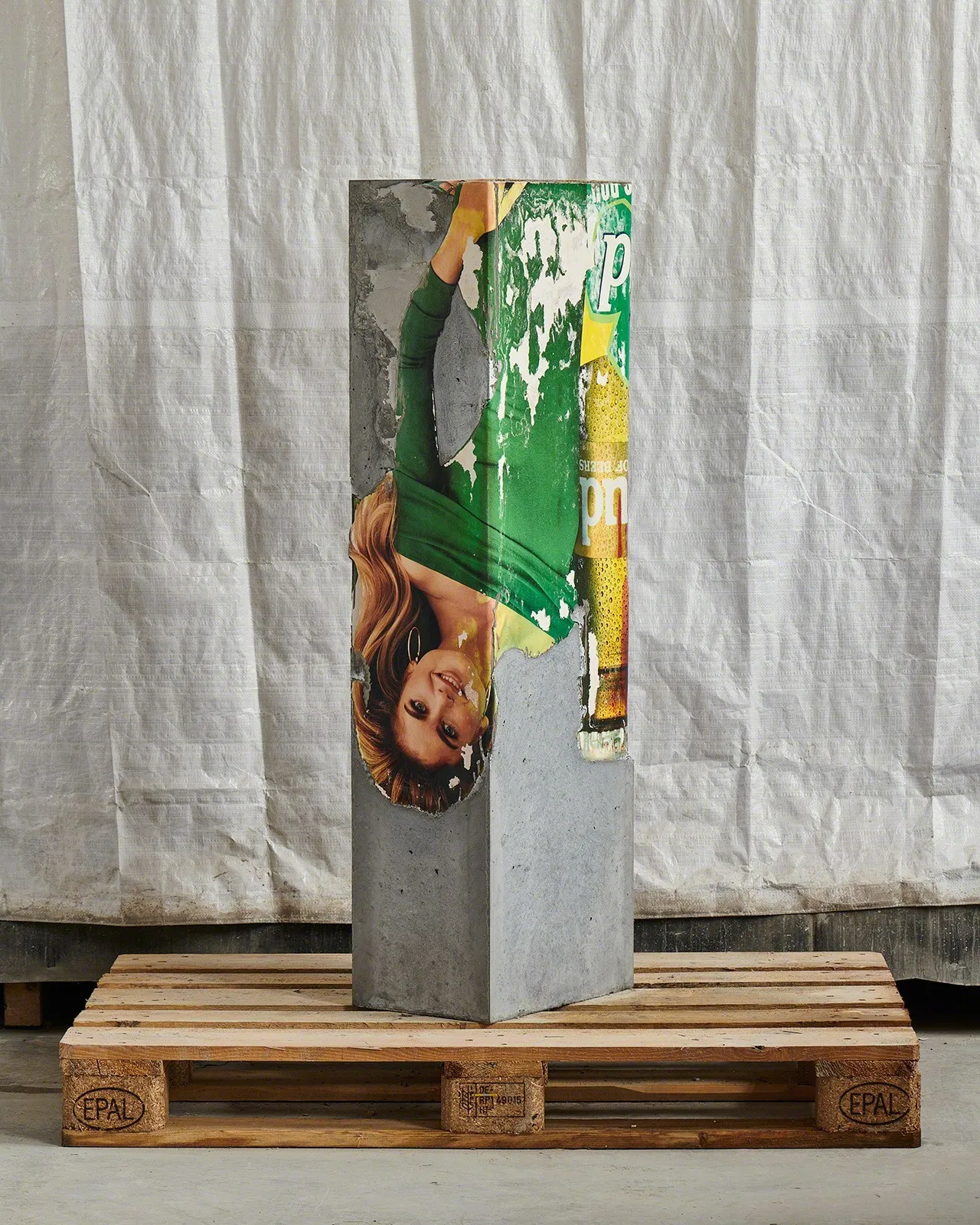
In the evolving terrain of contemporary sculpture, few artists manage to recalibrate the familiar with the same quiet disorientation as Catharine Czudej. Her 2019 work For St. Patrick’s Day exists not as a singular object alone, but as a conceptual pivot—an articulation of her ongoing inquiry into material, perception, and the instability of meaning. Constructed from cardboard, concrete, and styrofoam, the piece occupies a paradoxical space: physically grounded yet conceptually unsettled.
At 120 × 25 × 36 inches (304.8 × 63.5 × 91.4 cm), the sculpture asserts presence. Its scale is neither monumental nor diminutive; instead, it sits within a human register, large enough to confront the viewer, intimate enough to suggest proximity. This balance becomes essential to Czudej’s practice, where recognition is the entry point—and disruption, the destination.
mat
The material composition of For St. Patrick’s Day reads almost like a coded statement. Cardboard—lightweight, disposable, transient—meets concrete, a substance synonymous with permanence and structural authority. Styrofoam, often associated with packaging and protection, introduces a third dimension: fragility masked as utility.
This triad forms a dialogue of contradictions. What appears solid may not be; what seems temporary may endure. Czudej’s manipulation of these materials destabilizes expectation, encouraging viewers to question not only what they see, but how they interpret the relationship between form and function.
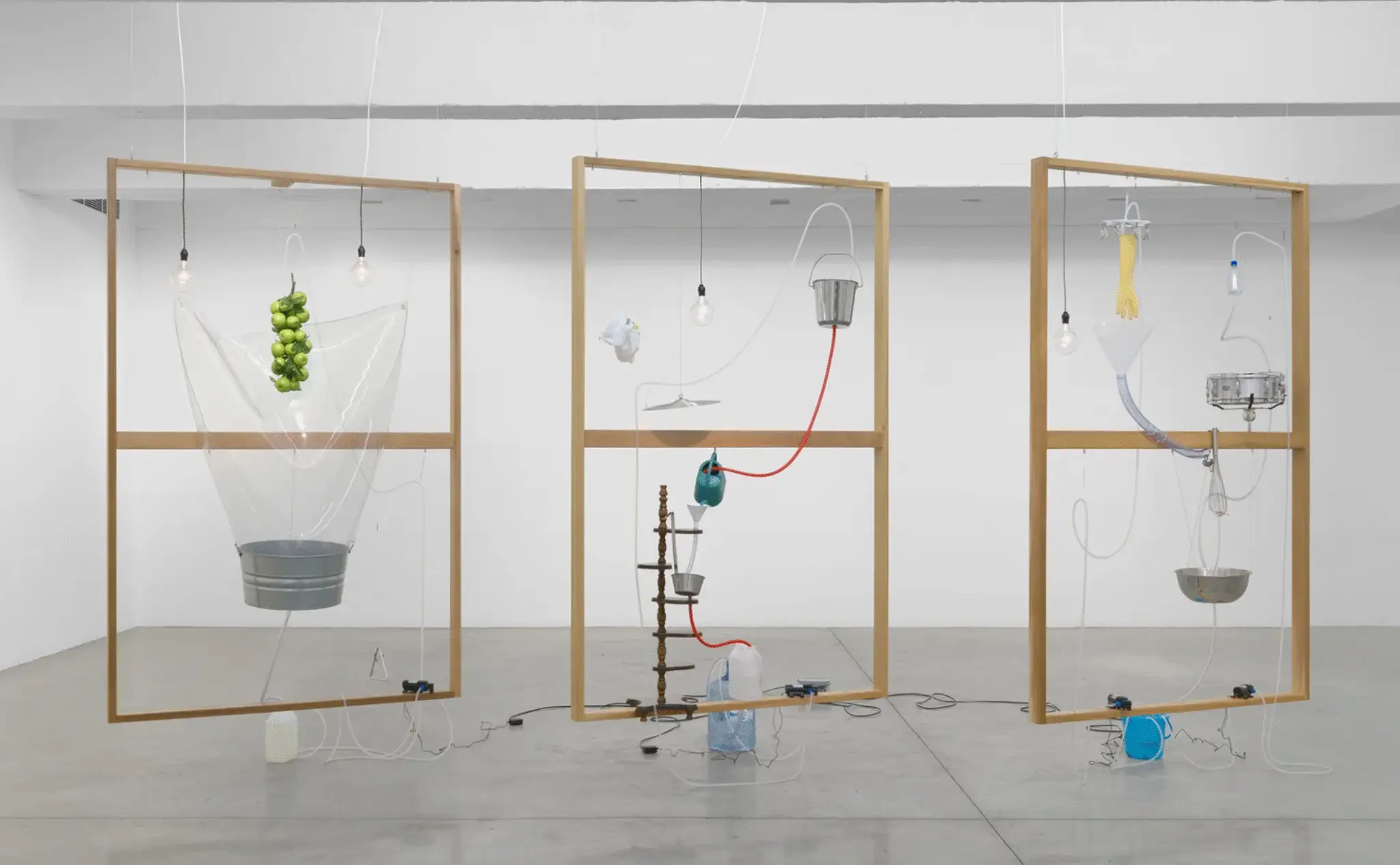
This approach echoes her broader body of work, where objects are rarely what they appear to be. A bicycle rendered in pretzel dough. A lamp constructed from edible materials. Everyday forms reimagined through unexpected mediums that challenge their perceived reliability. In each instance, the object becomes a site of tension—between recognition and doubt.
arcane
Czudej’s work operates within the lineage of surrealism, yet it resists direct alignment with its historical tropes. Instead of overt dream imagery or symbolic excess, her practice leans into a subtler form of the uncanny—one rooted in displacement rather than distortion.
The familiar is not transformed beyond recognition; it is shifted just enough to feel wrong.
This strategy aligns with her own description of her process: taking something ordinary and repositioning it to create unease. The result is a kind of perceptual friction. The viewer recognizes the object, understands its intended function, yet senses that something is off. That tension becomes the work’s central narrative.
In For St. Patrick’s Day, this unease is amplified through scale and material. The object’s physicality invites interaction—suggesting weight, stability, presence—while its construction undermines those assumptions.
idea
Underlying Czudej’s practice is a sustained engagement with representations of the body—particularly the female body—and its historical framing. While For St. Patrick’s Day may not explicitly depict a figure, it participates in this discourse through absence.
The object becomes a surrogate body. Its surfaces, textures, and structural tensions echo corporeal qualities—skin, bone, fragility, resilience. By abstracting the body into object form, Czudej shifts the conversation from representation to sensation.
This move is significant. It bypasses the visual language of depiction and instead engages the viewer on a tactile, almost subconscious level. The sculpture is not something to be read; it is something to be felt, even if only imaginatively.
sci-fi
Czudej’s stated interest in science fiction further complicates the reading of her work. Rather than referencing specific narratives or aesthetics, she draws from the genre’s underlying logic: the reconfiguration of reality.
Science fiction often operates by introducing small deviations into familiar systems—altering rules, shifting contexts, destabilizing norms. Czudej applies this logic to the physical world. Her sculptures feel as though they belong to a slightly altered reality, one where materials behave differently, where objects carry unexpected meanings.
For St. Patrick’s Day can be understood within this framework. It is not futuristic in appearance, yet it suggests a world where the boundaries between materials—and by extension, between meanings—are fluid.
flow
There is, within Czudej’s work, a subtle thread of humor. Not overt or comedic, but present in the absurdity of the constructions. A sofa made of pretzels. A lava lamp reconstructed from discarded containers. These gestures carry a lightness that contrasts with the conceptual weight of the work.
Yet this humor is always accompanied by a sense of fragility. The objects appear unreliable, even precarious. They invite engagement while simultaneously resisting it. This duality—invitation and refusal—creates a dynamic tension that defines the viewer’s experience.
In For St. Patrick’s Day, this tension manifests through material uncertainty. The sculpture’s surface may suggest durability, but its components hint at vulnerability. The viewer is left to navigate this ambiguity, to question whether the object can be trusted.
hx
Czudej’s practice has been shaped through a series of exhibitions that situate her work within a broader contemporary discourse. From Nuit Américaine at Office Baroque in 2014 to Concrete Island at VENUS in 2017, and her 2019 presentation with Michael Benevento, her trajectory reflects a consistent exploration of material and perception.
These exhibitions provide a framework for understanding For St. Patrick’s Day not as an isolated piece, but as part of an evolving investigation. Each show builds upon the last, refining her approach while expanding its conceptual reach.
The involvement of Ginerva Gambino further situates the work within an international context, connecting it to a network of galleries that engage with experimental, materially driven practices.
scale
The dimensions of For St. Patrick’s Day conjure a crucial role in its impression. At over three meters in length, the sculpture commands space without overwhelming it. Its horizontal orientation suggests a relationship to architecture—perhaps a fragment of a larger structure, or an object displaced from its original context.
This spatial ambiguity is key. The work does not dictate how it should be encountered; instead, it allows the viewer to navigate around it, to construct their own understanding through movement and perspective.
In this sense, the sculpture functions as an environment as much as an object. It shapes the space it occupies, altering the viewer’s perception of that space in subtle but significant ways.
rare
As a unique work, For St. Patrick’s Day resists reproduction—not only physically, but conceptually. Its materials, its construction, its presence are all tied to a specific moment and context. This singularity reinforces the themes of instability and impermanence that run through Czudej’s practice.
In a cultural landscape increasingly defined by replication and distribution, the uniqueness of the piece carries additional weight. It exists as an object that cannot be fully translated or duplicated, emphasizing the importance of direct experience.
fwd
Ultimately, For St. Patrick’s Day operates as a proposition. It suggests that reality, as we perceive it, is less stable than we assume. Materials can deceive. Objects can mislead. Familiarity can be constructed—and deconstructed—with subtle shifts.
Czudej’s work does not offer resolution. It does not seek to clarify or define. Instead, it opens a space of uncertainty, inviting the viewer to inhabit that space, to question their assumptions, to reconsider the relationship between what is seen and what is understood.
end
In the hands of Catharine Czudej, sculpture becomes less about form and more about perception. For St. Patrick’s Daystands as a testament to this approach—a work that engages not through spectacle, but through quiet disruption.
It is a reminder that the most compelling transformations are often the least visible. That a slight shift—a change in material, a repositioning of form—can alter the way we experience the world.
And in that alteration lies the true power of the work: not in what it is, but in what it makes possible.