CELINE Soft Triomphe: The Emblem, Dissolved into Form

March 19, 2026
a subtle
When a house like CELINE adjusts its viewership language, the shift rarely announces itself loudly. Instead, it unfolds through proportion, tactility, and gesture—elements that speak directly to those attuned to nuance. The introduction of the Soft Triomphe line, first revealed at the Printemps 2026 show under Michael Rider, signals precisely such a recalibration.
This is not reinvention for spectacle. It is refinement for longevity.
Reappearing at the Été presentation at Domaine National de Saint-Cloud, the Soft Triomphe bags affirmed their role as more than seasonal accessories. They are, instead, a study in continuity—how a house emblem evolves without losing its authority.
At its core, the Soft Triomphe is about ease. Not casualness, but control without rigidity. It introduces a new rhythm into CELINE’s leather goods—one that privileges touch, wearability, and the quiet confidence of objects designed to integrate into daily life.
View this post on Instagram
stir
Creative transitions at heritage houses often arrive with a manifesto. Rider’s approach is more restrained, yet no less deliberate. The Soft Triomphe functions as an opening argument—a tactile thesis on what CELINE can become under his direction.
Rather than dismantling the house codes, Rider compresses them. The Triomphe emblem, historically bold and declarative, is miniaturized and softened. Its presence remains unmistakable, but its expression becomes intimate.
This move is strategic.
Luxury in 2026 no longer depends on overt signaling. Instead, it thrives in recognition among those who understand proportion, material, and finish. Rider’s CELINE leans into this shift, repositioning the brand within a landscape increasingly defined by subtlety over statement.
consider
The Triomphe motif has long served as one of CELINE’s most recognizable signatures. Traditionally rendered in assertive scale and polished hardware, it functioned as both closure and ornament.
In the Soft Triomphe line, the emblem undergoes a transformation.
Scaled down to a miniature form, the Triomphe becomes less of a focal point and more of a detail discovered. The magnetized closure integrates seamlessly into the bag’s architecture, eliminating visual interruption. This is not branding imposed—it is branding absorbed.
The result is a new hierarchy of attention. The eye no longer gravitates immediately toward hardware. Instead, it moves across the surface—tracing the curvature of lambskin, the fall of the silhouette, the balance between structure and softness.
This recalibration reflects a broader cultural movement within luxury: logos are no longer declarations. They are whispers.
role
Material has always been central to CELINE’s identity, but the Soft Triomphe elevates it to narrative status.
The choice of supple shiny lambskin is not incidental. It is foundational.
Lambskin carries a unique duality—it is both delicate and resilient, capable of absorbing movement while maintaining integrity over time. In the Soft Triomphe, this quality is harnessed to create a surface that responds to the body. The bag does not resist; it adapts.
This responsiveness introduces a new kind of luxury—one defined not by rigidity, but by interaction.
The sewn-back construction technique employed by CELINE’s leather goods workshops plays a crucial role here. By reversing traditional assembly methods, the house achieves a finish that is both lightweight and tactile. Seams are minimized, weight is reduced, and the overall object gains a fluidity rarely found in structured luxury bags.
The result is a form that feels alive—capable of evolving with use, rather than remaining static.
flow
Softness, in the context of luxury design, is often misunderstood. It is not the absence of structure, but the careful calibration of it.
The Soft Triomphe embodies this principle through its curving silhouette. Each bag maintains a defined shape, yet avoids rigidity. The edges are rounded, the lines continuous, the transitions seamless.
This approach creates a sense of movement—even when the bag is at rest.
It also aligns with contemporary lifestyle needs. Modern consumers require objects that transition effortlessly between contexts—work, travel, leisure—without demanding adjustment. The Soft Triomphe achieves this through proportion.
Sized for everyday use, the bags accommodate essentials without excess. They neither overwhelm nor disappear. Instead, they occupy a precise middle ground—visible, functional, and refined.
phil
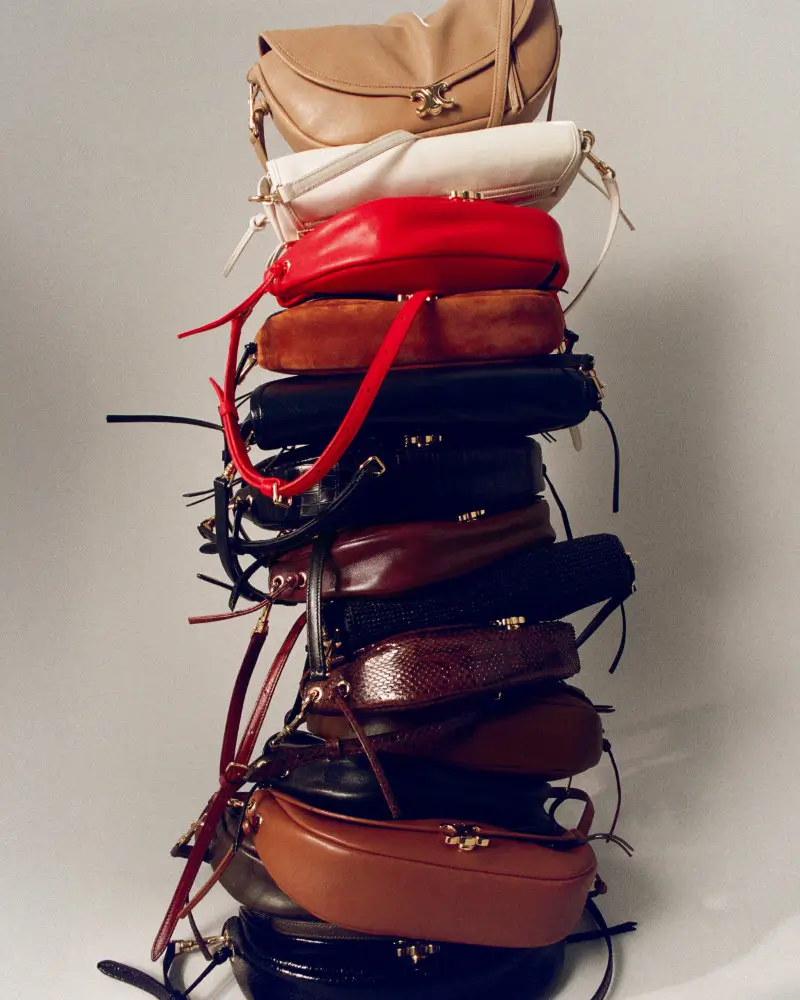
The Soft Triomphe line launches with two silhouettes: the Besace and the Half Moon. While distinct in form, they share a unified philosophy.
the besace
The Besace is defined by its rounded body and front flap. It carries echoes of traditional satchel design, yet its execution is entirely contemporary.
The curvature softens the form, while the flap introduces a sense of layering. This interplay between openness and closure creates visual depth without complexity.
Worn crossbody or on the shoulder, the Besace sits comfortably against the torso. Its proportions are calibrated to complement movement rather than restrict it.
the half moon
The Half Moon, by contrast, is more streamlined. Its crescent shape follows the natural line of the body, creating an almost ergonomic relationship between object and wearer.
This silhouette reflects a broader trend within fashion toward anatomical design—objects that mirror the human form rather than oppose it.
The Half Moon’s simplicity is its strength. Free from excess detailing, it relies entirely on material and proportion to communicate value.
refine
The concept of “everyday luxury” has become ubiquitous, yet rarely realized with precision. Too often, it results in objects that dilute luxury in pursuit of accessibility.
The Soft Triomphe approaches the idea differently.
It does not simplify luxury—it refines it.
Every element, from the lambskin to the closure to the construction, is executed at the highest level. What changes is not the quality, but the intention. The bags are designed to be used, not preserved.
This shift reflects a generational change in luxury consumption. Ownership is no longer about accumulation; it is about integration. Objects must justify their presence through daily relevance.
The Soft Triomphe meets this demand by offering a balance between durability and delicacy. It invites use, yet retains the aura of craftsmanship.
idea
In fashion, restraint is often the most difficult quality to achieve. It requires confidence—both from the designer and the wearer.
The Soft Triomphe embodies this confidence.
By reducing the scale of the Triomphe emblem, by prioritizing material over hardware, by smoothing the silhouette, CELINE signals a departure from overt branding. This is not a rejection of identity, but a maturation of it.
The bags communicate through absence as much as presence.
This approach aligns with a broader cultural moment in which consumers seek authenticity over amplification. The most compelling objects are those that reveal themselves gradually—through use, through touch, through time.
celine
It is important to view the Soft Triomphe not as an isolated product, but as part of a larger trajectory within CELINE.
The house has long balanced minimalism with heritage. Under previous creative directions, this balance manifested in different ways—sometimes through sharp tailoring, sometimes through bold accessories.
Rider’s contribution lies in recalibrating this balance toward softness.
This does not mean abandoning structure or identity. Instead, it introduces flexibility—both literal and conceptual. The Soft Triomphe becomes a bridge between past and future, connecting the house’s established codes with a new sensibility.
pos
The luxury bag market in 2026 is saturated with icons. From archival revivals to hyper-branded statements, the landscape is crowded with objects competing for attention.
The Soft Triomphe distinguishes itself by opting out of this competition.
It does not demand attention—it rewards it.
This positioning is particularly relevant within a cultural environment increasingly influenced by “quiet luxury.” Yet, unlike many interpretations of this trend, the Soft Triomphe avoids austerity. It retains warmth through material, intimacy through scale, and presence through form.
In this sense, it represents a more nuanced evolution of the trend—one that acknowledges the desire for subtlety without sacrificing character.
craft
One of the most compelling aspects of the Soft Triomphe is the invisibility of its craftsmanship.
The sewn-back technique, the precise calibration of weight, the integration of the closure—these elements are not immediately apparent. They reveal themselves through use.
This invisibility is intentional.
In true luxury, craftsmanship does not announce itself. It supports the object silently, allowing the user to experience the result without being distracted by the process.
The Soft Triomphe exemplifies this philosophy. It feels effortless, yet is the product of significant technical expertise.
style
The versatility of the Soft Triomphe positions it as a foundational piece within contemporary wardrobes.
Its neutrality allows it to move across styles—paired with tailored suiting, casual denim, or eveningwear. This adaptability is crucial in a fashion landscape increasingly defined by hybridity.
The bags do not dictate styling—they accommodate it.
This quality enhances their cultural resonance. Rather than aligning with a specific subculture or aesthetic, the Soft Triomphe exists within a broader spectrum. It becomes a canvas for personal expression.
clue
The Soft Triomphe is, ultimately, a study in cadence.
It slows the pace of luxury, encouraging consideration over immediacy. It shifts attention from spectacle to substance, from branding to material, from rigidity to movement.
Under Michael Rider, CELINE appears to be entering a phase defined not by radical change, but by precise adjustment. The Soft Triomphe encapsulates this approach—an object that feels both familiar and new, both grounded and forward-looking.
In a market saturated with noise, its quietness becomes its strength.
And in that quietness, CELINE finds a new voice.