Beauty Is a Movement — The CC League by Chanel Beauty and the Rewriting of Power

March 17, 2026
new
There are moments when a brand does not merely release a campaign—it recalibrates the language through which it speaks. With The CC League, Chanel Beauty proposes a shift that feels both inevitable and quietly radical. Beauty, here, is no longer framed as a static condition, nor as an aesthetic endpoint. It becomes motion. It becomes force. It becomes a field in which identity is not displayed but lived.
“Beauty is a movement” is not a slogan. It is a repositioning.
In an industry historically anchored in stillness—posed faces, perfected surfaces, controlled light—Chanel introduces velocity. The body is no longer a site of correction but of capability. The face is no longer a canvas alone, but an extension of action, intention, and presence.
This is beauty not as image, but as energy.
View this post on Instagram
think
At the core of this shift lies a sentence that has long defined the house:
“To be irreplaceable, you have to be different.”
Gabrielle Chanel did not conceive of beauty as conformity. Her revolution was not only sartorial but philosophical—liberating the body from constraint, redefining elegance as autonomy rather than ornament.
The CC League extends this ethos into the present. It does not reinterpret Chanel’s legacy; it activates it.
Difference, in this context, is not aesthetic deviation. It is self-authorship. It is the capacity to exist outside prescribed narratives of femininity, strength, or desirability. It is the refusal to be interchangeable.
And in a cultural moment saturated with replication—filters, trends, algorithmic sameness—this insistence on difference acquires renewed urgency.
theory
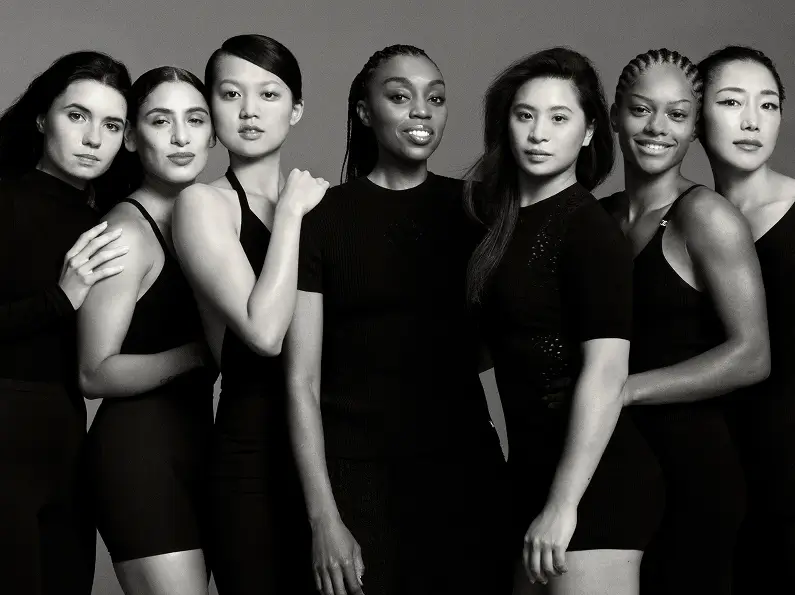
The CC League is composed of seven athletes. The number is deliberate.
Seven is often associated with balance, completion, and harmony. Yet within this campaign, it functions less as a symbol of closure and more as a framework for plurality. Each athlete represents a distinct discipline, a distinct rhythm, a distinct relationship to movement and to self.
Together, they do not form a uniform group. They form a constellation.
Each point emits its own light. Each trajectory remains independent. The collective exists not to homogenize but to amplify difference.
This is a critical distinction. Where traditional campaigns often seek cohesion through sameness—aligned aesthetics, synchronized poses—The CC League constructs cohesion through divergence. Unity emerges not from uniformity, but from shared intention.
idea
By centering athletes, Chanel Beauty engages with a body that is inherently active. This is not incidental.
The athletic body resists passivity. It is defined by training, by repetition, by resilience. It carries marks of effort—muscle, tension, breath. It is a body that does not simply appear; it performs.
In the context of beauty, this introduces a profound shift.
Perfection gives way to process. Surface gives way to function. The emphasis moves from how the body is seen to what the body does.
Yet Chanel does not abandon aesthetics. Instead, it expands them. Strength becomes beautiful not as a metaphor, but as a visible, embodied reality. Grace is no longer synonymous with delicacy; it becomes a quality of control, of precision, of presence within movement.
The face, within this framework, is not erased. It becomes expressive in new ways—flushed, focused, alive.
View this post on Instagram
flow
One of the most enduring narratives within beauty has been that of correction—the idea that products exist to fix, conceal, or improve.
The CC League disrupts this narrative.
Transformation, here, is not about becoming something else. It is about becoming more fully oneself. It is an expansion rather than an adjustment.
This aligns with Chanel Beauty’s broader trajectory, which increasingly emphasizes individuality over standardization. The products are not presented as tools of conformity but as instruments of expression—extensions of identity rather than replacements for it.
In this sense, beauty becomes a practice. It is something one does, not something one achieves.
lang
Movement, within the campaign, operates as a form of language.
Each athlete speaks through her discipline—through gesture, rhythm, repetition. The body articulates what words cannot: determination, hesitation, release, control.
This non-verbal language carries a particular resonance within the context of beauty. It bypasses the prescriptive. It resists categorization. It invites interpretation.
In visual terms, this is expressed through imagery that privileges motion over stillness. Blur replaces sharpness. Sequence replaces singularity. The viewer is not presented with a fixed image but with a continuum.
This introduces a temporal dimension to beauty. It is no longer captured in a single frame; it unfolds.
focus
The campaign repeatedly returns to the pairing of power and grace. Historically, these qualities have been gendered—power aligned with strength, grace with softness.
The CC League dissolves this binary.
Power is shown as endurance, as focus, as the capacity to persist. Grace is shown as fluidity, as adaptability, as the ability to inhabit movement fully.
Both coexist within each athlete. They are not opposing forces but complementary ones.
This redefinition carries broader cultural implications. It challenges the expectation that women must choose between strength and elegance, between authority and beauty. It asserts that these qualities are not mutually exclusive but inherently intertwined.
role
While individuality is central to The CC League, the collective remains essential.
The athletes are presented not as isolated figures but as part of a shared field. Their differences are not barriers but points of connection.
This reflects a broader shift within contemporary culture, where identity is increasingly understood as relational rather than singular. One becomes oneself not in isolation, but in dialogue with others.
The CC League embodies this dynamic. It creates a space in which multiple expressions of beauty can coexist without hierarchy.
There is no singular ideal. There is only multiplicity.
xp
For Chanel Beauty, this campaign represents an expansion rather than a departure.
The house has long engaged with notions of freedom, from Gabrielle Chanel’s early interventions in fashion to its ongoing exploration of femininity as autonomy. What changes here is the medium.
By incorporating athletes, movement, and performance, Chanel extends its narrative into new territories. Beauty intersects with sport, with discipline, with physicality.
This intersection reflects broader cultural currents. The boundaries between categories—fashion, beauty, sport, wellness—are increasingly porous. Consumers do not experience these domains separately; they experience them as part of a continuum.
The CC League responds to this reality. It situates beauty within life, rather than apart from it.
eco
Despite its thematic emphasis on movement, the campaign maintains a visual restraint that is distinctly Chanel.
The palette is controlled. The compositions are deliberate. There is an absence of excess.
This restraint functions as a counterbalance to the dynamism of the subject matter. It creates space for the viewer to engage, to project, to interpret.
It also reinforces the brand’s identity. Chanel does not need to overwhelm. Its authority lies in precision, in clarity, in the confidence to do less.
fwd
The CC League ultimately gestures toward a future in which beauty is not dictated but discovered.
It suggests that the most compelling expressions of beauty emerge not from adherence to external standards, but from alignment with internal ones. From knowing oneself. From inhabiting one’s body fully. From moving through the world with intention.
This is not an easy proposition. It requires effort, awareness, and, at times, resistance. But it is precisely this difficulty that gives it value.
Beauty, in this framework, is not effortless. It is earned—not through conformity, but through authenticity.
sum
“To be irreplaceable, you must be different.”
The repetition of this statement within the campaign is not redundant. It is rhythmic. It echoes, much like movement itself.
The CC League does not conclude with a single image or a single message. It continues—through the athletes, through the audience, through the ongoing evolution of what beauty can mean.
In positioning beauty as movement, Chanel does more than redefine a category. It opens a space.
A space in which difference is not only accepted but essential. A space in which power and grace coexist. A space in which the individual and the collective are not in opposition but in dialogue.
A space in which beauty is no longer something to be seen, but something to be lived.