A Study in Restraint and Resolve: Charlie Hunnam in Stone Island Marina Spring/Summer 2026

March 31, 2026
2 hours ago
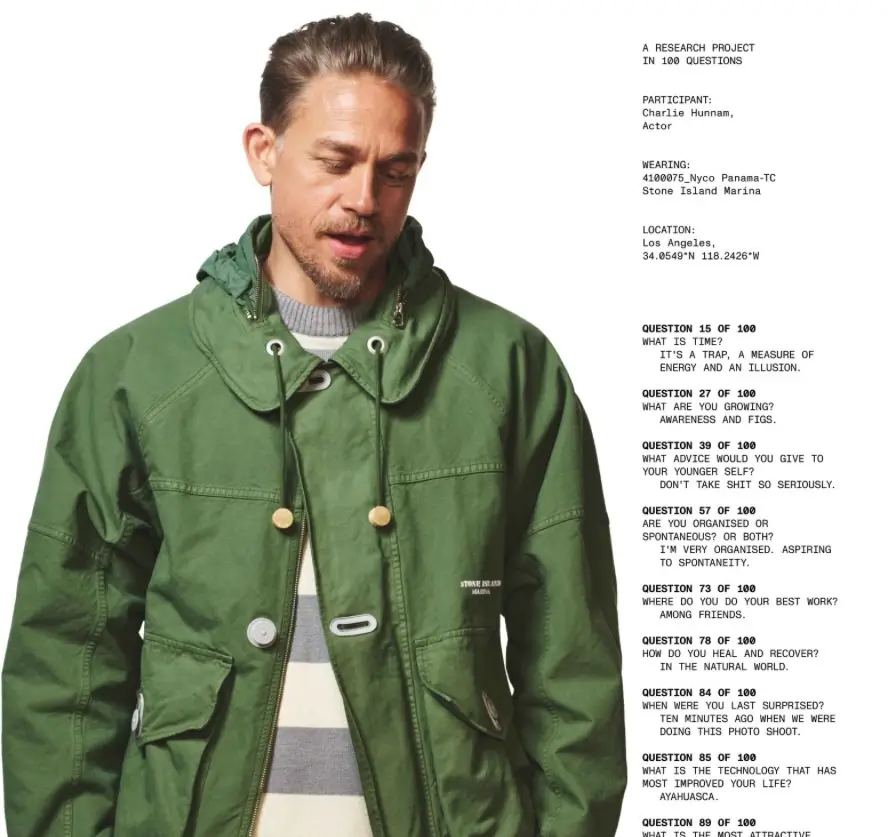
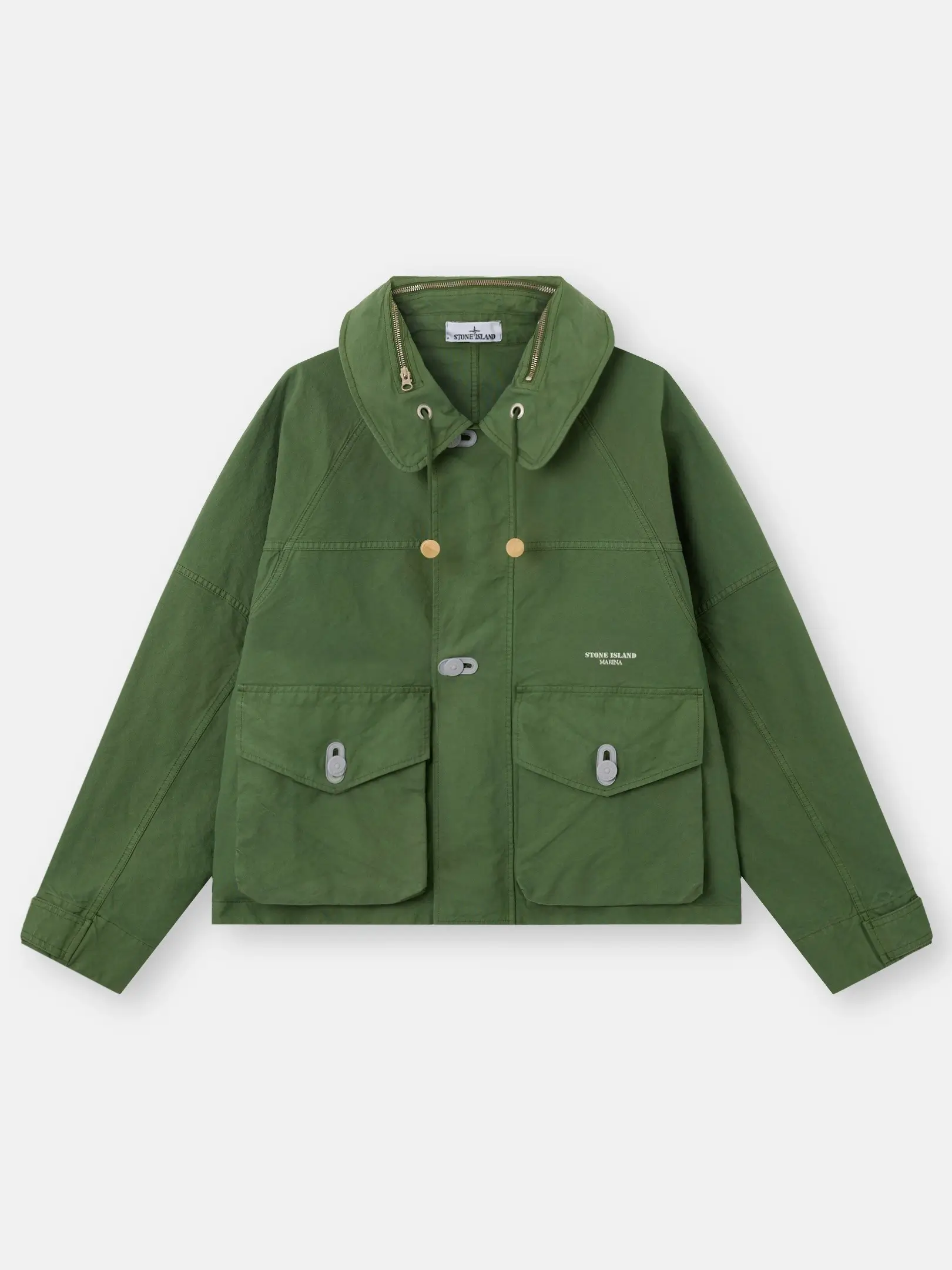
There is a mystique kind of presence that resists amplification. Charlie Hunnam has long occupied that space—visible, yet withholding; articulate, yet uninterested in spectacle. His appearance in Stone Island Marina’s Spring/Summer 2026 proposition, wearing the 4100075 Nyco Panama-TC jacket, does not operate as a campaign in the traditional sense. It reads instead as documentation: of a mindset, of a material, of a condition.
The excerpt from Community as a Form of Research frames the encounter with deliberate sparseness. His responses—“Don’t take shit so seriously,” “Aspiring to spontaneity,” and the disarming invocation of ayahuasca as transformative technology—signal a refusal to over-intellectualize what is fundamentally experiential. This same ethos is embedded within Stone Island’s Marina line, where garments are less about aesthetic assertion and more about operational clarity.
The Nyco Panama-TC jacket becomes a site where philosophy and fabrication meet without friction.
View this post on Instagram
flow
The 4100075 Nyco Panama-TC jacket presents itself as a coach silhouette—familiar, almost understated—but its construction reveals a deeper agenda. The panama weave nylon-cotton composition introduces a duality: breathability paired with tensile resilience. It is a fabric engineered not for static environments, but for movement across variable conditions.
Garment dyeing, a longstanding pillar within Stone Island’s methodology, is not merely a finishing process here—it is a recalibration of surface identity. The anti-drop treatment further situates the piece within a pragmatic register, ensuring that function is not aestheticized but embedded.
The foldaway hood speaks to contingency. It exists when needed, disappears when not. Adjustable cuffs, hand pockets, and the two-way zip fastening reinforce a modular logic. Nothing is ornamental; everything is considered.
Within the Marina line, this logic is amplified. Originally conceived as a nautical extension of the brand’s research-driven ethos, Marina garments carry an implicit relationship to exposure—wind, salt, unpredictability. The Nyco Panama-TC jacket translates that lineage into an urban context without diluting its intent.
role
Hunnam’s alignment with this garment is not incidental. His career has consistently navigated characters defined by internal tension rather than external flourish. Whether in independent cinema or large-scale productions, his performances often suggest a negotiation between control and release.
His answer—“Don’t take shit so seriously”—could be misread as dismissal. Instead, it functions as calibration. It implies an understanding that intensity, when unchecked, becomes distortion. The Nyco Panama-TC jacket mirrors this principle. It is precise without rigidity, structured without constraint.
The admission of being “very organised” while “aspiring to spontaneity” introduces a productive contradiction. It is the same contradiction embedded in technical garments: engineered systems designed to accommodate unpredictability.
Even the mention of ayahuasca, unexpected within the context of a fashion editorial, aligns with this narrative. It suggests a pursuit of altered perception—not as escapism, but as inquiry. Within Stone Island’s framework, research operates similarly. Fabrics are not just developed; they are interrogated.
imply
Since its inception, the Marina line has functioned as a parallel exploration—less about seasonal trend cycles, more about environmental adaptation.
The nautical references are not decorative. They are structural. Early Marina pieces were designed with maritime conditions in mind, where exposure is constant and failure is consequential. Over time, these principles have been translated into garments suited for contemporary mobility—urban, transitory, and increasingly unpredictable.
Spring/Summer 2026 does not depart from this lineage. Instead, it refines it. The Nyco Panama-TC jacket exemplifies a shift toward lighter constructions without compromising durability. The panama weave, in particular, allows for airflow while maintaining structural integrity—a critical balance in warmer climates.
This evolution reflects a broader movement within technical fashion: the transition from heavy-duty performance wear to adaptive, everyday systems. Stone Island remains distinct in that its innovations are not framed as spectacle. They are integrated, often quietly, into garments that reveal their complexity over time.
culture
What distinguishes Stone Island in 2026 is not merely its technical proficiency, but its cultural positioning. The brand occupies a space where subcultural credibility intersects with institutional recognition. It is worn by those who value process over presentation, by individuals who understand clothing as an extension of thought rather than identity performance.
Hunnam’s presence reinforces this positioning. He is not a conventional fashion figure, nor does he perform as one. His engagement with the garment feels incidental, almost accidental—yet precisely for that reason, it resonates.
The Nyco Panama-TC jacket does not require validation. It exists within a framework of utility that transcends seasonal relevance. In an era where fashion cycles accelerate to the point of redundancy, such permanence becomes radical.
show
Function, within this context, is not a constraint but a language. Each element of the jacket communicates a specific intention. The anti-drop finish addresses environmental unpredictability. The two-way zip allows for ventilation and movement. The adjustable cuffs calibrate fit in response to changing conditions.
This language is not immediately legible. It requires engagement, an understanding that develops through use. In this sense, the garment operates similarly to Hunnam’s responses—brief, almost opaque, yet loaded with implication.
The refusal to over-explain becomes a form of respect. It assumes that the wearer, like the reader, is capable of interpretation.
commune
The framing of this editorial within Community as a Form of Research introduces another layer. It suggests that knowledge is not produced in isolation, but through interaction—between individuals, between materials, between contexts.
Stone Island’s approach aligns with this methodology. Its innovations are not the result of singular breakthroughs, but of iterative processes informed by a network of influences: industrial research, subcultural adoption, environmental necessity.
Hunnam’s participation in this framework is subtle yet significant. His answers do not position him as an authority, but as a participant. He offers fragments rather than conclusions, contributing to a collective understanding rather than defining it.
rebel
There is a restraint that runs through every aspect of this narrative. The jacket does not over-design. Hunnam does not over-speak. Stone Island does not over-brand.
This restraint is not absence; it is discipline. It reflects a confidence in the underlying structure, an understanding that excess often compensates for lack of substance.
In Spring/Summer 2026, this approach feels increasingly relevant. As fashion grapples with sustainability, with overproduction, with the saturation of imagery, the value of considered design becomes more apparent.
The Nyco Panama-TC jacket, in its quiet precision, offers an alternative model.
fin
The most compelling aspect of this intersection between Charlie Hunnam and Stone Island is its refusal to resolve into a singular narrative. It remains open, adaptable, responsive.
The jacket does not dictate how it should be worn. It responds to the wearer. Hunnam does not prescribe meaning. He offers perspective.
“Don’t take shit so seriously” is not a dismissal of seriousness, but a reminder of proportion. It suggests that depth does not require heaviness, that precision can coexist with ease.
In this sense, the Nyco Panama-TC jacket becomes more than a garment. It becomes a framework—one that accommodates movement, invites interpretation, and, above all, resists finality.
It is, like the best forms of research, unfinished.