Chutes and Signals: The Subterranean Systems of Erwan Sene

May 18, 2025
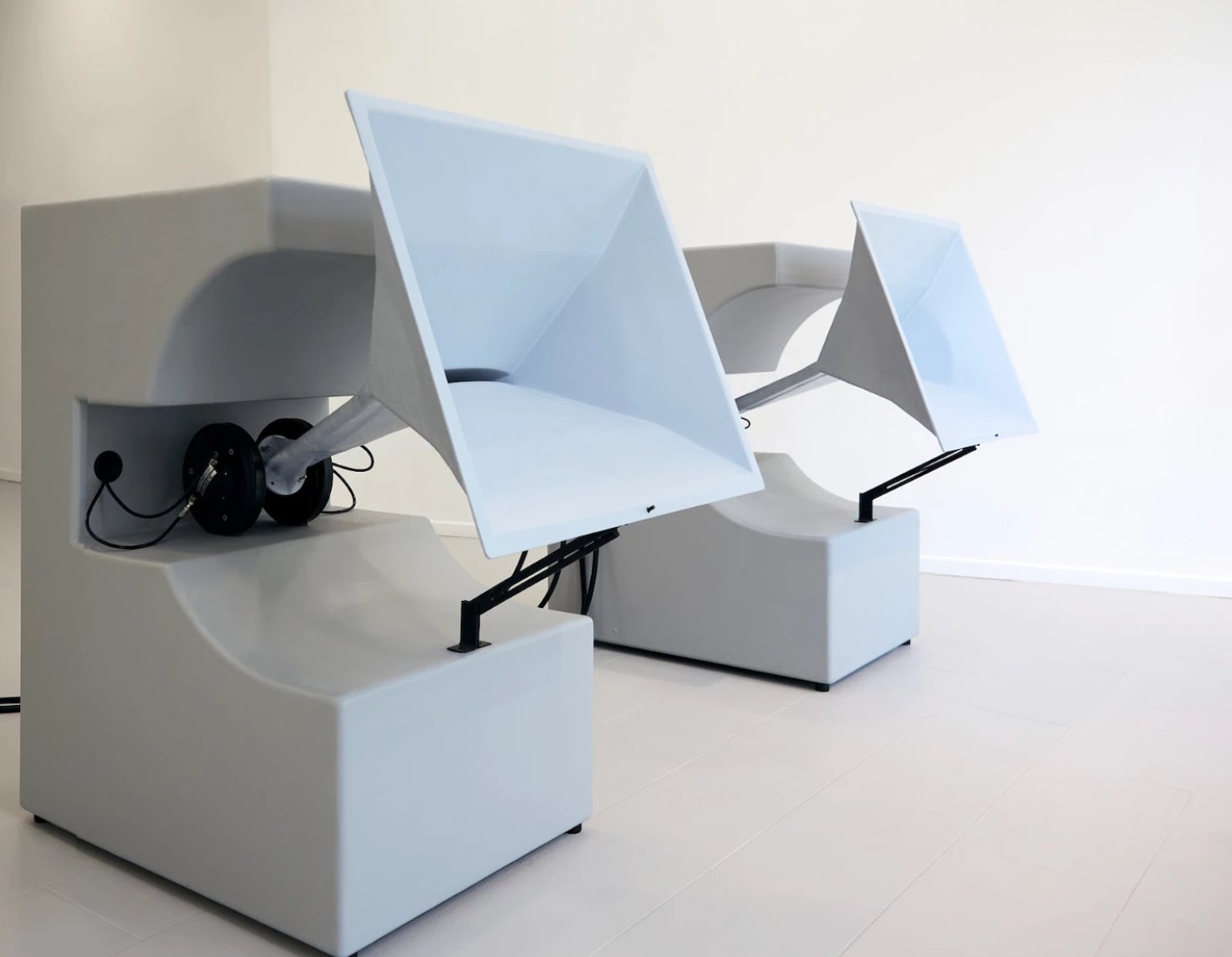


Erwan Sene’s Chutes and Signals, on view in Berlin through June 3, 2025, doesn’t so much occupy a gallery space as it reconstitutes it. Transforming the venue into a playful, menacing, and multi-sensory terrain, Sene crafts an environment where meaning feels both imminent and unstable. Supported by Courrèges and continuing the artist’s collaboration with Nicolas Di Felice, this exhibition plunges into the emotional and political undercurrents of Paris’ sewer system.
This is not a sewer as symbol, not metaphor—but mechanism. The show operates like a coded language system, drawing on architectural memory, sonic distortion, and sculptural estrangement to reflect on how cities digest trauma, filter history, and signal desire through waste.
What emerges is more than an art show. It is a comprehensive literature of surfaces and subtexts—of materials executed into forms that hold emotion, of compositions rendered as fractured spatial syntax.
The Parisian Subterrane as Archive
Sene’s point of entry—Paris’ underground infrastructure—isn’t a neutral subject. It is a political body. In Chutes and Signals, that body is opened up like an anatomical model: mapped, sampled, and reconstructed in material fragments.
But this is not urban romanticism. There are no iron-wrought elegies to Haussmann’s plans, no lush sepia reconstructions of the catacombes. Instead, Sene presents the underground as function over form: a realm of pressure and drainage, where signals travel like rumors through rusted arteries.
The sewer becomes an operating system—capable of logic, error, and resistance. In this frame, Sene’s installation acts as both interface and organism. It shows us the machine behind the myth of the city.
Execute—The Politics of Form and Force
In Chutes and Signals, to execute a work means to give form with force—to press an idea through material constraint until it becomes readable, functional, disruptive. Many of the sculptural elements feel as if they’ve been ejected or expelled: pressure valves of accumulated tension, extruded into material presence.
There is urgency here. Tension. The works do not sit—they are held. Hinged. Tilted. Perched. A sense of gravity pervades, both literal and symbolic. Things threaten to collapse.
The sewer as a system was built to process excess—waste, runoff, overflow. Likewise, Sene’s works process cultural detritus. There’s a kind of semiotic sewage in play here—signals rendered unreadable by repetition, saturation, distortion.
To execute a form here is to handle risk: the risk of overexposure, of misfire, of illegibility.
Compose—Signal and Chute
The show’s title points to the twin engines of this system: chutes (drops, collapses, descents) and signals (transmissions, alerts, pulses). One implies gravity; the other, communication. One falls, the other reaches.
Sene composes the show not as a sequence of discrete works but as an orchestration of atmospheres. The layout reads like the inside of a game engine’s debug map: half theme park, half tactical interface. Sculptural paintings function like paused glitch-screens. Sound installation pulses with mechanical indifference.
Compositional logic here borrows from both urban choreography and computational architecture. Pathways curve. Volumes block and beckon. Objects behave like nodes—some send, others receive. The viewer is implicated in the data loop.
This is not traditional storytelling. It is environmental literacy—you read it by navigating it.
Render—Material as Message
To render is not only to visualize, but to make an idea physically legible. Sene’s materials don’t just perform—they confess. Fiberglass, steel, resin, fabric: each surface feels processed, not simply chosen.
One sculptural painting might resemble a chunk of insulation torn from a tunnel. Another may imitate a pressure gauge, turned senseless. A model might look like a ride schematic at a decaying amusement park—except the ride loops back into the earth.
Here, materials are emotionally coded. Rust and sheen. Tension wires. Embossed logos. Echoes of industrial signage.
To render something in Chutes and Signals is to make it flicker between reference and refusal—between something you almost recognize and something you cannot place.
Sewer as Metaphor, System, Seduction
The sewer is more than setting. It is metaphor, model, and metaphor’s undoing.
In cities, the sewer is the inverse of the skyline. It is what happens after monumentality.
Sene uses this spatial inversion as a philosophical pivot. Instead of looking up, he asks us to look beneath. To look under history, under ideology, under comfort. His Luna Park of waste logic is a space of confrontation disguised as whimsy.
There are echoes of Bataille’s base materialism here—art not elevated, but buried. Not sublime, but abject. And yet the works seduce: their curves, their color codes, their mechanical polish. The installation creates a feedback loop between attraction and revulsion, drawing us into a pleasure circuit rooted in breakdown.
Miniatures, Sound, and System Thinking
The miniature models function like scale fictions—proposals for infrastructures that may not exist, or may already have failed. They are speculative in tone, fragile in execution, and quietly satirical.
These miniatures evoke surveillance infrastructure, industrial amusement rides, or public service mechanisms gone rogue. They hint at the fantasy of control—and its collapse.
The sound installation—industrial, repetitive, ambient—doesn’t seek immersion but interruption. It scores the space like a warning tone, like the low-frequency hum of a facility long since evacuated.
Together, these works do more than decorate—they simulate. They form a closed symbolic system, one that implicates its audience as both subject and operator.
Emotional Infrastructure
Beneath the intellectual frameworks lies something more intimate: the city as a vessel of emotional compression.
What is grief in a sewer? What is memory in steel piping? What happens when architecture forgets what it was built for?
Sene’s work taps into these psychological flows, embedding anxiety into surface treatment, loneliness into spatial rhythm. The Luna Park setting—a reference to play and spectacle—becomes uncanny. Not joyous, but erratic. Not escape, but loop.
The sewer becomes not just physical infrastructure, but emotional metaphor: the place where unexpressed feelings settle, calcify, or flood.
Impression
Chutes and Signals resists summary because it resists resolution. It does not close a chapter—it opens a circuit. Through layered compositions, executed forms, and rendered abstractions, Erwan Sene has crafted a literature of debris—a visual syntax of things society represses, redirects, or forgets.
In refusing spectacle while mimicking its structure, the exhibition critiques seduction even as it uses it. Its Luna Park is both shrine and decoy. Its sewer is both origin and omen.
This is an art of signals without guarantees, of systems that misfire, of beauty drawn from infrastructure too often ignored. It’s an invitation to think through waste—not as absence, but as archive.
By turning the underground into an art space, Sene doesn’t romanticize the hidden—he renders it, composes it, executes it. And in doing so, he offers a rare form of clarity: one not found in the monument, but in the residue.