Courrèges Resort 2026: A Parisian Manifesto in Mirror-Polished Selfies

June 1, 2025
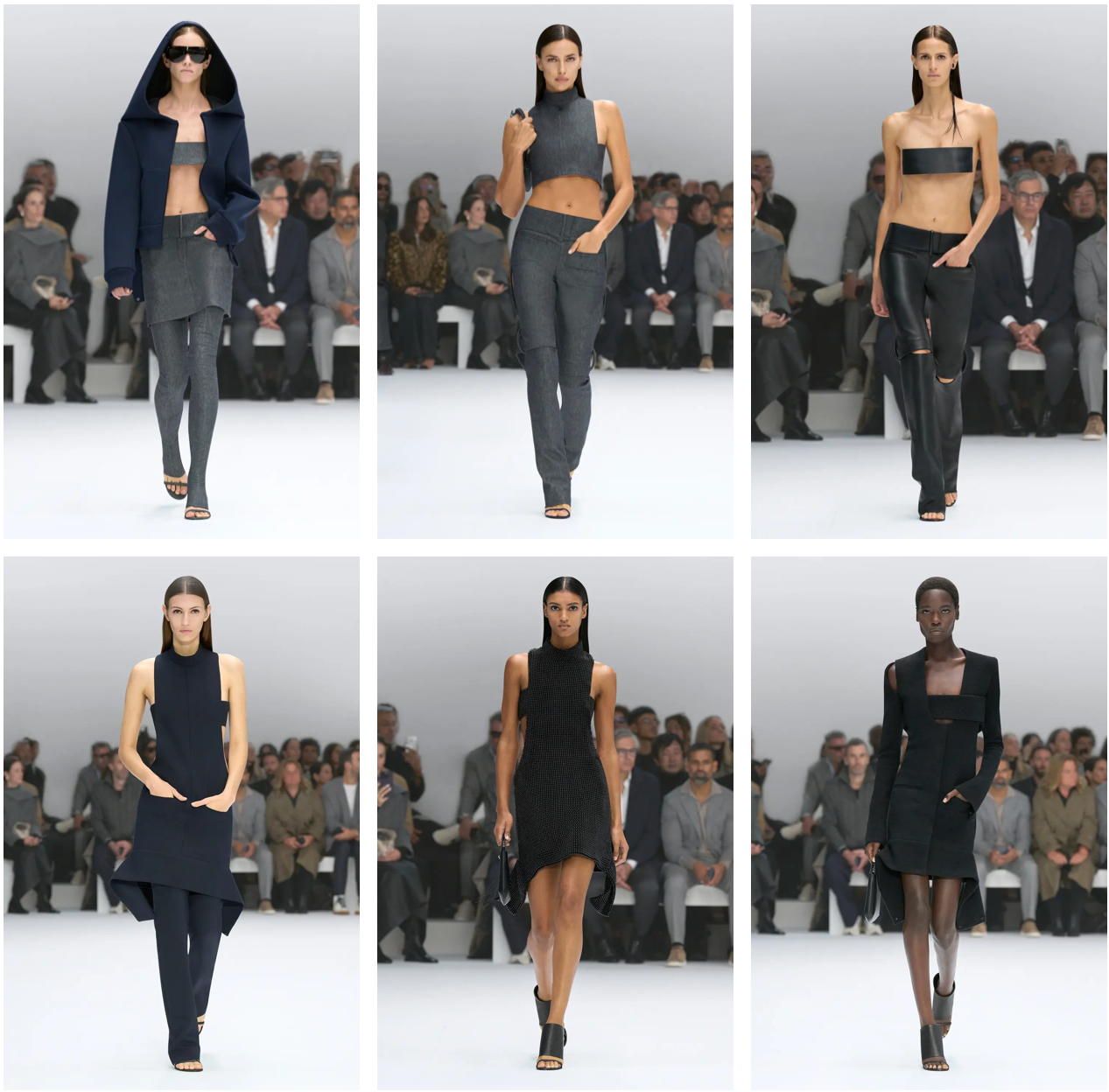
In a fashion landscape cluttered with throwbacks, watered-down haute, and overproduced campaigns, Courrèges – under the direction of Nicolas Di Felice – continues to sharpen its voice with quiet but resonant conviction. The house’s latest Resort 2026 Spring/Summer collection steps firmly into the cultural pulse of Paris not just through what it designs, but how it chooses to show up. And this time, that meant stepping into the street, turning the camera inward, and giving the city back to its citizens – or rather, to its muses.
Once known for its iconic white backdrops and stark minimalism, Courrèges pivots without losing its core identity. The latest collection abandons the sterile studio setting in favor of raw, unfussed selfie portraits – no filters, no polish – taken by friends of the house in mirrors scattered across Paris. This isn’t about democratizing fashion for the sake of a trend. It’s about re-centering the city that birthed the brand. And in the hands of Di Felice, this change of format becomes more than aesthetic; it’s a statement about presence, participation, and place.
A New Visual Language
Forget sterile runways and model poses. For Resort 2026, Courrèges rewires the syntax of the lookbook. Instead of curated backdrops or constructed environments, the city becomes both canvas and collaborator. Mirrors positioned on sidewalks, alleyways, and public spaces capture spontaneous reflections of the clothes and the people wearing them. It’s a visual dialogue between the wearer, the viewer, and the Parisian cityscape — fragments of life caught in motion.
Participants like Axel Gay and Samuel Elie, longstanding collaborators and extensions of the brand’s creative soul, appear less like models and more like co-authors. Their selfies feel personal, lived-in, and unpretentious. The format – raw and imperfect – strips fashion of its performative armor. What remains is real: the garment, the body, the street, and the glance.
This choice isn’t accidental. In a digital culture saturated with artifice, Courrèges flips the lens – literally – and lets authenticity run the show. There are no heavy filters, no production tricks. Just light, mirrors, and the occasional smear of Parisian dust. It’s fashion as snapshot, not spectacle.
Courrèges: A Parisian Vibe Reinvented
Few brands have managed to hold onto the elusive grip of “Parisian cool” without resorting to cliché. Courrèges does it by updating its vocabulary without abandoning its accent. Nicolas Di Felice has turned what could have been a dusty archive into a treasure trove of futuristic nostalgia. Under his direction, the brand embodies a very specific kind of mood: minimalist, yes, but with a rave-tinted edge, a knowing nod to both the 1960s and the 2000s, somewhere between Go-Go and Gabber.
The Resort 2026 collection leans into this intersection. There’s a sleekness, a functional minimalism, and an undercurrent of party culture that animates the silhouettes. It’s not just about clothes you wear to a rave — it’s about clothes that carry the residual energy of one. The Courrèges woman (and man) walks with the confidence of someone who’s danced until sunrise and still looks sharp. There’s defiance in the calm.
Menswear, Soft Power, and Shoulder Lines
Menswear is no afterthought here. The men’s pieces strike a balance between structure and slouch. Oversized leather jackets, which feel almost like uniforms of rebellion, are paired with boxy polo shirts — a fusion of utility and understatement. Curved trousers hug the legs just enough to break formality. Sock-like shoes ground the looks in ease, even when they echo space-age aesthetics pulled from the brand’s archives.
It’s a wardrobe that suggests a soft kind of power. The proportions are generous but not indulgent. Di Felice’s mastery lies in his ability to make silhouette decisions that feel both intuitive and intentional. There’s confidence in how things fall and fold, how they skim the skin or push out from the shoulder. It’s masculine energy without posturing.
Icons Revisited, Futures Imagined
Staples from Di Felice’s previous collections still play a strong role. The buckled strapless tops return, acting as sculptural punctuation marks in the otherwise streamlined silhouettes. These pieces — structured, sensual, and unapologetically modern — are becoming signatures in their own right, a kind of shorthand for the Di Felice era.
But newness also enters the scene, most notably in the form of accessories. The new Strip bag, soft-shaped yet meticulously engineered, deserves special mention. Its clever magnetic flap system gives wearers the option to pack discreetly or reveal contents boldly. It folds, flexes, and functions without sacrificing aesthetics — much like the collection itself. There’s a top zip pocket for essentials, a clasp for closure, but the real utility lies in its adaptability. This isn’t a statement bag; it’s a solution disguised as one.
Fashion in the Age of Self-Image
There’s something poignant about the selfie-as-lookbook. It’s easy to dismiss this as a gimmick — yet another way brands try to go “authentic” for a marketing edge. But Courrèges does it differently. The mirror isn’t there for vanity. It’s a reminder: fashion is a conversation we have with ourselves, in public. The mirror becomes a threshold between the private gaze and the street’s collective eyes.
This presentation is also a comment on how fashion is consumed today — through front-facing cameras, on Instagram Stories, in moments captured on the go. By building the campaign around unfiltered selfies, Courrèges isn’t just reflecting the current moment; it’s shaping it. The brand doesn’t need to preach about identity, participation, or digital-native culture. It lives it, and lets the format do the talking.
The Courrèges Philosophy: Space, Light, and Human Heat
And yet, despite all the digital awareness and media-savvy formatting, what makes Courrèges work — and what makes this collection resonate — is its material discipline. Every piece is rooted in tangible considerations: cut, texture, utility, weight. There’s no gimmick in the garment itself. The tech fabrics, the leather, the architectural lines — they all serve the body. And while white is less dominant this time, the spirit of lightness persists. Even the darker looks feel reflective, as if borrowing brightness from within.
This is what sets Courrèges apart from the noise. It isn’t about costume or provocation. It’s about presence — about making space for oneself in a world that’s constantly trying to define you. Whether that’s through a leather coat that swings just right, or through the act of capturing your reflection in the middle of a busy boulevard, the result is the same: self-possession.
Nicolas Di Felice: The Architect of Relevance
With each collection, Nicolas Di Felice tightens the brand’s language without shrinking its scope. He doesn’t chase headlines. He builds. His approach to creative direction — from campaign format to garment structure — is always considered, always spatial. A Courrèges piece doesn’t just fit. It frames. It orbits the wearer. It gives room.
Resort 2026 is not revolutionary in the sense of shock or spectacle. But it is radical in its restraint. In a world where fashion often screams to be seen, Courrèges whispers — and still commands attention.
The City Wears Courrèges
At a time when brands are racing to the metaverse, Courrèges walks the streets of Paris with a mirror under its arm. It doesn’t need fantasy. It needs reflection. This Resort 2026 collection is a love letter to the city, its surfaces, its citizens. And it’s a manifesto for a kind of fashion that doesn’t just want to be worn — it wants to be used, lived in, photographed, walked through.
Di Felice isn’t selling clothes. He’s proposing a lifestyle — quiet but sure, grounded but fluid, with one foot in the rave and the other in the museum. And as long as he continues to mirror the rhythm of real life with this much clarity, Courrèges won’t just remain relevant — it will remain essential