Damien Hirst: Decoding Pharmacy London Boxed Set (2002)

March 22, 2026

intro
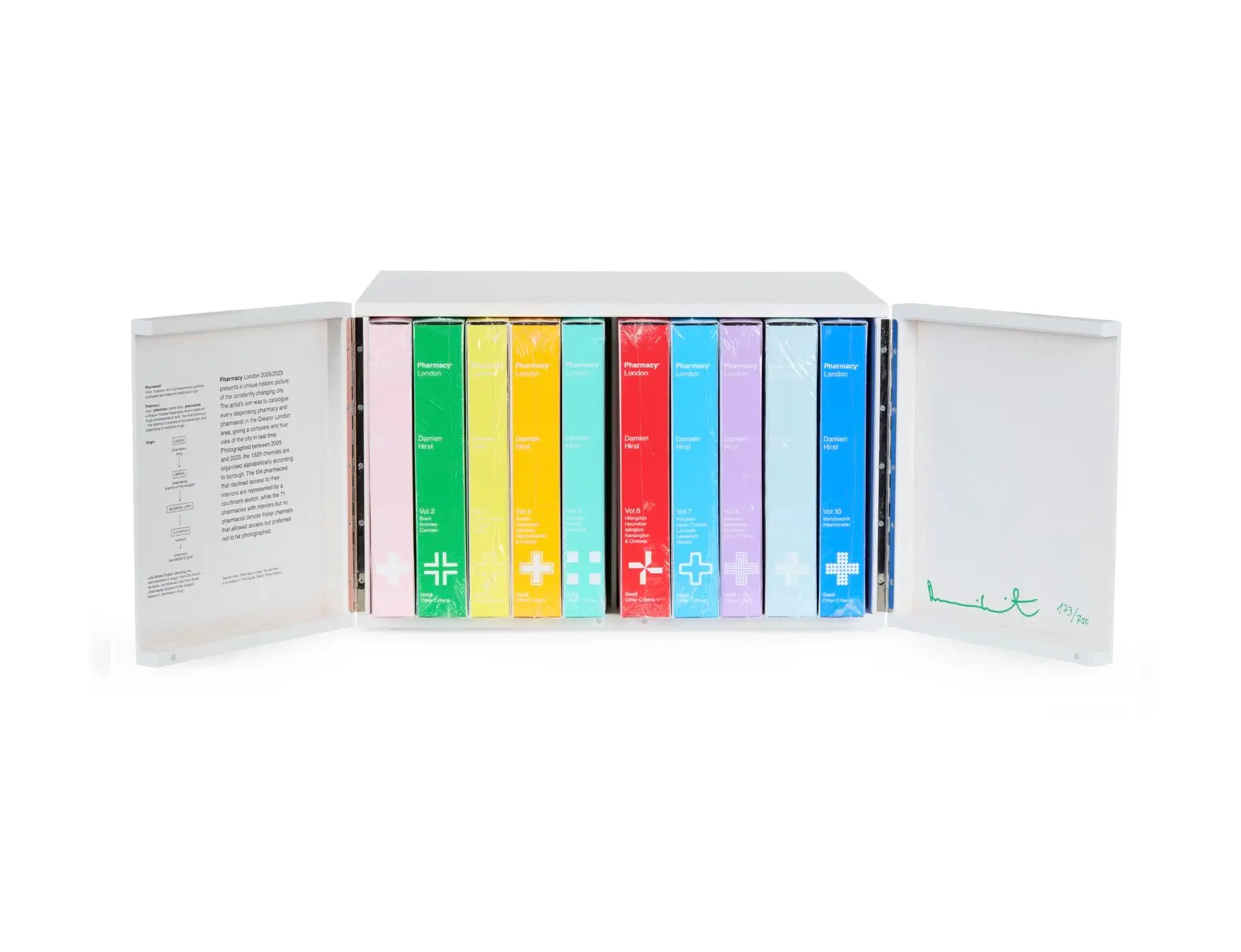
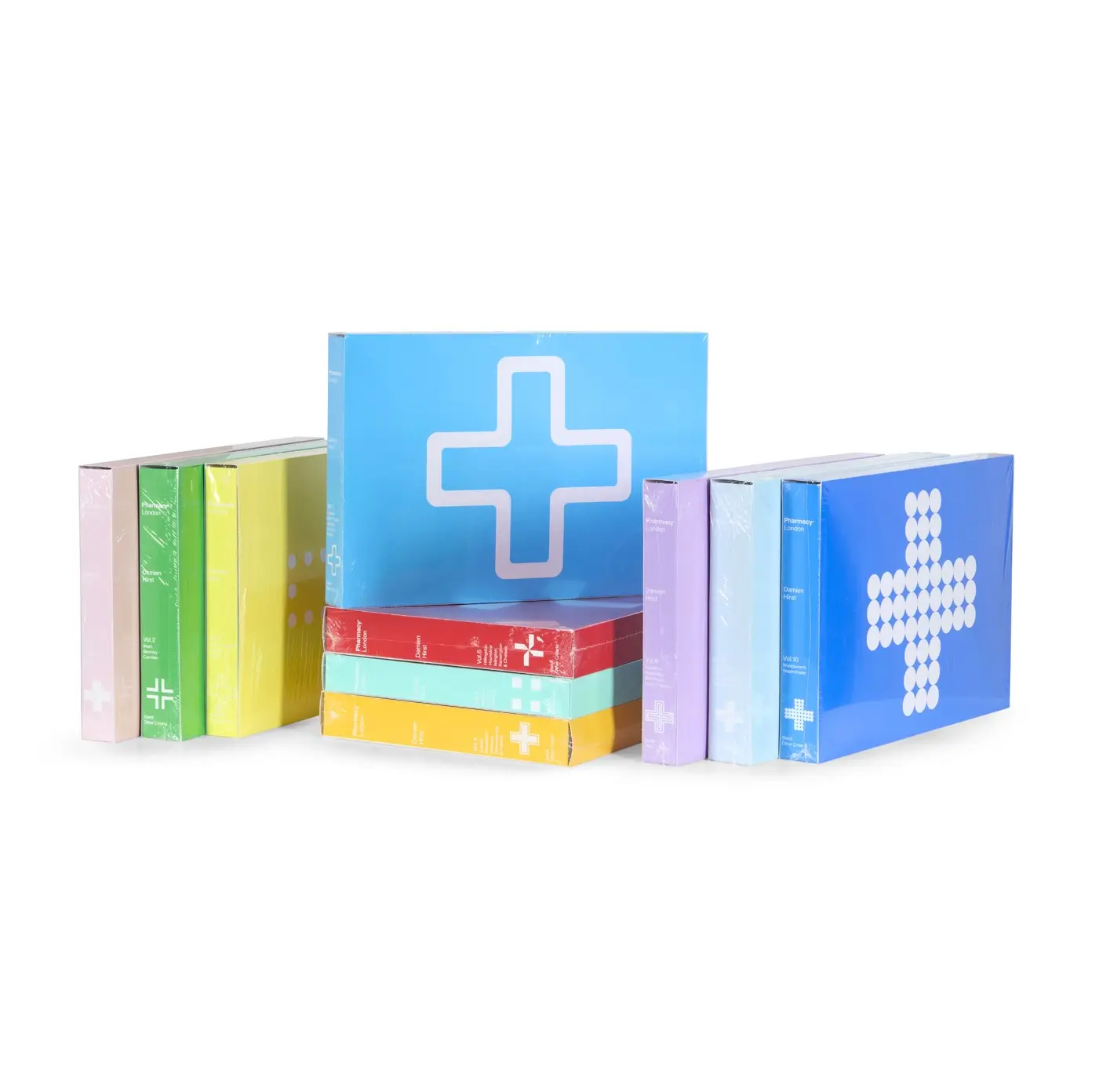
There is a quiet faith embedded in the act of taking a pill. A belief that relief can be packaged, labeled, systematized—sold. In Pharmacy, London (Boxed Set), Damien Hirst dissects that belief with clinical precision, transforming medicine from a tool of healing into an object of contemplation.
The boxed set, produced in 2000, exists as an extension of Hirst’s broader Pharmacy project—a conceptual ecosystem that spans installation, restaurant, prints, and sculptural works. It is not simply a collection of images; it is a compressed archive of a worldview. One where science, commerce, and faith converge under fluorescent light.
To encounter this work is to confront a question that sits at the core of Hirst’s practice: what do we believe in when we believe in medicine?
idea
The origins of Pharmacy, London (Boxed Set) lie in the physical installation of Pharmacy, first realized in the early 1990s and later expanded into a functioning restaurant in London. The space was meticulously constructed—white tiles, stainless steel surfaces, rows of pharmaceutical products arranged with almost religious symmetry.
It resembled a laboratory, a shop, and a shrine all at once.
The boxed set translates this environment into a portable form. Through prints and packaged elements, it distills the visual language of the pharmacy into a series of repeatable images. Bottles, labels, typographic systems—each component becomes part of a larger grammar.
This grammar is not neutral. It carries the authority of science, the reassurance of branding, and the seduction of order.
method
One of the most striking aspects of the Pharmacy series is its obsessive organization. Shelves are lined with objects in perfect alignment, colors distributed with calculated balance. There is no chaos, no deviation.
This order is comforting.
It suggests that everything has its place, that every ailment has its cure, that the complexity of the human body can be reduced to a system of inputs and outputs.
But this comfort is also a fiction.
Hirst’s work exposes the gap between the appearance of control and the reality of uncertainty. The pharmacy becomes a stage where order is performed, not guaranteed.
flow
In Pharmacy, London (Boxed Set), packaging is elevated from functional design to conceptual content. Labels, logos, and color codes are not merely decorative—they are the artwork.
Each element carries meaning. The typography evokes authority. The color palettes suggest specific effects—calming blues, urgent reds, sterile whites. The repetition of forms reinforces trust.
This is the language of pharmaceuticals, but it is also the language of consumer culture more broadly.
Hirst understands that belief is often mediated through design. We trust what looks trustworthy. We accept what appears systematic.
The boxed set captures this dynamic with precision, turning the aesthetics of medicine into a subject of scrutiny.
stir
At its core, Pharmacy is about commerce.
Medicine, in Hirst’s universe, is not just a practice—it is a product. Pills are packaged, priced, and displayed. Healing becomes something that can be bought.
This is not a cynical observation; it is a structural one. The modern healthcare system is deeply intertwined with market logic. Pharmaceuticals are developed, branded, and distributed within economic frameworks.
Hirst does not reject this reality. Instead, he amplifies it.
By presenting pharmaceutical imagery within the context of art, he collapses the distinction between healing and selling. The viewer is left to navigate this overlap.
trad
Hirst has often spoken about his interest in belief systems. Religion, science, and art all offer ways of making sense of the world, of confronting uncertainty.
In Pharmacy, these systems intersect.
The clinical environment evokes scientific authority. The repetition and symmetry suggest ritual. The presentation of objects invites contemplation.
The pharmacy becomes a kind of secular temple, where pills replace relics and labels replace scripture.
But unlike traditional religious spaces, this temple is explicitly tied to commerce. Faith is not just practiced—it is purchased.
edition
The boxed set format is significant. Unlike a singular painting or sculpture, an edition exists in multiple copies. It can be distributed, collected, circulated.
This aligns with Hirst’s broader interest in repetition and systematization. The artwork is not unique—it is reproducible.
This reproducibility mirrors the logic of pharmaceuticals themselves. Pills are mass-produced, standardized, identical.
By adopting this format, Hirst reinforces the conceptual framework of the work. The medium becomes part of the message.
author
As with many of Hirst’s projects, the Pharmacy series involves a degree of delegation. Assistants conjure a role in the production of works, executing designs within a defined system.
This challenges traditional notions of authorship. The artist becomes a director, a conceptual architect, rather than a solitary maker.
In the context of Pharmacy, this approach feels particularly apt. The work is about systems, not individuals. It is about structures of belief, not personal expression.
The absence of the artist’s hand becomes a statement in itself.
view
There is a distinct visual cleanliness to the Pharmacy works. Surfaces are smooth, colors are controlled, compositions are precise.
This sterility is both aesthetic and conceptual.
It reflects the ideals of modern medicine—purity, control, elimination of contamination. But it also creates a distance between the viewer and the subject.
The work feels untouchable.
This distance is important. It prevents emotional immersion, encouraging analytical engagement instead. The viewer is not meant to feel comforted, but to observe.
culture
Pharmacy, London (Boxed Set) emerges from the cultural context of the 1990s, a period marked by the rise of the Young British Artists.
This was a moment of experimentation, provocation, and media visibility. Artists like Hirst were not just creating works—they were shaping cultural narratives.
The Pharmacy project reflects this ethos. It is bold, conceptually driven, and deeply aware of its own visibility.
At the same time, it engages with broader societal shifts—the increasing commodification of healthcare, the growing influence of branding, the intersection of science and consumer culture.
cept
The Pharmacy series has been both celebrated and critiqued. Some see it as a sharp commentary on contemporary life, a work that captures the complexities of belief and commerce.
Others view it as emblematic of the very systems it critiques—an artwork that participates in the commodification it exposes.
This tension is central to Hirst’s practice. His work does not resolve contradictions; it inhabits them.
Over time, Pharmacy has become one of the defining projects of his career, influencing how artists approach themes of system, repetition, and institutional critique.
fin
To engage with Pharmacy, London (Boxed Set) is to enter a space where meaning is both constructed and destabilized.
You are presented with objects that promise clarity—labels, systems, structures. But beneath that clarity lies ambiguity.
What does the medicine do? What does the artwork mean? What do we believe in?
Hirst does not provide answers. Instead, he offers a framework—a system within which questions can circulate.
In this sense, the boxed set functions like the pharmacy it represents. It dispenses not cures, but possibilities.
And in doing so, it reveals something fundamental about contemporary life: that our deepest beliefs are often packaged, organized, and sold back to us—beautifully, convincingly, and without resolution.