Daniel Arsham’s Mobile Phone (FR 01) and the Afterlife of Technology

March 30, 2026
52 minutes ago
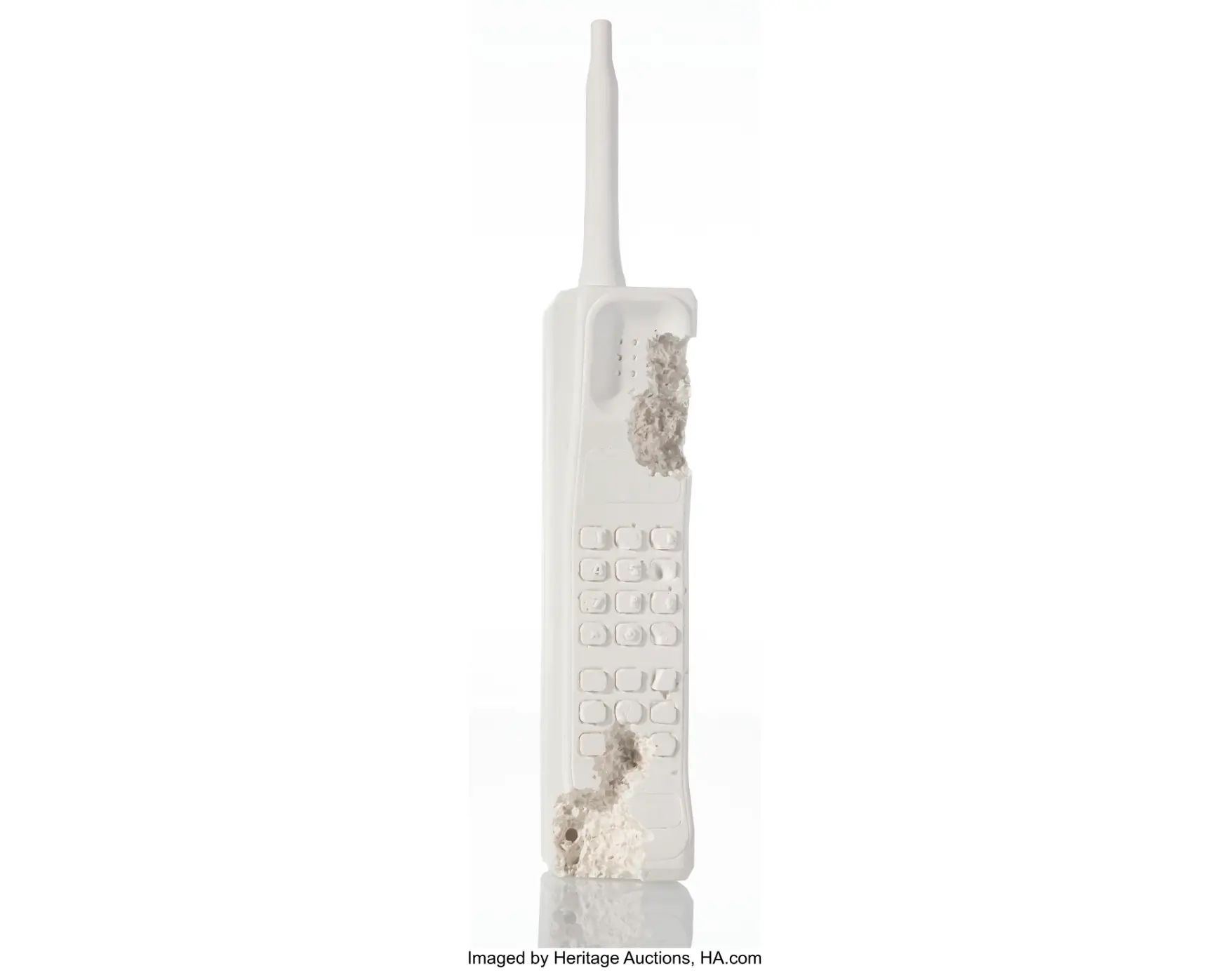
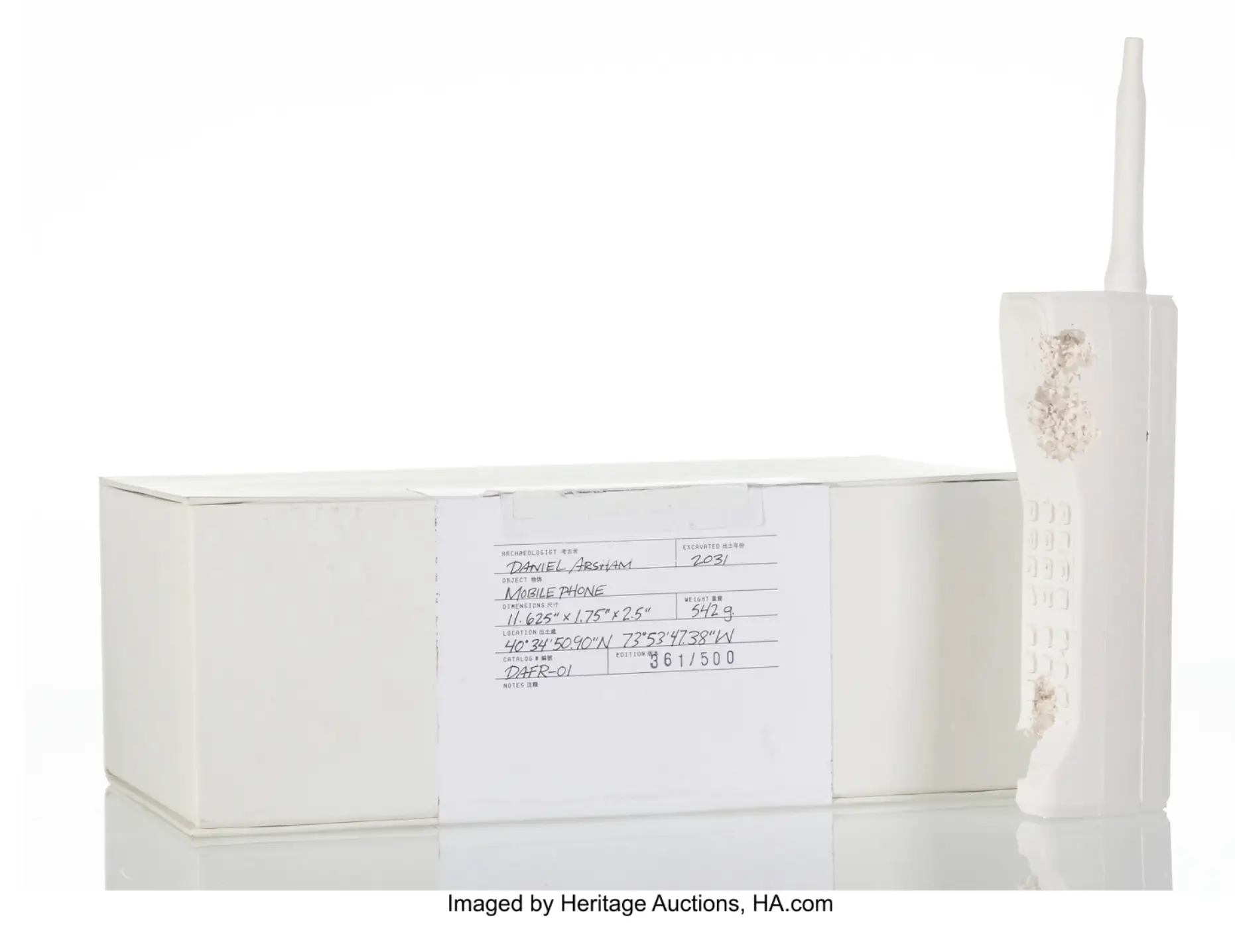
In the evolving language of contemporary art, few figures have constructed as coherent—and as quietly disruptive—a vocabulary as Daniel Arsham. His work consistently interrogates time, material, and cultural memory, operating at the intersection of architecture, sculpture, and speculative archaeology. Within this continuum, Mobile Phone (FR 01) (2013) emerges not as a singular object but as a conceptual hinge: a modestly scaled sculpture that encapsulates Arsham’s broader inquiry into the lifecycle of objects and the fragility of modern permanence.
Rendered in plaster and embedded with glass fragments, the work transforms an everyday technological artifact—the mobile phone—into something resembling an archaeological relic. It is a paradox in material and meaning: a contemporary device reimagined as if unearthed centuries from now. The piece does not simply depict decay; it stages it, inviting viewers into a future where our most ubiquitous objects are reduced to enigmatic remnants.
stir
Arsham’s practice is often framed through the lens of what he terms “fictional archaeology,” a conceptual framework in which contemporary objects are presented as though they have survived the passage of deep time. Unlike traditional archaeology, which seeks to reconstruct the past through material remains, Arsham’s approach projects forward—imagining how the present might be perceived by future civilizations.
Mobile Phone (FR 01) is emblematic of this methodology. The sculpture appears partially eroded, its surface fractured and punctured by crystalline intrusions. These glass fragments evoke mineralization, suggesting that the object has undergone a geological transformation. The phone is no longer functional; its identity is preserved only through its silhouette and recognizable form.
This act of temporal displacement destabilizes the viewer’s relationship to the object. The mobile phone, typically associated with immediacy, connectivity, and rapid obsolescence, is recast as something ancient and enigmatic. In doing so, Arsham collapses temporal boundaries, creating a dialogue between present and future that is both speculative and unsettling.
mat
The material composition of Mobile Phone (FR 01) is central to its conceptual impact. Plaster, a material historically associated with architectural models and classical sculpture, provides a neutral, almost clinical surface. Its matte whiteness recalls museum casts and fragments of antiquity, positioning the object within a lineage of preservation and display.
In contrast, the embedded glass fragments introduce a dynamic element of rupture and luminosity. These shards catch and refract light, creating points of visual tension across the otherwise subdued surface. The interplay between plaster and glass can be read as a dialogue between stability and fragmentation, between the illusion of permanence and the inevitability of decay.
The use of glass is particularly significant. It suggests crystallization—a process through which organic or manufactured materials are gradually replaced by minerals over time. This geological metaphor reinforces the notion that the phone has been subjected to forces far beyond its intended lifespan. It is no longer a product of industrial design but a hybrid artifact shaped by both human and natural processes.
flow
By selecting the mobile phone as his subject, Arsham engages with one of the most defining objects of the 21st century. The mobile phone is not merely a tool; it is an extension of identity, a repository of personal data, and a conduit for global communication. Its ubiquity makes it an ideal candidate for Arsham’s speculative archaeology.
In Mobile Phone (FR 01), the device is stripped of its functionality and reduced to its physical form. This reduction prompts a reconsideration of what the object represents. Without its digital interface—without the invisible networks that give it meaning—the phone becomes a shell, a relic of a system that no longer exists.
This transformation raises questions about the durability of digital culture. While physical objects can survive in altered states, digital information is far more fragile, dependent on infrastructures that may not endure. Arsham’s sculpture thus highlights a paradox: the objects that define our era may outlast the data they once contained, leaving future observers with incomplete narratives.
show
Erosion in Arsham’s work is not simply a depiction of decay; it is an aesthetic strategy that reveals the internal structure of objects. In Mobile Phone (FR 01), the surface appears to have been eaten away, exposing cavities filled with crystalline forms. This process of subtraction creates a sense of movement, as though the object is in a state of continuous transformation.
The visual language of erosion carries symbolic weight. It suggests the passage of time, the inevitability of entropy, and the vulnerability of human-made systems. At the same time, it introduces an element of beauty. The fractured surfaces and sparkling inclusions create a delicate balance between destruction and creation.
This duality is central to Arsham’s practice. His works often oscillate between ruin and refinement, presenting decay not as an endpoint but as a stage in an ongoing process. In this sense, Mobile Phone (FR 01) can be understood as both a relic and a work in progress—a snapshot of transformation frozen in time.
idea
One of the most compelling aspects of Mobile Phone (FR 01) is its ability to disrupt conventional perceptions of time. The sculpture resists easy categorization, existing simultaneously in the present and the imagined future. This temporal ambiguity invites viewers to reconsider their own relationship to the objects that populate their daily lives.
Encountering the work in a gallery setting, one might initially recognize the form of a mobile phone. However, this recognition is quickly complicated by the object’s altered state. The erosion and crystallization obscure its functionality, transforming it into something unfamiliar. This tension between recognition and estrangement is key to the work’s impact.
Arsham’s manipulation of time also extends to the viewer’s imagination. By presenting the phone as a future relic, he encourages speculation about the conditions that might have led to its transformation. What kind of world would produce such an artifact? What histories would be lost or preserved? These questions linger, extending the experience of the work beyond its physical presence.
praxis
Mobile Phone (FR 01) belongs to a broader body of work in which Arsham reinterprets everyday objects through the lens of fictional archaeology. From cameras and cassette players to sneakers and classical busts, his sculptures consistently explore the intersection of cultural memory and material transformation.
This approach is closely tied to his background in architecture and design. Arsham often collaborates with brands and institutions, translating his conceptual framework into a variety of contexts. However, works like Mobile Phone (FR 01)retain a distinct intimacy. Their scale and subject matter invite close inspection, emphasizing the tactile qualities of the materials.
The piece also reflects Arsham’s interest in the aesthetics of ruin. Drawing inspiration from both classical antiquity and modern decay, he creates objects that feel suspended between eras. This synthesis of historical and contemporary references positions his work within a broader discourse on time and memory in contemporary art.
evolve
The mobile phone is perhaps the most rapidly evolving object of our time. New models are released annually, rendering previous versions obsolete. This cycle of innovation and obsolescence is a defining feature of contemporary consumer culture.
In Mobile Phone (FR 01), Arsham captures this dynamic by freezing the object at a moment of transformation. The phone is no longer new, but it is not entirely gone. It exists in a liminal state, caught between use and abandonment.
This liminality extends to the concept of memory. Mobile phones are repositories of personal and collective histories, storing photographs, messages, and data. Yet these memories are inherently unstable, subject to deletion, corruption, or technological incompatibility. By transforming the phone into a physical relic, Arsham foregrounds the tension between preservation and loss.
The sculpture thus operates on multiple levels: as an object, as a symbol, and as a commentary on the impermanence of digital culture. It invites viewers to consider what aspects of their lives might endure—and what might vanish without a trace.
view
Despite its relatively small scale, Mobile Phone (FR 01) possesses a strong spatial presence. The interplay of light and shadow across its surface enhances its sculptural qualities, emphasizing the depth of its cavities and the translucency of the glass fragments.
As light interacts with the embedded glass, it creates subtle shifts in color and intensity. These variations animate the object, giving it a sense of vitality despite its theme of decay. The sculpture becomes a dynamic entity, changing in response to its محیط.
This sensitivity to light is characteristic of Arsham’s work. By incorporating reflective and refractive materials, he introduces an element of unpredictability. The viewer’s experience of the piece is never fixed; it evolves with perspective and illumination.
grad
Mobile Phone (FR 01) can be understood as a quiet monument to the present. It does not celebrate technological progress; instead, it reflects on its transience. By presenting a familiar object in an unfamiliar state, Arsham encourages a deeper engagement with the material culture of our time.
The work’s power lies in its subtlety. It does not rely on grand gestures or overt narratives. Instead, it operates through suggestion and implication, inviting viewers to draw their own connections. In this way, it embodies a form of critical reflection that is both accessible and profound.
fin
In an age defined by rapid change and digital abstraction, Mobile Phone (FR 01) offers a moment of pause. It asks us to consider the physical traces of our lives and the ways in which they might be preserved—or transformed—over time.
Through his use of plaster and glass, Daniel Arsham creates an object that is at once fragile and enduring. The sculpture stands as a testament to the complexity of material and cultural memory, bridging the gap between past, present, and future.
In fossilizing the mobile phone, Arsham does not merely document an object; he reimagines its trajectory. The result is a work that resonates beyond its immediate context, offering a nuanced exploration of time, technology, and the enduring human desire to leave a mark.