The Windbreaker Season: Lightness, Control, and the Return of Movement

April 4, 2026
39 seconds ago
Spring doesn’t settle anymore—it circulates. Temperature shifts mid-commute. Wind cuts through sun. Rain arrives without warning and disappears just as quickly. The wardrobe has had to recalibrate, not toward seasonal statements, but toward pieces that can operate inside instability.
The windbreaker, once peripheral, now sits at the center of that recalibration.
Not because it has changed dramatically—but because everything around it has. What used to be considered purely functional has been pulled into focus by designers who understand that modern dressing is less about fixed looks and more about movement between conditions.
Across collections this season, the windbreaker doesn’t resolve into one idea. It fragments. It stretches. It becomes interior and exterior, technical and tactile, visible and quiet—depending on who’s shaping it.
This is not a trend cycle. It’s a redistribution of importance.
And it begins, unexpectedly, with softness.
miu mui
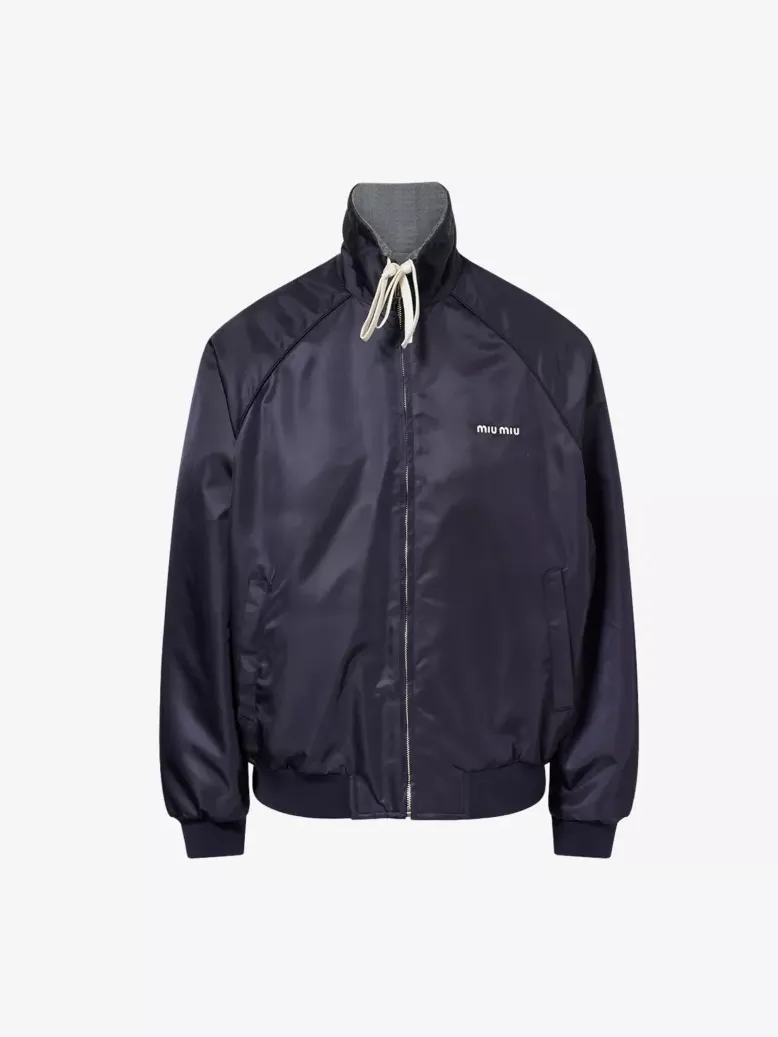
At Miu Miu, the windbreaker doesn’t start as protection—it starts as comfort.
The blouson reversible shell jacket sits in a space that resists clean categorization. It carries the outer language of a windbreaker—technical shell, zip construction, cropped proportions—but its interior shifts the equation entirely. Fully lined in soft grey fleece, it absorbs the logic of insulation, of warmth, of something meant to be lived in rather than simply worn through.
That interior matters. It reframes the garment from something reactive to something proactive. Instead of waiting for the weather to dictate its use, the piece anticipates fluctuation—cold mornings, warmer afternoons, indoor transitions that no longer require a full change of layers.
This is where Miu Miu’s perspective diverges from traditional technical wear. It doesn’t privilege performance metrics. It privileges experience.
The reversibility compounds that idea. Two surfaces, two conditions, one object. It acknowledges that dressing is no longer linear—outfit choices are made in fragments, adjusted throughout the day, reversed when necessary.
The windbreaker becomes less of a shield and more of an environment.
And in that shift, it gains weight—not physically, but conceptually. It’s no longer the lightest layer. It’s the most adaptable one.
saint laurent
Where Miu Miu begins with interior softness, Saint Laurent restores structure—but without rigidity.
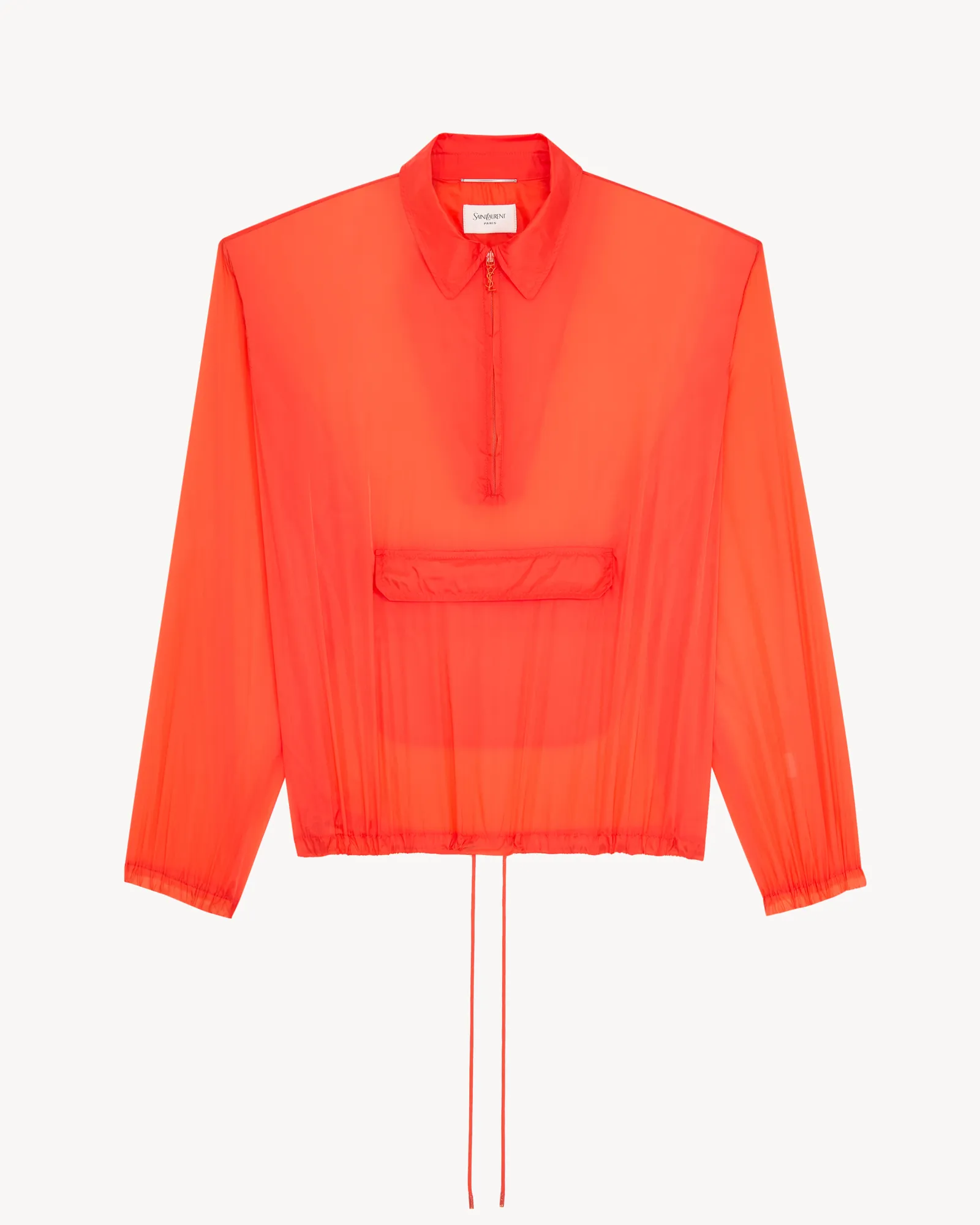
Under Anthony Vaccarello, the windbreaker becomes a study in proportion. The Cassandre version, rendered in nylon faille, carries a silk-adjacent sheen that immediately disrupts expectations. What should read as technical instead feels almost formal.
That tension is deliberate.
The wide-shoulder silhouette anchors the piece in the house’s established language—sharp, slightly exaggerated, carrying a sense of control. But the fabric softens the line just enough to prevent it from becoming severe. Movement remains intact. The garment holds shape without locking into it.
Color-blocking introduces another layer of precision. It’s not decorative. It’s structural—guiding the eye across the body, reinforcing the silhouette without overcomplicating it.
The men’s version simplifies this logic further. Reduced detailing, cleaner lines, a quieter execution that allows the piece to slip into more formal contexts. When Mark Ronson wore it over a shirt and tie, the gesture didn’t feel disruptive. It felt inevitable.
That’s the shift.
The windbreaker is no longer confined to casual space. It enters tailoring without needing permission.
The Saint Laurent S/S 2026 collection draws from Fire Island—but not through direct reference. There are no literal translations of beachwear or overt summer codes. Instead, the influence operates atmospherically.
Ease becomes the throughline.
Clothing sits lighter on the body. Layers remain intentional but never heavy. The windbreaker, in this context, becomes a carrier of that ease—not as a seasonal necessity, but as a constant that allows the rest of the look to remain fluid.
This is where the garment’s repositioning becomes clear. It’s no longer reactive. It’s foundational.
prada
If Saint Laurent refines the windbreaker through proportion, Prada reframes it through visibility.
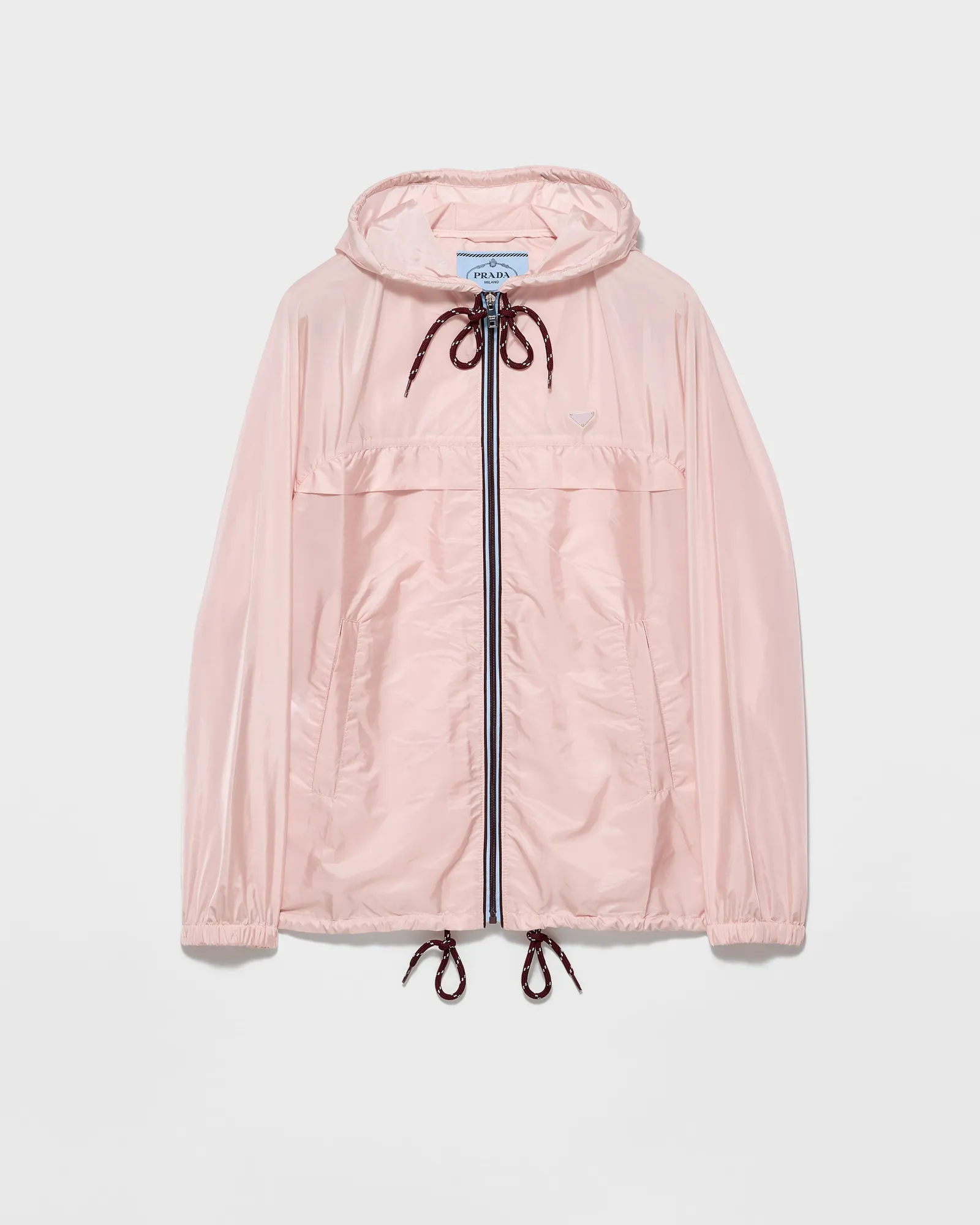
The Lightweight Re-Nylon Hooded Raincoat operates with clarity. The silhouette is direct—no excess detailing, no unnecessary layering. A hood, a streamlined body, a length that balances coverage with movement.
But the color interrupts everything.
A saturated pink cuts through the muted palette that often defines transitional dressing. It refuses to blend. It positions the windbreaker not as something to disappear into an outfit, but as something that defines it.
That choice matters in a season built on uncertainty. Where weather shifts constantly, clarity in design becomes a form of stability.
Material reinforces this. Re-Nylon, Prada’s regenerated fabric, carries a narrative beyond aesthetics—linking the garment to sustainability and broader environmental awareness through initiatives like Sea Beyond.
But visually, the impact is immediate.
The windbreaker becomes a signal. Not just protection, but presence.
loewe x on
Where Prada asserts presence, Loewe, in collision with On, dissolves the windbreaker back into motion.
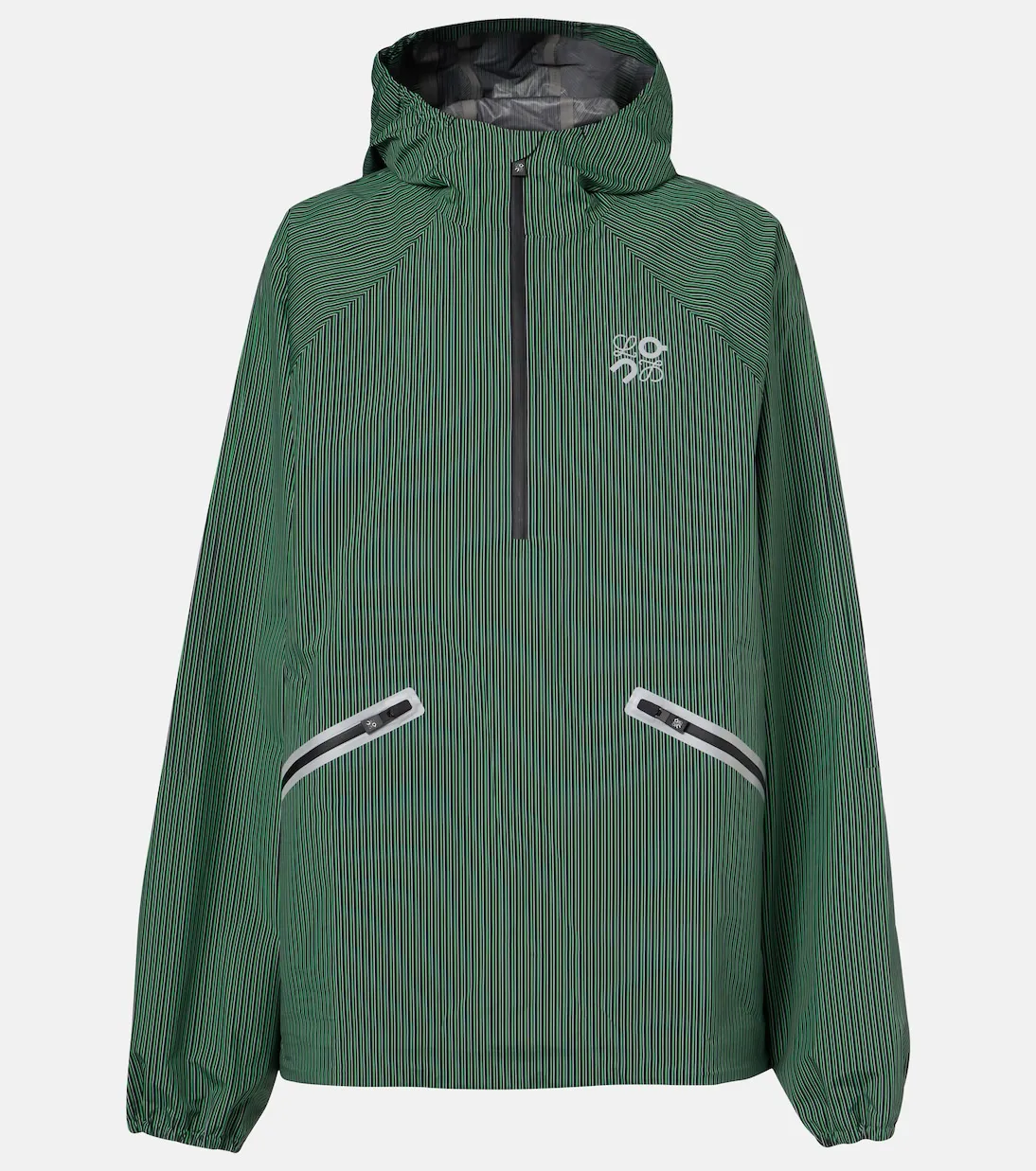
The Storm Striped Half-Zip Jacket doesn’t attempt to distance itself from its performance origins. It leans into them. Lightweight, weatherproof, and fully packable, it’s designed to move in and out of use without friction.
That’s the defining quality here: flexibility.
The jacket can exist fully—worn, structured, visible—or disappear entirely, folded into a bag, waiting for the next shift in weather. It doesn’t demand commitment. It responds to circumstance.
Striping adds a visual rhythm, reinforcing the idea of movement even when the wearer is still. The half-zip construction allows for ventilation, adjustment, control over how the garment sits on the body.
This is clothing built for unpredictability—not just environmental, but behavioral.
Commutes that turn into walks. Walks that turn into runs. Days that don’t follow a fixed pattern.
The windbreaker, in this context, becomes an extension of that unpredictability.
flow
Across Miu Miu, Saint Laurent, Prada, and Loewe, the windbreaker doesn’t resolve into a singular identity.
It expands.
Interior softness. Structural precision. Visual clarity. Functional movement.
Each approach addresses the same condition from a different angle: instability.
And that’s why the garment has become ubiquitous—not because it dominates visually, but because it solves a problem that continues to evolve.
stir
The runway didn’t create this shift—it recognized it.
Street-level dressing had already begun prioritizing adaptability. Lightweight layers that could be added or removed without disrupting the entire look. Pieces that didn’t require commitment to a single condition.
The windbreaker fits that logic perfectly.
Designers responded by refining it—introducing new materials, adjusting proportions, repositioning it within luxury contexts. What was once purely functional became expressive, without losing its utility.
The result is a garment that moves seamlessly between spaces.
Runway to street. Formal to casual. Interior to exterior.
season
Spring’s unpredictability isn’t temporary—it’s structural now.
Weather patterns shift more abruptly. Daily routines stretch across more environments. The need for clothing that can respond quickly, without overcomplication, has become constant.
The windbreaker answers that need without trying to overdefine it.
It doesn’t solve the season. It works within it.
clue
The windbreaker no longer sits at the edge of the wardrobe.
It has moved inward—becoming a piece that supports, adjusts, and carries the rest of the look without demanding control over it.
It doesn’t announce itself.
It doesn’t need to.
Because in a season defined by change, the most valuable garments are the ones that can move through it without resistance.
And the windbreaker does exactly that.