Review: Lil Uzi Vert Rocks Dior SS26

March 28, 2026
19 minutes ago
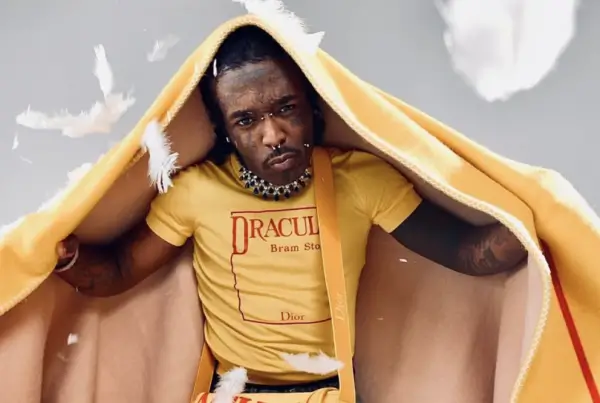
Lil Uzi Vert has never approached fashion as mere styling. It’s closer to authorship—an instinctive, self-directed layering of references that move between haute houses, internet ephemera, and personal mythology. Either stepping out in full Dior tailoring or leaning into the coded maximalism of Gucci, Uzi treats garments as narrative devices. So when a recent Instagram vlog surfaced—Uzi in a Gucci monogram tracksuit, casually holding Dior’s Spring Summer 2026 “Dracula” Book Cover Tote—the moment felt less like product placement and more like alignment.
The bag itself, designed under the direction of Jonathan Anderson, belongs to a broader graphic-led series that mines classic literature not for nostalgia, but for structure. These are not ironic accessories. They are objects that carry the weight of text, reframed into something tactile, immediate, and visible. And among them, Dracula—originally published in 1897 by Bram Stoker—becomes an especially charged reference.
View this post on Instagram
stir
The premise is deceptively simple: take the visual language of vintage book covers and transpose it onto luxury accessories. But what Dior achieves here goes beyond novelty. The “Dracula” tote doesn’t just reference literature—it performs it.
Rendered with typographic fidelity and a deliberately aged aesthetic, the bag mimics the tactility of a well-worn paperback. There’s a quiet insistence in its design, a refusal to shout despite its conceptual clarity. It invites recognition rather than demanding attention. You either understand the reference, or you don’t. And in that way, it operates like a password within fashion culture.
This is where Anderson’s approach becomes distinct. Rather than abstracting literature into vague motifs, he retains its literal surface—the cover, the title, the author—allowing the object to remain legible. The result is something that feels archival yet contemporary, intellectual yet accessible. A book, but also a bag. A story, but also a signal.
frame
Why Dracula? Why now?
The novel itself is a study in dualities—modernity and superstition, desire and fear, visibility and concealment. These tensions translate surprisingly well into fashion, especially in an era where identity is constantly negotiated through image. To carry Dracula is not just to reference gothic literature; it is to engage with its themes.
There is something inherently performative about vampirism—the idea of transformation, of existing between worlds. It mirrors fashion’s own cycles of reinvention. Trends emerge, disappear, and return, often altered but still recognizable. In that sense, Dracula becomes less a historical text and more a living framework.
On Uzi, this reads intuitively. Their style has always flirted with the liminal—between masculine and feminine, street and luxury, sincerity and spectacle. The “Dracula” tote doesn’t disrupt that language; it extends it. It becomes another layer in a broader narrative that Uzi has been constructing over years.
theme
What makes the Instagram moment compelling is its lack of overt framing. There is no campaign, no official rollout. Just Uzi, a camera, and a bag. Yet within that simplicity lies a kind of authority.
Uzi has long operated as a conduit between fashion houses and a younger, digitally native audience. Not in the traditional sense of endorsement, but through usage. When Uzi wears something, it enters circulation differently. It becomes lived-in, contextualized, and—crucially—interpretable.
Here, the juxtaposition is key: a Gucci monogram tracksuit paired with a Dior literary tote. Two distinct brand languages, brought into dialogue through a single individual. It’s not about cohesion in the conventional sense; it’s about tension. And within that tension, something new emerges.
transition
There is a broader shift happening within luxury fashion—one that prioritizes references not as decoration, but as infrastructure. Collections are increasingly built on ideas that extend beyond the garment itself: art history, architecture, literature. But the challenge has always been translation. How do you make these references legible without diluting them?
The “Dracula” tote offers one answer. It doesn’t translate the novel; it presents it. Unaltered, yet recontextualized. The wearer becomes the interpreter.
This is where fashion begins to resemble literacy—not in the academic sense, but in its ability to communicate through symbols. To recognize the bag is to participate in a shared cultural vocabulary. To carry it is to contribute to that vocabulary.
show
What’s striking about the tote is its restraint. In a landscape saturated with logos and overt branding, it operates differently. The branding is there—subtle, embedded—but it’s secondary to the reference itself.
This creates a different kind of value. Not just monetary, but cultural. The bag rewards attention. It asks for a slower kind of engagement, one that contrasts with the rapid consumption typical of social media.
And yet, paradoxically, it thrives within that same ecosystem. Uzi’s vlog is proof of that. A fleeting clip, easily scrolled past, yet capable of embedding itself in the viewer’s memory. The image lingers, even if the moment doesn’t.
straddle
There is an inherent tension in turning a 19th-century novel into a 21st-century accessory. One belongs to the archive, the other to the algorithm. But the success of the “Dracula” tote lies in its ability to bridge that gap.
It doesn’t modernize Dracula in the conventional sense. Instead, it allows the novel to exist within a new context, one shaped by fashion, media, and identity. The bag becomes a point of convergence—a place where past and present meet without collapsing into each other.
For Uzi, this convergence feels natural. Their aesthetic has always drawn from multiple timelines, blending references in ways that resist linear interpretation. The tote fits into that framework seamlessly.
fin
Perhaps the most compelling aspect of the moment is its subtlety. There is no explicit statement being made, no caption explaining the significance. And yet, the meaning is there, embedded in the object itself.
This is where fashion, at its most effective, operates. Not as explanation, but as suggestion. The “Dracula” tote doesn’t tell you what to think. It offers a reference, and leaves the rest to you.
In the hands of Lil Uzi Vert, that reference becomes amplified, but not distorted. It remains intact, even as it moves through different contexts. And in that movement, it gains new layers.
When it comes to bridging the space between fashion and culture, you can always count on Uzi—not to simplify the conversation, but to complicate it in the right ways.