Echo Valley: The Quiet Horror of Unconditional Love

June 12, 2025
10 months ago
In the quiet folds of rural Pennsylvania, a woman rides horses. The air is crisp, the landscape green, and the rhythm of life slow but aching. Yet something festers beneath the soil—secrets, violence, guilt. And in Apple TV+’s chilling new psychological thriller Echo Valley, that rot begins to surface in devastating waves.
At its core, Echo Valley is not a film about crime. Nor is it merely a character study. It is a maternal nightmare stretched across suspense, a pressure-cooked portrait of love turned feral. Directed with poetic tension by Michael Pearce and written with raw precision by Brad Ingelsby, the film opens wide the question: How far would you go to protect the person who tore you apart?
Premiering globally on June 13th, Echo Valley is the kind of tightly wound feature that grips from its opening frame and never loosens its hold. A drama. A thriller. A family portrait in flames.
The Plot: Bloodlines and Boundaries
Julianne Moore stars as Kate Garrett, a woman with a past as worn and raw as the rural roads she now rides daily on horseback. Once a therapist for high-risk youth, Kate has long escaped into the quiet, pastoral life of her horse-training facility, Echo Valley—an idyllic stretch of land marked by trails, rusted fences, and the ever-present possibility of redemption. But peace is elusive, and in Kate’s world, it’s only ever the stillness before the storm.
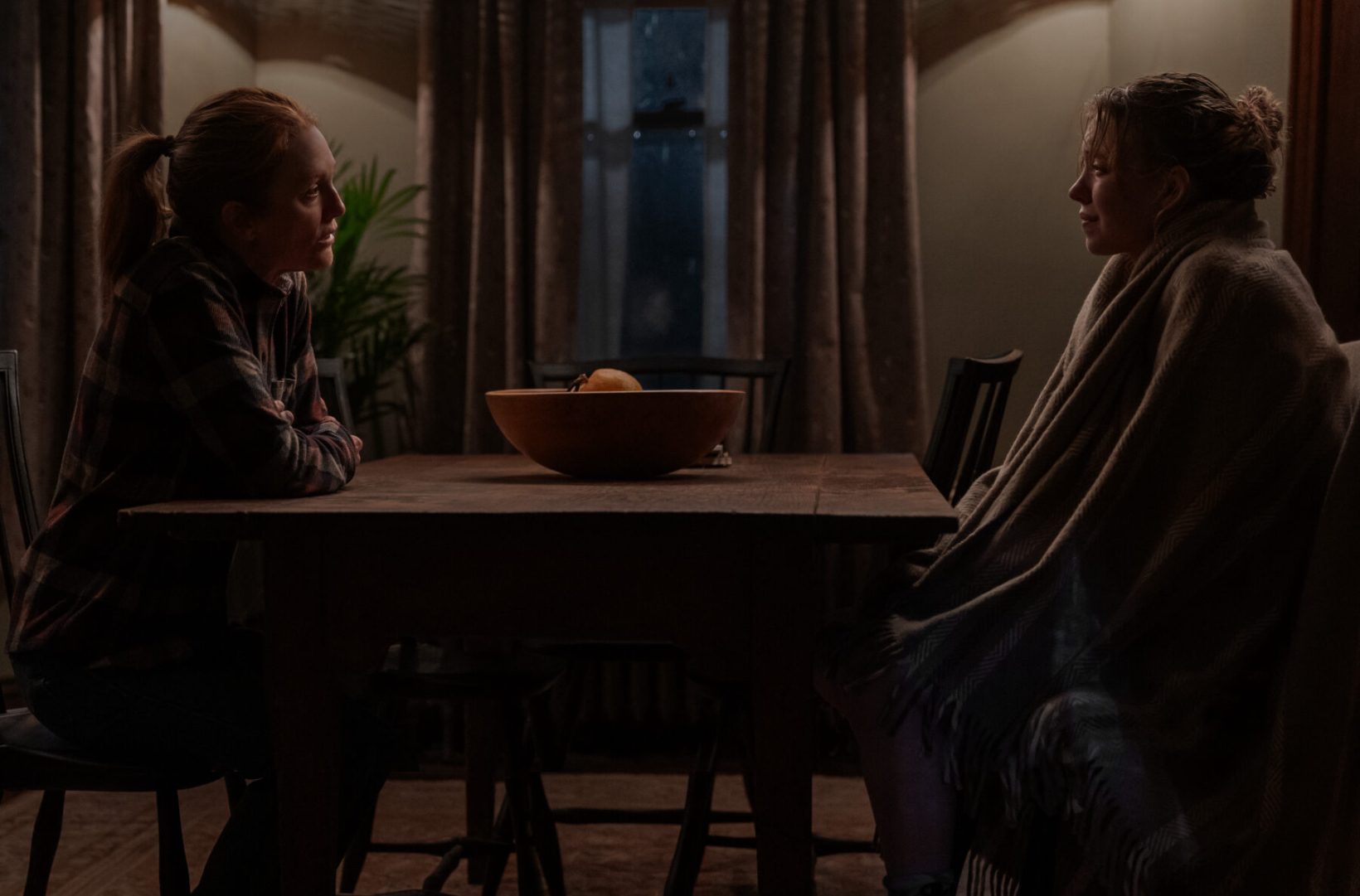
The storm arrives in the form of Claire (Sydney Sweeney), Kate’s daughter, whose reappearance is violent, visceral, and wrapped in silence. Blood on her hands. Panic in her eyes. A crime has occurred—one she won’t fully explain. And from that moment forward, the mother-daughter relationship becomes a noose tightening with every decision, every deception.
Their dynamic forms the film’s fractured heart. Kate, cool but loving, determined but shaken, must decide whether she can trust Claire. Claire, volatile and evasive, must decide whether she can trust herself. And all the while, the audience is left on edge, suspended in ambiguity.
The Performances: Ice, Fire, and Broken Glass
Moore delivers one of her most controlled performances in years. This is a woman who feels like a bramble—quiet and capable but dangerous when cornered. Every gesture, every look is calculated. Not manipulative—protective. She radiates a weathered elegance, but beneath that surface lies a sharp edge. Her Kate is not merely a mother; she’s a sentinel, constantly measuring risk, reading body language, recalibrating her instincts with each breath.
Sweeney, best known for her explosive, meme-worthy performance in Euphoria, reinvents herself here. Her Claire is raw, feral, guilt-ridden. There are no big emotional breakdowns, no television melodrama. Her portrayal is internalized, mysterious, and laced with panic. It’s a brave, chilly performance—never begging for sympathy, only understanding.
But the film’s most unsettling turn belongs to Domhnall Gleeson, whose presence distorts the movie’s rhythm like a dropped metronome. As a figure from Claire’s world—a man with intentions darker than they first seem—Gleeson is spectral, measured, and terrifying in his banality. He doesn’t twirl a mustache. He whispers promises, asks leading questions, and watches too carefully.
Supporting turns from Fiona Shaw and Kyle MacLachlan provide rich texture. Shaw brings quiet, resigned grief, while MacLachlan delivers unnerving charm—a reminder that Echo Valley isn’t just about trauma but the environments that enable it.
The Making: A Marriage of Worlds
Michael Pearce, known for his textured debut Beast and sci-fi thriller Encounter, brings his trademark visual naturalism and brooding tone to this third directorial outing. With Echo Valley, he trades overt genre tropes for slow-burning dread. His direction never shouts; it murmurs. The camera lingers on cracked knuckles, dusty sunlight, the undulation of a horse’s breath. Every scene breathes.
Brad Ingelsby, coming off the Emmy-winning success of Mare of Easttown, again mines the grit of working-class Pennsylvania to tell a story where crime and family are forever entangled. If Pearce is the sculptor, Ingelsby is the soul-writer—his dialogue precise, his characters wounded but whole. Together, they craft a film that feels both cinematic and deeply intimate.
Their creative alliance is vital. Pearce’s British perspective gives Echo Valley its arthouse restraint, while Ingelsby’s American instincts ground it in domestic realism and narrative clarity. This is a story rooted in dirt, sweat, and generational hurt. And it shows.
The Cinematography: Isolation and Echoes
Shot with a painter’s eye by Benjamin Kracun, the cinematography balances claustrophobia and pastoral expanse. There are moments when the camera backs up just enough to let us breathe—to admire the fog rolling across the hills or the stillness of a barn before dawn. But more often, we are inside rooms, corridors, kitchens—close enough to see veins tremble beneath skin.
The film’s color palette is restrained: sage greens, rust reds, pewter grays. Nature is not romanticized. It is neutral, even indifferent. Echo Valley is beautiful, yes—but it also becomes a prison, an accomplice, a witness.
The Score: Sound as Suspicion
Composer Dickon Hinchliffe (of Winter’s Bone and Leave No Trace) weaves a subtle but deeply unsettling score. There are no loud cues or manipulated swells. Just hollow chords, cello scratches, and ghostly hums—like an old radio left on in a barn.
Silence plays as much of a role as music. In Echo Valley, quiet is never peace—it is prelude. The rustle of hay, the slam of a truck door, the sharp hiss of breath in panic—each sound is designed to disorient.
Influence and Intention: A Cinematic Lineage
Both Pearce and Ingelsby have cited a tapestry of influences in crafting Echo Valley. There are echoes of:
- Debra Granik’s Winter’s Bone: in its portrait of a girl navigating danger in a closed rural world.
- The Coen brothers’ Blood Simple: in its exploration of crime, culpability, and psychological spirals.
- David Lynch’s The Straight Story: not in tone, but in how the rural can carry spiritual weight.
- Ingelsby’s own Mare of Easttown: the same emotional density, the same bruised authenticity.
This is a film that draws from the canon of American noir, family tragedy, and psychological thrillers, but with a distinct authorial voice—one that cares less about spectacle and more about consequence.
Echoes Within: The Core Question
At its emotional epicenter, Echo Valley is a film about love at war with morality. What do we owe our children? What parts of ourselves are we willing to erase to save them? Can redemption come through action—or only through sacrifice?
Kate isn’t heroic. She’s human. And that humanity—messy, irrational, burning—is what lingers.
Impression u
Echo Valley is not easy viewing. It’s not designed to comfort or entertain in conventional terms. It demands your attention, then dismantles your certainty. But for those who enter its world, it offers a powerful, primal meditation on what it means to love someone when that love becomes dangerous.
It’s a film that doesn’t just ask “What happened?” but “What would you do?”
And when the credits roll and the wind quiets, that question will echo, again and again.