Echoes of the Spectral State: Wang Tuo’s “Tungus” and the Ritual of Historical Reckoning

April 12, 2025
Cinema as Seance
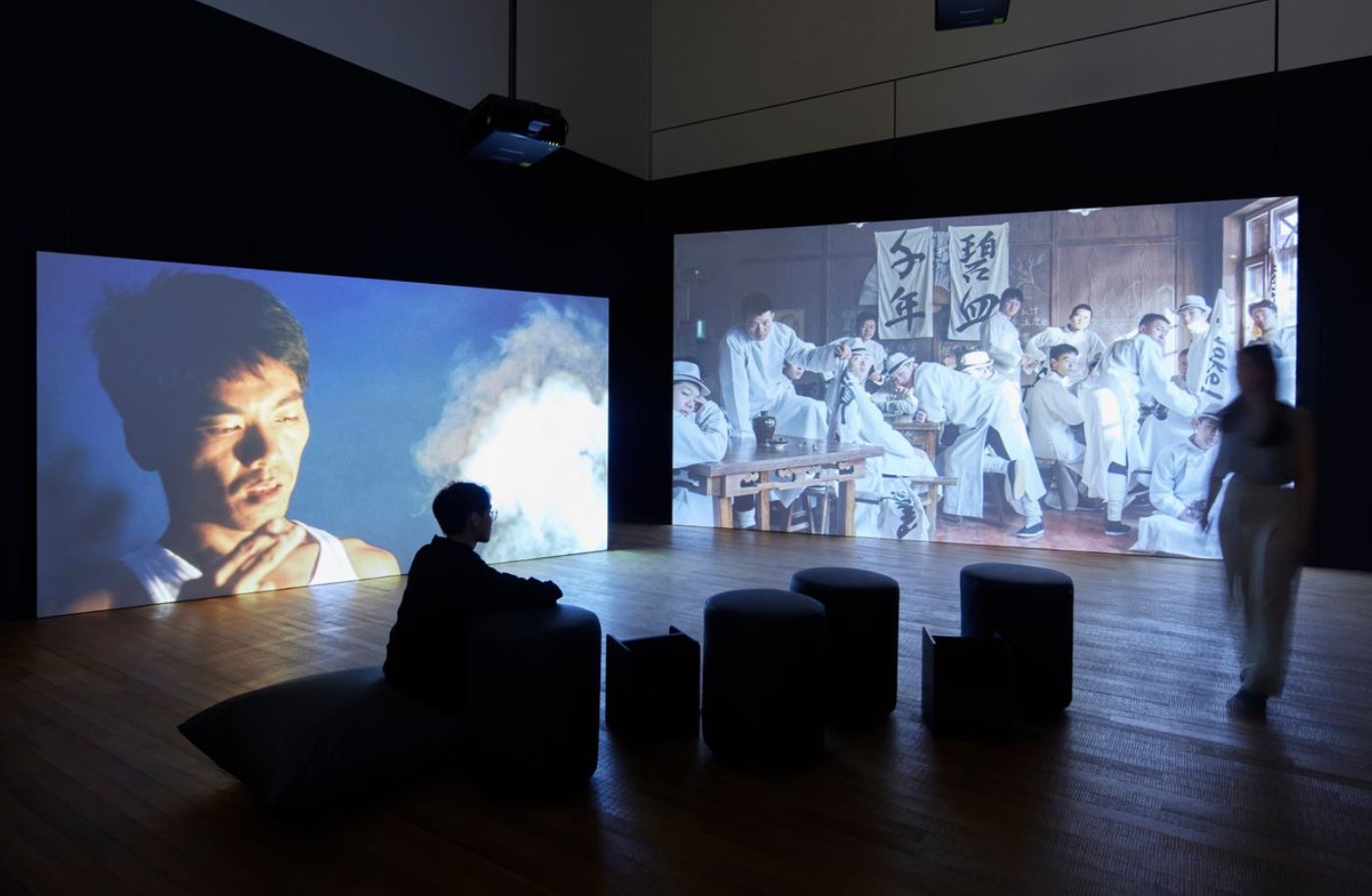
In Tungus (2021), Chinese artist and filmmaker Wang Tuo delivers more than a 66-minute video work. He crafts a ritual, a resonant exorcism of the ghosts that haunt Northeast Asia’s war-torn history. Framed in crisp 4K digital clarity, but drenched in spiritual density, Tungus represents the third movement in his ambitious four-part series, The Northeast Tetralogy (2018–2021). Together, the works form a polyphonic reflection on regional trauma, cultural memory, and the psychic afterlives of revolution and repression.
But Tungus stands alone in its ability to unearth the ritualistic logic of history—not as a static sequence of dates and disasters, but as a field of transmission where time folds and reactivates itself through the medium of the body. Wang doesn’t just retell history. He summons it. He turns the act of filmmaking into a séance of politics, myth, and survival.
The Narrative Arc: Non-Linearity as Resistance
The narrative scaffolding of Tungus is built not to guide but to disrupt. Wang deploys a non-linear structure that operates like dream logic. Past and present coexist, historical figures appear beside contemporary avatars, and memory is not an echo but a living, mutating force.
The central event anchoring Tungus is the 1948 Siege of Changchun, in which hundreds of thousands of civilians were trapped and starved during a prolonged blockade by the Chinese Communist Army. Wang juxtaposes this tragedy with episodes from the Jeju Uprising in South Korea and with fictional elements of a contemporary man who appears possessed, a proxy for the historical unconscious.
Characters drift through time like spirits without fixed coordinates. A soldier from the siege meets a dissident in modern Seoul. A young man convulses, not from epilepsy, but from ancestral burden. The plot resists summary, not out of incoherence, but to deny the viewer the comfort of chronology. This is a film that must be felt before it is understood.
IPan-Shamanism: The Ritual Mode of the Political
Wang Tuo has described Tungus and its companion works as engaging in a form of “pan-shamanism”—a concept he defines as a state of channeling through which individuals become mediums of forgotten, suppressed, or unresolved histories. In this framework, a person does not remember history. They are possessed by it.
Throughout Tungus, the human body becomes a site of involuntary expression. Convulsions, trance states, echoing dialogue, and sudden reenactments replace traditional dialogue. A young man begins speaking in voices that are not his own. A woman dances to a song she does not recognize. These moments are not “performances” but transmissions—signaling the presence of a history that refuses to die quietly.
Through this mode, Wang transforms the screen into a ritual chamber. The characters become shamans not of tradition but of rupture. They are trans-temporal hosts through whom war, revolution, famine, and ideology pass like ghosts.
Historical Referents: Rewriting a Region’s Trauma
Though presented in fictional abstraction, Tungus is deeply rooted in concrete historical trauma. The Siege of Changchun (1948) remains one of the darkest chapters of China’s civil war—a calculated starvation campaign that left an estimated 160,000 civilians dead. In Wang’s vision, this siege is not only a political atrocity, but a psychic wound, one that continues to fester beneath the surface of official memory.
By pairing this with references to the Jeju Uprising in South Korea—another episode of post-war brutality and ideological suppression—Wang draws lines of kinship between regional histories that are often siloed by national narratives. He shows how trauma doesn’t recognize borders, and how the ghosts of Northeast Asia speak a shared language of silence, shame, and struggle.
But he also implicates the present. The possession scenes in contemporary time suggest that this history is not past. It is unresolved, reincarnating itself in the bodies and behaviors of the descendants. The past is not behind us, Wang argues. It is inside us.
Visual Language: Architecture of the Invisible
Tungus is visually arresting in ways that defy spectacle. Shot in 4K with cinematic precision, the film favors long, unbroken takes and architectural compositions. Buildings are framed not just as settings, but as vessels—holding history in their walls, like bones holding calcium.
The color palette oscillates between ashen grays, blooded ochres, and ritualistic whites. Light sources flicker. Shadows gather. Interiors feel both sacred and violated. Every space in the film feels like it has witnessed something, even if we’re never told what.
Wang’s use of slow tracking shots, minimal cuts, and symmetrical framing evokes the stillness of a painting, or more appropriately, a memorial. The camera does not direct attention—it invites haunting. Its gaze is not assertive but absorptive.
Sound and Silence: Voices from the Abyss
The sound design of Tungus plays an equally critical role in shaping its emotional and narrative intensity. Silence is never empty—it hums. Ambient tones, ritual drumming, radio static, and field recordings form an acoustic fog that heightens the film’s otherworldly quality.
At times, we hear voices layered atop one another—whispers, mantras, cries. This polyphony mirrors the film’s theme of multiplicity of memory. Just as no historical event has a single truth, Tungus does not offer a singular audio track—it offers a chorus of echoes.
The use of traditional Korean and Chinese musical elements, reinterpreted through electronic distortion, bridges eras. The soundtrack becomes a space of cultural sedimentation, where the folk and the digital commingle. It’s not background noise—it’s the collective unconscious speaking.
Performances as Possession
The cast of Tungus delivers performances that transcend acting. They embody. Wang works with performers as if they are physical instruments—tuning their breathing, posture, and rhythm to reflect not character but frequency.
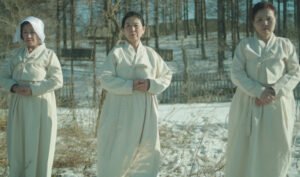
Particularly arresting are scenes of bodily convulsion and ritual trance. A man folds inward, shaking uncontrollably on a hospital gurney. A woman walks a circle, whispering lines that feel like confessions from another life. These are not metaphorical moments. They are thematic enactments—where body becomes conduit, and performance becomes invocation.
This corporeality gives Tungus a visceral dimension, grounding its heady ideas in somatic immediacy. It’s not just a film to watch. It’s a film to feel in the solar plexus.
Tungus in the Tetralogy: The Penultimate Pulse
As the third entry in The Northeast Tetralogy, Tungus serves as a threshold work. It inherits the historical inquiries of the earlier entries—Smoke and Fire, Distorting Words—and expands their narrative scope. It also sets the stage for the final piece, The Second Interrogation, bringing the series closer to the edge of the present day.
What distinguishes Tungus is its ritual vocabulary. Where the previous works employed documentary aesthetics and overt politics, Tungus ventures into mythopoeia, transforming history into cosmology. It is both chronicle and conjuring.
As such, it is the most spiritual of the four films, yet paradoxically, the most grounded in human consequence. It links shamanic practice with civic memory, spiritual possession with archival silence.
Tribute in Reflection: Why Tungus Matters Now
In an age where history is weaponized, redacted, or flattened into meme, Tungus insists on depth. It reasserts the importance of haunting as methodology. It reminds us that silence is not the end of a story—it’s the beginning of a responsibility.
Wang Tuo’s achievement with Tungus is not just formal or political. It’s ethical. He builds a cinematic structure where memory is not just recounted, but relived, where history is not abstract, but animated in flesh, voice, and vibration.
To watch Tungus is to accept a pact. You will not be explained to. You will be haunted. And in being haunted, you will remember—not what happened, but what still happens, in us, around us, through us.
Beyond the Archive, Into the Ritual
Wang Tuo’s Tungus is not a film. It is a vessel. A slow, deliberate act of resistance against historical erasure. A rite for the unseen. A platform where memory, body, and spirit converge in an uneasy, beautiful, necessary alliance.
It demands time. It offers no resolution. And in doing so, it becomes one of the most important works of video art in East Asia’s postmodern canon—not because it records the past, but because it knows the past is not done with us yet.