Erick Medel: Stitching the Soul of Boyle Heights into Art

March 10, 2025
1 year ago
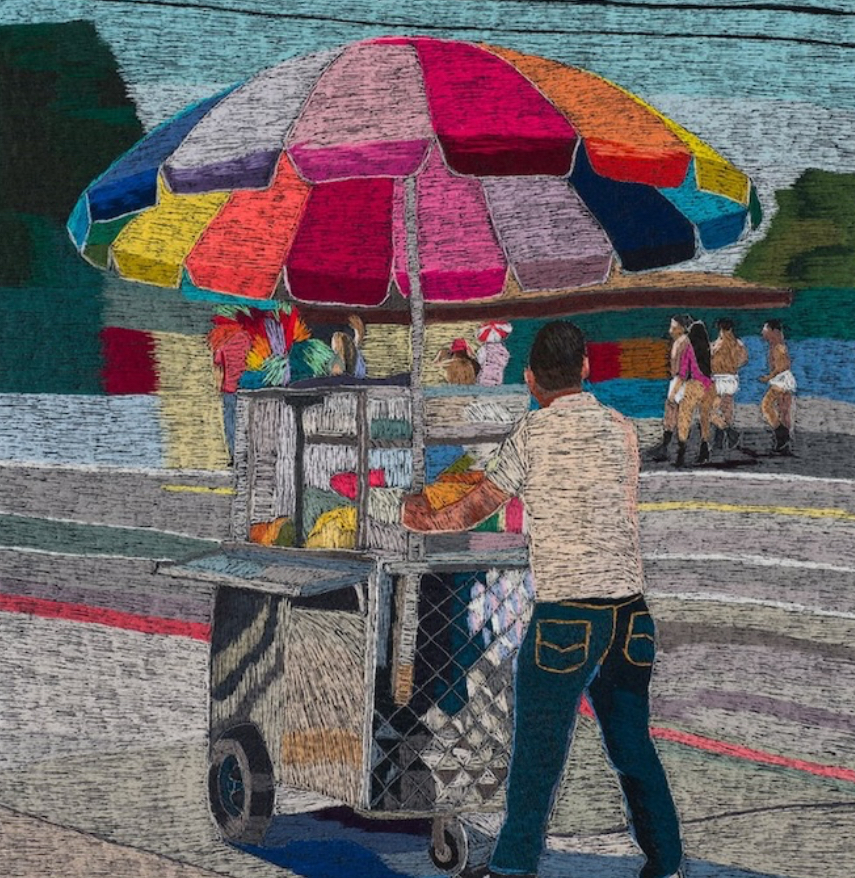

Los Angeles is a city of stories, and for artist Erick Medel, those stories come to life through needle and thread. Medel, a Los Angeles-based artist, has made a name for himself by capturing the everyday vibrancy of his Boyle Heights neighborhood through an unconventional yet deeply evocative medium—thread on denim.
His work pays homage to the immigrant experience, weaving together moments of joy, struggle, and resilience that define life in his community. With an eye for the poetic in the mundane, Medel transforms fabric into a canvas of lived experiences, using each stitch to bring his memories and observations to life.
A Unique Medium: The Power of Thread on Denim
Unlike traditional painting or photography, Medel’s technique involves embroidering scenes onto denim, a fabric historically linked to labor and resilience. Denim, often associated with the working class, becomes a powerful symbol in his hands—one that reflects the experiences of immigrants who have built their lives in Boyle Heights and beyond. Each thread is like a brushstroke, layering stories into the fabric with meticulous detail.
Medel’s approach is not just about aesthetics; it is an intentional choice to honor the history and labor of immigrant communities. Denim, sturdy and durable, mirrors the perseverance of the people he portrays.
His pieces often depict street vendors, family gatherings, neighborhood shops, and social interactions that might otherwise go unnoticed. By immortalizing these everyday moments, Medel elevates them to something worthy of attention and admiration.
The Exhibition: “Vidas” and Its Impact
Medel’s exhibition, Vidas, at the Charlie James Gallery, is a testament to his dedication to storytelling through art. The title, which translates to “Lives” in English, perfectly encapsulates the essence of his work.
Each embroidered piece is a glimpse into a personal or collective memory, representing the rich cultural fabric of Boyle Heights.
Among the standout works in Vidas are those that capture the small but significant details of life—moments of affection, bustling street markets, local businesses, and interactions that shape the daily rhythm of his community. These works are not just nostalgic reflections but also affirmations of existence.
They document histories, celebrate traditions, and remind viewers of the humanity within immigrant communities that are often marginalized in mainstream narratives.
Personal Significance: Art as a Tribute
For Medel, every stitch carries meaning. His pieces are deeply personal, often inspired by real-life encounters and experiences. Whether it’s a scene of a vendor pushing a cart or a child running alongside a parent, his work reflects his own upbringing and the people who have shaped his identity.
His art becomes a tribute not only to his immediate surroundings but also to the broader immigrant experience in Los Angeles. Each piece holds a story—sometimes one of struggle, sometimes one of triumph, but always one of resilience.
His work is a visual record of a community that has contributed immensely to the cultural landscape of the city yet often goes unrecognized.
Capturing the Beauty in Everyday Life
One of Medel’s greatest strengths is his ability to see beauty in the everyday. The moments he chooses to embroider—such as a casual conversation between friends, the intimacy of a couple holding hands, or the vibrant energy of a block party—speak to a deeper truth about immigrant life. These are not grand, historical events but rather the seemingly insignificant moments that, when woven together, define a community.
His work resonates because it is familiar, whether or not one has lived in Boyle Heights. The images he creates are universal, tapping into shared human experiences of family, labor, celebration, and connection.
They offer an alternative perspective to the often negative or one-dimensional portrayals of immigrant communities in media and politics. Instead of focusing on hardship alone, Medel’s art emphasizes joy, dignity, and the everyday triumphs of working-class life.
The Process: A Labor of Love
Creating each embroidered piece is a labor-intensive process that requires patience and precision. Unlike digital art or painting, embroidery is time-consuming, with each stitch carefully placed to form an intricate image.
Medel’s process involves first conceptualizing a scene, often inspired by personal memories or observations. He then sketches his vision before meticulously embroidering it onto denim, using thread to build layers of depth and movement.
His dedication to the craft is evident in the final product. The texture of the thread adds a tactile element to his work, inviting viewers to not just see but feel the stories he tells. The stitches, though delicate, create a sense of permanence, much like the lasting impact of the immigrant experience on the city itself.
The Larger Conversation: Art as Advocacy
Medel’s work extends beyond artistic expression—it is a form of advocacy. In a time when immigrant communities face increasing challenges, his art serves as a reminder of their contributions and their humanity. By focusing on everyday moments, he challenges stereotypes and offers a counter-narrative to the dominant discourse surrounding immigrants in the United States.
His choice to use denim as a medium further strengthens this message. Denim, historically associated with laborers, is a material deeply embedded in the immigrant workforce. By embroidering images of immigrants onto denim, Medel symbolically stitches their stories into the fabric of American history—an assertion that these lives matter, that they are woven into the very identity of the nation.
Inspiration and Influence
Medel’s work is influenced by both his personal background and broader artistic movements. The tradition of textile art has deep roots in many cultures, including Indigenous and Latin American embroidery practices. His work also aligns with the ethos of Chicano art, which has long been used as a tool for cultural expression and political commentary.
His work resonates with other artists who use textiles as a means of storytelling, such as Bisa Butler and Tschabalala Self, but maintains a distinct voice rooted in the specificity of Boyle Heights and Los Angeles. By blending traditional embroidery with contemporary themes, Medel bridges the past and the present, creating art that is both timeless and deeply relevant.
Impression
As Medel continues to gain recognition, the future of his work holds exciting possibilities. His art has the power to reach wider audiences, sparking conversations about immigration, labor, and the beauty of everyday life. The growing appreciation for textile-based art, coupled with a renewed interest in diverse narratives, positions him as a key figure in contemporary art.
With Vidas already making an impact, it is likely that Medel’s work will continue to evolve, perhaps incorporating new techniques or expanding into larger-scale projects. Regardless of the direction he takes, his commitment to storytelling through thread will remain a defining characteristic of his practice.
Stitched Stories That Endure
Erick Medel’s artistry goes beyond aesthetics—it is a celebration of life, a documentation of history, and an act of resistance. Through his innovative use of thread on denim, he captures the soul of Boyle Heights, offering viewers a glimpse into a world that is rich with culture, resilience, and love. His work stands as a tribute to the immigrant experience, ensuring that these stories are not only told but remembered.