Études Studio Oversized Nylon Bomber: Utility Recast in Champagne

April 8, 2026
2 hours ago
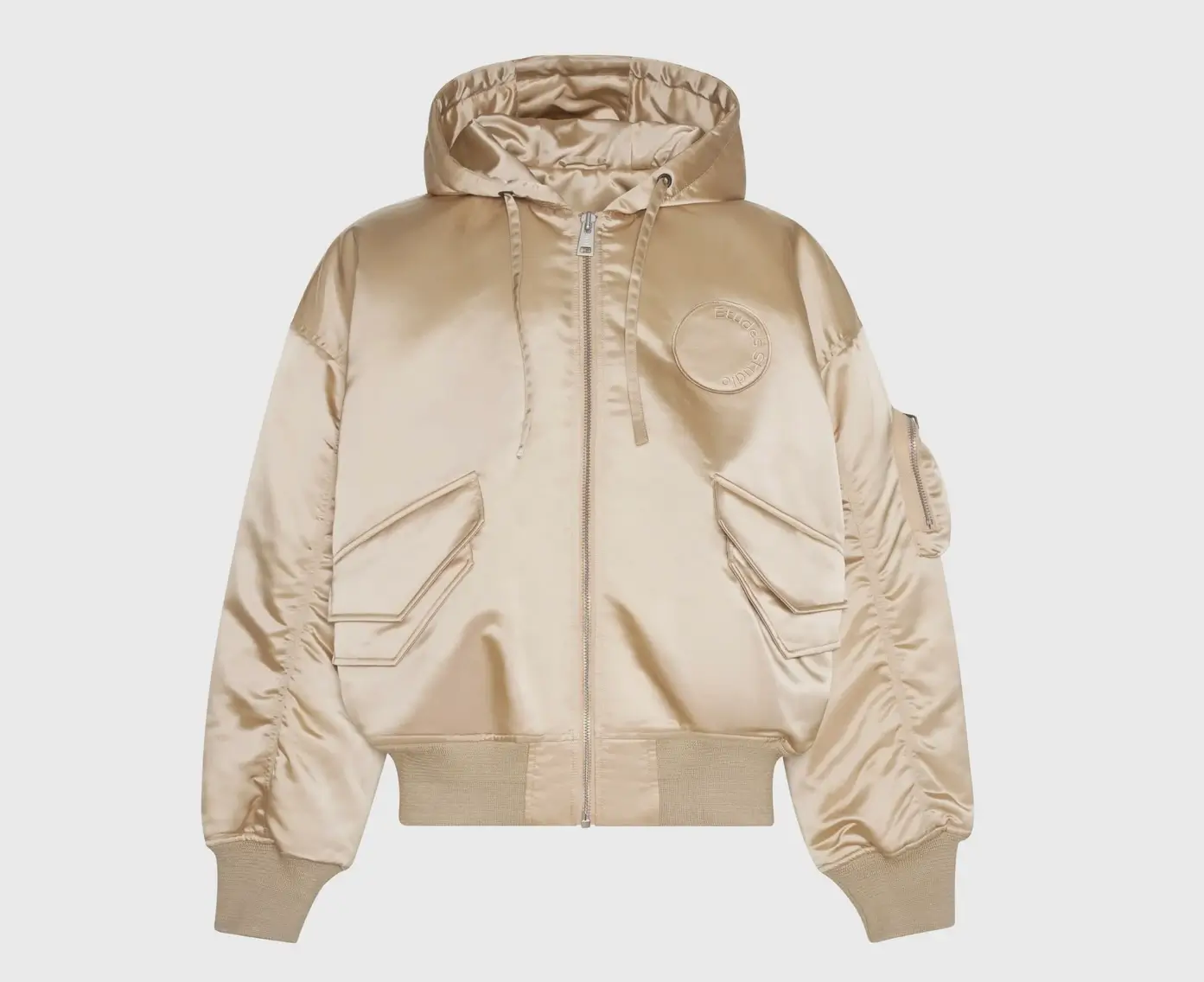
The bomber jacket has always carried a kind of cultural shorthand—flight, function, rebellion, uniform. With Études Studio, that shorthand is not erased but rewritten. Their interpretation of the nylon bomber doesn’t try to compete with the archive of military authenticity; instead, it reframes it as a surface for contemporary identity—measured, graphic, and quietly subversive.
What appears, at first glance, as a familiar silhouette reveals itself through proportion, texture, and coded detail. This is not simply outerwear. It’s a system of cues.
volume
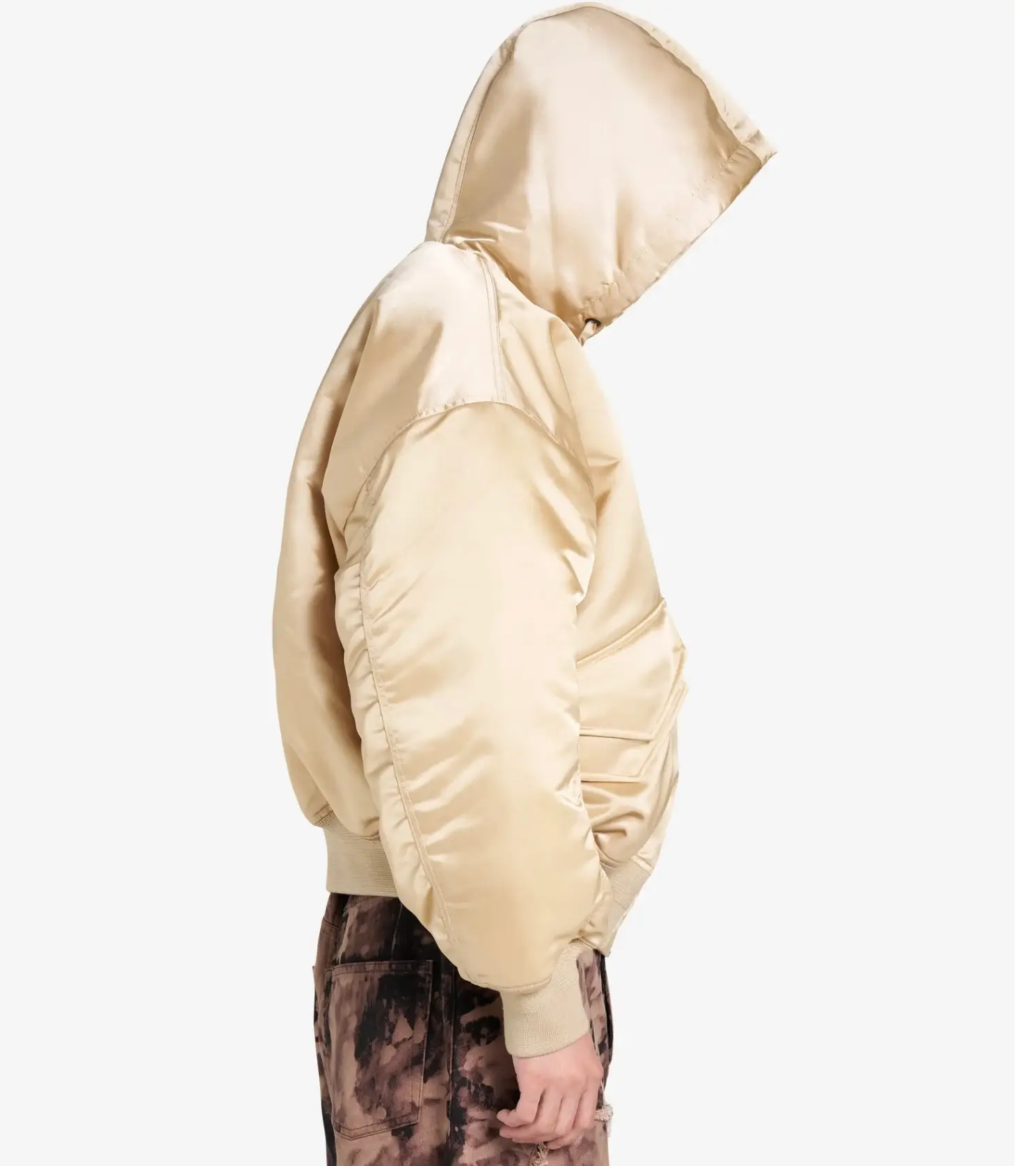
The oversized fit is the first disruption. Not exaggerated to the point of costume, but enough to alter posture and presence. It sits off the body, creating a margin—space between garment and wearer that feels intentional rather than incidental. That space becomes part of the design language.
Unlike traditional MA-1 proportions that hug the torso and taper into a compact silhouette, this iteration expands outward. The shoulders drop. The sleeves carry weight. The body length balances without collapsing. It’s a recalibration of utility through proportion—less about aerodynamics, more about stance.
This shift in volume also reframes how the jacket interacts with layering. It accommodates without crowding. A hoodie beneath doesn’t feel like an afterthought; it becomes integrated into the composition. The bomber becomes less of a final layer and more of a central piece around which the rest of the look organizes itself.
View this post on Instagram
consider
Nylon, historically tied to durability and function, is treated here with restraint. There’s no aggressive sheen, no overt technical posturing. Instead, the material reads as controlled—matte enough to absorb light, structured enough to hold shape.
The choice is deliberate. Nylon becomes less about performance and more about memory—referencing its military lineage while softening its visual aggression. It holds the garment together without demanding attention, allowing the silhouette and details to lead.
There’s also a subtle tension in how the fabric moves. It doesn’t collapse easily, but it isn’t rigid either. It responds. That responsiveness gives the jacket a lived quality, even when new.
written
The bomber’s architecture remains intact, but its purpose shifts.
A front zip closure runs cleanly through the center—direct, uninterrupted. Rib-knitted cuffs and hem ground the silhouette, providing the only real points of compression in an otherwise expanded form. These elements anchor the garment, preventing it from drifting into abstraction.
Flap pockets sit at the sides, familiar in placement but softened in execution. They don’t bulge or dominate. They integrate. Inside pockets add a layer of quiet practicality—hidden, but expected.
Then there’s the utility pocket on the upper left sleeve. A signature detail of flight jackets, here it functions less as a tool and more as a reference point. It signals history without reenacting it. The placement remains precise, but its meaning is aesthetic as much as functional.
This is where Études Studio operates most clearly: not by removing function, but by recontextualizing it.
flow
On the chest, a detachable patch introduces a shift in tone. It’s small, but it carries weight.
Branding here is not permanent. It can be removed, repositioned, or ignored entirely. That flexibility turns identity into something fluid rather than fixed. The wearer decides how visible the label becomes.
This approach aligns with Études Studio’s broader philosophy—graphic language as a tool, not a constraint. The patch is less about logo placement and more about participation. It invites interaction.
In a landscape where branding is often amplified to excess, the option to detach feels almost radical.
delve
The inside of the jacket offers a different kind of expression. Fully lined with a jacquard print, it introduces texture and pattern where it’s least expected.
This is not lining as afterthought. It’s lining as counterpoint.
Where the exterior remains controlled and minimal, the interior carries visual density. The jacquard print doesn’t shout—it reveals itself in motion, in the brief moments when the jacket opens or shifts. It’s a private detail that becomes public only intermittently.
That duality—restraint outside, expression inside—creates a layered experience. The garment isn’t static. It changes depending on how it’s worn, how it moves, how it’s seen.
balance
The bomber jacket, in its original form, was never meant to be expressive. It was built for purpose, for consistency, for uniformity. Études Studio retains that skeleton but removes the rigidity of its meaning.
This version exists somewhere between uniform and personal statement. It references a shared visual history while allowing for individual interpretation.
The oversized fit resists strict categorization. The detachable patch resists fixed identity. The jacquard lining resists surface-level reading. Together, these elements create a garment that feels complete but not closed.
It doesn’t dictate how it should be worn. It suggests possibilities.
style
Worn with tailored trousers, the jacket introduces tension—formal meets functional. Paired with denim or cargos, it settles into a more expected rhythm, but still retains its distinct proportions.
Footwear shifts the narrative further. Clean sneakers emphasize the modernity of the silhouette. Heavier boots pull it closer to its utilitarian roots. Either direction works, because the jacket itself doesn’t anchor to a single aesthetic.
Layering becomes an extension of its design. A hoodie amplifies its volume. A simple tee keeps it restrained. The bomber adapts without losing its identity.
That adaptability is key. It doesn’t require a specific context to function. It creates its own.
fin
There’s no overt spectacle here. No aggressive rebranding of a classic. Instead, Études Studio offers a quieter assertion: that even the most established garments can still shift, still evolve, still carry new meaning.
The bomber jacket remains recognizable. That’s important. But recognition doesn’t equal repetition.
Through proportion, material, and detail, this piece reframes what a bomber can be in a contemporary wardrobe. Not louder. Not more complex. Just more considered.
In a landscape saturated with reinterpretations, that restraint stands out.
The result is a jacket that doesn’t try to dominate the conversation. It holds its ground.