
Exploring Jeroen Allart’s Rotterdam: A Modern Scope to the City’s Spirit and Landscape

November 12, 2024
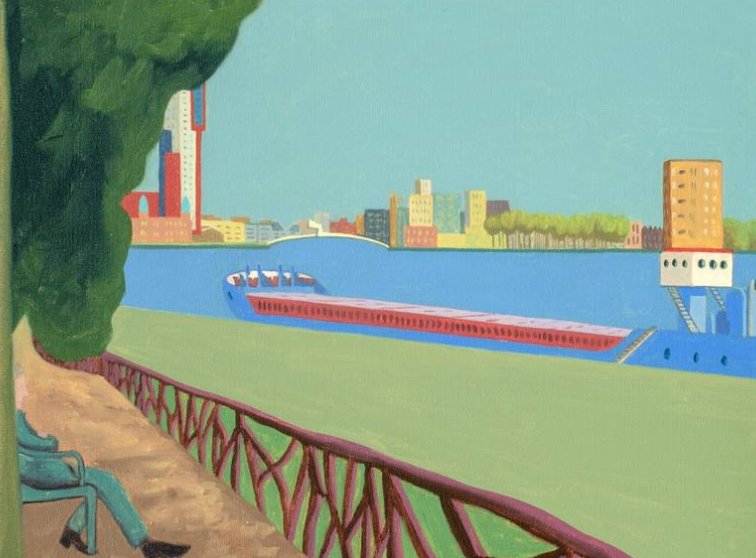
Jeroen Allart’s “Rotterdam” is more than just a painting; it is a vibrant portrayal of the dynamic Dutch city and an evocative celebration of urban life, architecture, and human resilience. Known for his use of bold colors, simplified forms, and striking compositions, Allart has a distinct style that transforms familiar landscapes into vivid, almost abstract experiences. In “Rotterdam,” he brings his unique perspective to the city, capturing its essence with a modern sensibility that resonates with anyone familiar with Rotterdam’s complex identity.
Rotterdam has long been a symbol of resilience and innovation, rising from the ashes of World War II destruction to become a modern metropolis characterized by architectural experimentation and a forward-looking spirit. Allart’s portrayal is both a tribute to this legacy and a commentary on how the city continues to evolve, blending its historical roots with a progressive, artistic vision. Here we explore the elements, themes, and interpretations within Allart’s “Rotterdam,” uncovering how this work encapsulates the heart of the city and its place in the broader world of contemporary art.
Allart’s style is instantly recognizable. He employs vivid, saturated colors and bold, clean lines that simplify complex subjects without losing their essence. This approach lends his work a sense of clarity and purpose, stripping away extraneous details to focus on the heart of the scene. In “Rotterdam,” this style is particularly effective, as it mirrors the city’s modernist architecture, known for its bold shapes and colors. The clarity and directness in Allart’s forms echo Rotterdam’s ethos—uncomplicated yet powerful, forward-looking, and always willing to experiment.
The painting likely employs a mix of primary colors and contrasting shades, as is common in Allart’s work, to create a visual energy that draws the viewer’s attention to specific elements. This color palette also invokes a sense of optimism, a fitting tone for a city that has consistently reinvented itself. Allart’s choice to simplify the city’s complex architecture into clean, geometric forms is both an aesthetic choice and a way to symbolize Rotterdam’s strength in simplicity. The focus on shapes over intricate details allows viewers to experience the city’s essence without distraction.
To understand the emotional depth of Allart’s work, it’s essential to consider Rotterdam’s history. The city was heavily bombed during World War II, leaving much of its historic center in ruins. Instead of reconstructing the old buildings, the city took a bold approach, transforming itself into a hub of architectural innovation. Rotterdam’s skyline is now a striking blend of modernist towers, unconventional structures, and wide, open spaces that reflect both its past and its forward-thinking mentality.
Allart’s “Rotterdam” taps into this narrative of resilience and rebirth. His depiction of the city feels like an acknowledgment of its tragic past, yet it’s infused with a sense of optimism and renewal. The simplicity of his lines and forms could be interpreted as a visual metaphor for the city’s recovery—stripped down, rebuilt, and reimagined for a new era. Allart’s interpretation of Rotterdam is not nostalgic; instead, it looks to the future, celebrating the city’s evolution and its refusal to dwell in the past.
One of the hallmarks of Allart’s work is his use of color, which plays a crucial role in conveying the atmosphere and emotion of “Rotterdam.” His palette in this painting is likely bold and varied, reflecting the city’s vibrant energy. The choice of bright colors can be seen as a celebration of life and growth, qualities that Rotterdam embodies in its commitment to urban renewal and social diversity.
In “Rotterdam,” colors are not just decorative—they are symbolic. The blues might represent the city’s waterways and the port, which is one of the largest in Europe and a vital part of its economy and identity. Reds and oranges could signify energy and progress, mirroring the city’s constant development and its status as a cultural and economic powerhouse. Allart’s choice of colors brings a dynamic quality to the painting, making Rotterdam feel alive and bustling, much like the real city itself.
Allart’s approach to form in “Rotterdam” is one of simplification, a choice that aligns with both his style and the city’s architectural character. Rotterdam is a city of clean lines and bold structures, often celebrated for its minimalist yet impactful designs. By reducing buildings and landscapes to their fundamental shapes, Allart captures the city’s essence without overwhelming the viewer with details.
This simplification also serves to create a more universal image of the city, one that resonates with anyone who understands the language of modern architecture. Instead of focusing on specific landmarks, Allart’s Rotterdam is an abstraction of the city itself—its energy, its resilience, its willingness to adapt. This technique invites viewers to connect with the painting on a conceptual level, allowing them to interpret Rotterdam’s forms and colors in ways that feel personal and subjective.
Rotterdam’s skyline has been shaped by some of the world’s most renowned architects, from Rem Koolhaas to Piet Blom. This architectural diversity is one of the city’s defining characteristics, and it’s reflected in Allart’s work. His painting doesn’t replicate specific buildings but rather captures the architectural ethos of Rotterdam—its openness to new ideas, its embrace of unconventional forms, and its commitment to a forward-thinking aesthetic.
Allart’s “Rotterdam” can be seen as a visual distillation of these influences, a tribute to the architects who have contributed to the city’s unique landscape. By abstracting the city’s forms, Allart honors Rotterdam’s architectural spirit without being confined by literal representation. The painting becomes a tribute to the city’s creative energy, its willingness to experiment, and its reputation as a hub for architectural innovation.
While “Rotterdam” is undoubtedly an exploration of the city’s physical landscape, it also resonates emotionally, especially for viewers familiar with Rotterdam’s story. Allart’s work captures a city that is both proud and progressive, one that has endured hardship yet refuses to be defined by it. This duality gives the painting a sense of depth and poignancy, as it reflects the human capacity for resilience and renewal.
In a broader sense, “Rotterdam” speaks to universal themes of change, adaptation, and growth. By portraying Rotterdam in this light, Allart’s work transcends the boundaries of geographical specificity, inviting viewers to reflect on similar experiences of transformation in their own lives or communities. The painting becomes more than a depiction of a city—it becomes a meditation on the resilience that defines all thriving urban spaces.
“Rotterdam” is part of Jeroen Allart’s larger body of work, which often focuses on landscapes, cityscapes, and rural scenes in the Netherlands. Allart’s exploration of Dutch identity through art reflects his fascination with the interplay between nature and urban development. His style is one that simplifies and idealizes, focusing on essence rather than intricate detail.
In this context, “Rotterdam” fits seamlessly into Allart’s artistic journey. It’s a painting that combines his love of landscape with his appreciation for architecture and human-made structures, yet it retains the vibrancy and immediacy that define his work. The painting is both an extension of his previous works and a departure, as it tackles the modern, urban complexity of Rotterdam rather than the quieter rural scenes often found in his portfolio.
In modern art, cityscapes often serve as symbols of societal change, progress, and the complexities of urban life. Allart’s “Rotterdam” is part of this tradition, yet it offers a uniquely optimistic perspective on urban transformation. Unlike works that critique or lament the loss of traditional landscapes to urban development, “Rotterdam” celebrates the possibilities that cities bring—their dynamism, their resilience, and their capacity to foster creativity and innovation.
This optimistic view makes “Rotterdam” relevant in a contemporary context where cities are continually evolving to meet the needs of growing populations and new challenges. Allart’s work reminds viewers of the beauty in this evolution, encouraging a sense of pride in urban spaces and the progressive spirit they represent.
Jeroen Allart’s “Rotterdam” is more than just a painting of a cityscape; it’s a tribute to the essence of Rotterdam itself—a city defined by resilience, innovation, and an unyielding spirit of progress. Through his use of bold colors, simplified forms, and an emphasis on the city’s architectural character, Allart captures the energy and optimism of Rotterdam, making it a symbol of modern urban resilience.
“Rotterdam” resonates not only with those who know the city but also with anyone who appreciates the beauty of transformation and growth. Allart’s painting is a celebration of how cities—and the people within them—can reinvent themselves over time. In doing so, he invites viewers to find inspiration in Rotterdam’s journey, to see the beauty in change, and to embrace the possibilities that come with rebuilding and reimagining.